


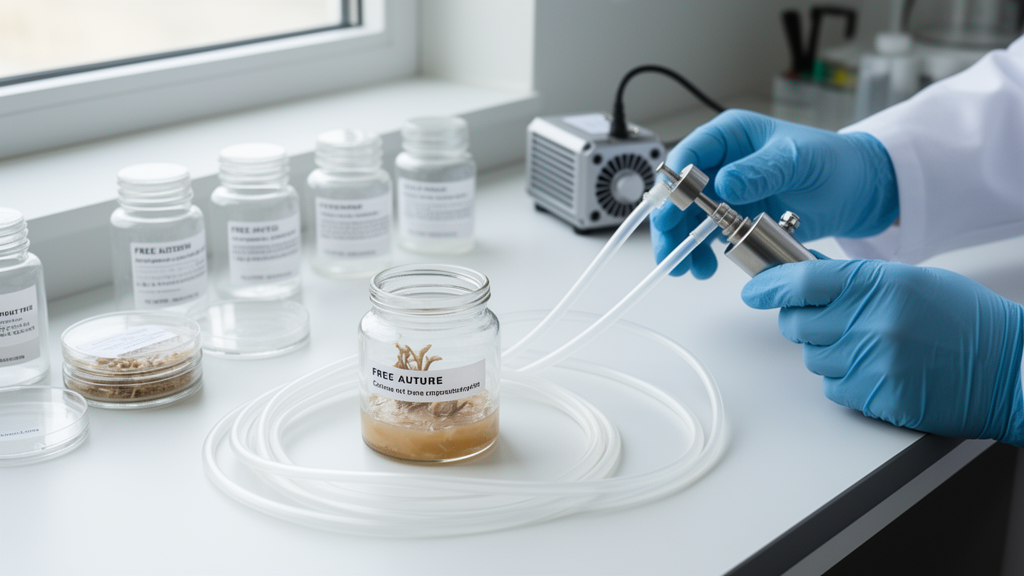
Fungi exhale an invisible chemistry. Volatile organic compounds released by growing colonies serve as signals between species, mediators of host colonization, and raw material for biotechnology, yet the way researchers capture those molecules has varied so widely from lab to lab that cross-study comparisons often collapse. A new open-access study in Fungal Biology and Biotechnology presents a standardized workflow built around polydimethylsiloxane, or PDMS, tubing, and validates it across the methodological choices that most distort fungal volatile data: solvent selection, sampling configuration, sorbent reuse, and temporal resolution.
Trichoderma atroviride Y145 grows fast and undergoes a visually striking transition from vegetative white mycelium to sporulating green colonies, a developmental shift with underlying metabolic consequences. Grosmannia clavigera EL035, by contrast, is a slow-growing symbiont of the mountain pine beetle Dendroctonus ponderosae that emits a low-intensity volatilome dominated by alcohols. If the silicone tubing method could perform under both chemically rich and chemically sparse conditions, the authors reasoned, it would hold up broadly.
The protocol itself is straightforward. One-centimeter segments of PDMS tubing, conditioned by methanol soaking and a 15-minute nitrogen purge at 120 degrees Celsius, were suspended above fungal cultures in sealed 473-milliliter glass chambers. Extraction required only half a milliliter of solvent and thirty seconds of vortexing, followed by ten passes of solvent through the tubing lumen with a Pasteur pipette. The authors found that sonication and centrifugation steps, initially included, made no quantitative difference and were dropped. Samples then went to gas chromatography-mass spectrometry for identification and quantification against analytical standards.
Solvent choice emerged as a quantitative, not qualitative, variable. Dichloromethane and diethyl ether recovered identical sets of detectable compounds, but dichloromethane consistently pulled out higher concentrations of key terpenes. In one-hour collections, both 6-amyl-alpha-pyrone and beta-phellandrene were recovered at significantly greater quantities with dichloromethane, with a least-squares mean difference of 0.109 micrograms per milliliter. Over four-day collections, dichloromethane significantly outperformed diethyl ether for d-limonene and beta-phellandrene, while alpha-phellandrene and 6-amyl-alpha-pyrone showed no solvent effect. Because composition stayed constant while concentrations shifted, the authors conclude that solvent selection matters chiefly for quantitative interpretation, and they recommend dichloromethane for untargeted profiling.
The comparison between passive PDMS sampling and the widely used dynamic push-pull method, which draws chamber air through activated carbon traps, revealed complementary rather than redundant views of the volatilome. Principal component analysis showed clear separation between the two methods for both fungi, confirmed by PERMANOVA with method explaining roughly 86 percent of compositional variance in each species. Push-pull sampling strongly enriched highly volatile compounds: in G. clavigera, terpenoids and small alcohols such as alpha-pinene showed log2 fold changes above 3 to 7 favoring the carbon traps, and in T. atroviride low-molecular-weight alcohols and d-limonene reached fold changes of 3 to 10. PDMS, in turn, preferentially enriched less volatile, hydrophobic metabolites like beta-caryophyllene and 6-amyl-alpha-pyrone. Neither method is simply better; each captures a different slice of the emission spectrum.
Perhaps the most practical finding concerns reuse. PDMS tubing previously deployed in experiments was re-treated with methanol and nitrogen conditioning and redeployed alongside fresh tubing across four sampling windows at 2, 4, 8, and 12 days of fungal growth. Recovery ratios, calculated as mean abundance in reused tubing divided by mean abundance in fresh tubing, clustered around 1.0 with a median near 1.1. Scatterplots of fresh versus reused abundances fell along the one-to-one line, particularly for dominant compounds such as 6-amyl-alpha-pyrone, 2-heptanone, and 2-nonanone. PERMANOVA detected no significant effect of reuse on overall profile composition, and Wilcoxon tests with false-discovery-rate correction found no compound-level differences in any window. Rigorous reconditioning, the authors argue, effectively eliminates residual chemical memory between deployments.
The workflow’s capacity for time-resolved sampling proved equally consequential. Sequential 96-hour PDMS deployments across days 0 to 4, 4 to 8, and 8 to 12 captured species-specific emission trajectories. In G. clavigera, the sesquiterpene beta-caryophyllene and the alcohols 2-methyl-1-butanol, 3-methyl-1-butanol, and phenylethyl alcohol all peaked in the earliest window and declined sharply thereafter; total volatile flux fell from roughly 0.034 to 0.0059 micrograms per milliliter per hour between day 4 and day 12. T. atroviride showed nearly the opposite pattern: beta-phellandrene appeared only in the first window, while 2-heptanone, 2-nonanone, and 6-amyl-alpha-pyrone rose steadily, pushing total flux from about 0.035 to 0.049 micrograms per milliliter per hour. Compound richness stayed modest and stable, meaning the method primarily tracked changing emission rates of a consistent chemical set rather than wholesale turnover in diversity.
The optimized workflow also distinguished physiological states within a single species. White and green morphotypes of T. atroviride Y145, cultured under identical conditions, maintained clearly separated volatile profiles in principal component analyses at every sampling endpoint from day 2 through day 12. Driver compounds included 2-pentyl furan, 6-amyl-alpha-pyrone, alpha- and beta-phellandrene, benzyl alcohol, and a suite of ketones and secondary alcohols. Flux trajectories diverged as well: early windows featured short pulses of monoterpenes and aromatics, while later windows showed ketone peaks that were consistently higher in the green, sporulating morphotype. The white morphotype maintained lower, more conservative emissions. Pairwise univariate tests flagged significant morphotype differences for only a subset of compounds at specific time points, a limitation the authors attribute to small sample size and zero inflation, but the multivariate separation was persistent and reproducible.
The authors are candid about the boundaries of their claims. Emission rates were normalized to deployment duration rather than fungal biomass, so flux estimates reflect per-culture rather than per-mass output, and incorporating growth measurements would strengthen ecological interpretation. The morphotype-volatilome association, however robust, remains correlational; disentangling causation will require transcriptomic and targeted metabolomic integration. The validation also rests on two fungal species and a defined set of analytical standards, so performance across broader taxonomic and chemical space remains to be established.
Even with those caveats, the study delivers what fungal volatile research has lacked: an empirically grounded set of recommendations. Use dichloromethane for broad untargeted coverage. Treat push-pull and PDMS as complementary tools when highly volatile compounds need accurate quantification alongside broader profiling. Adopt time-resolved sampling designs to capture metabolic dynamics. And report sorbent conditioning and reuse protocols explicitly. For a field whose biological conclusions have been constrained by inconsistent pre-analytical methods, a reusable, low-cost silicone tube that survives repeated deployments while resolving developmental chemistry may prove an unglamorous but consequential standard.
Subject of Research: A standardized PDMS-based extraction and sampling workflow for profiling fungal volatile organic compounds.
Article Title: A scalable PDMS extraction method for profiling fungal volatile compounds
Article References: Zaman, R., Heida, I. P., Anderson, H. T. K., Ishangulyyeva, G., Erbilgin, N., & Cahill, J. F. (2026). A scalable PDMS extraction method for profiling fungal volatile compounds. Fungal Biology and Biotechnology, 13(1), Article 5. https://doi.org/10.1186/s40694-026-00213-3
Image Credits: AI Generated
DOI: 10.1186/s40694-026-00213-3
Keywords: fungal volatile organic compounds, PDMS tubing, GC-MS, volatilomics, Trichoderma atroviride, Grosmannia clavigera, solvent extraction, passive sampling, method validation, temporal emission dynamics, morphotype profiling, biotechnology
News Source: Gregory Coleman. (October 29, 2026). Reusable Silicone Tubing Offers a Standardized Way to Track Fungal Volatile Emissions. Scienmag.



