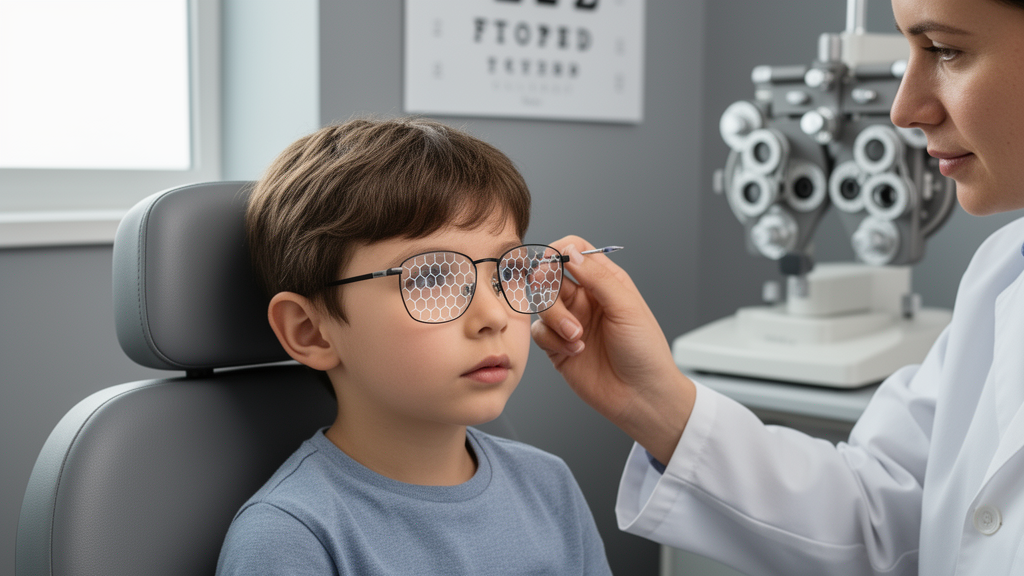
A large real-world comparison of two widely used myopia control treatments has found that the better option may depend on the child. In a retrospective analysis of more than 6,000 Chinese children treated at the Eye Hospital of Wenzhou Medical University, highly aspherical lenslet (HAL) spectacle lenses were associated with less axial length elongation than overnight orthokeratology (OK) contact lenses among younger children and those with mild myopia, while OK lenses showed an advantage in children with high myopia.
Myopia has become one of the most pressing public health challenges in eye care. Epidemiological projections cited by the researchers indicate that nearly half of the world’s population, 49.8 percent, could be affected by myopia by 2050, including 9.8 percent with high myopia. High myopia carries elevated lifetime risks of vision-threatening complications such as retinal detachment, myopic maculopathy, and glaucoma. Because myopia onset is shifting to earlier ages, children spend more years progressing before their refraction stabilizes, which amplifies the cumulative risk and has intensified the search for interventions that reliably slow the eye’s excessive growth.
Orthokeratology uses rigid lenses worn overnight that temporarily reshape the cornea, allowing clear daytime vision without glasses while simultaneously inducing peripheral myopic defocus that slows axial growth. HAL spectacles, commercially available as Stellest lenses, embed rings of highly aspherical lenslets around a central optical zone, creating a fixed peripheral defocus signal, typically between +3.00 and +5.00 diopters, while the child wears them like ordinary glasses during the day. Both approaches have demonstrated substantial efficacy against single-vision correction in randomized trials: OK lenses reduce axial length elongation by roughly 36 to 56 percent, and HAL lenses achieved 55 percent and 51 percent reductions in spherical equivalent progression and axial elongation, respectively, over 24 months in a landmark trial by Bao and colleagues.
What has been missing, the authors argue, is evidence about how the two treatments compare directly with each other, particularly across the full spectrum of refractive error. Most HAL data come from children with mild to moderate myopia, and whether the lenslet design works well in highly myopic children has remained uncertain. Conversely, conventional OK lenses are primarily prescribed for mild to moderate myopia, and their use in high myopia raises practical problems: residual uncorrected refractive error and suboptimal daytime acuity after lens removal. To address these gaps, the Wenzhou team turned to real-world clinical records rather than the tightly controlled conditions of a randomized trial.
The study screened electronic medical records of 26,308 children who underwent OK or HAL fitting at the hospital between January 2020 and March 2024. Stringent inclusion criteria narrowed this pool to 7,794 participants aged 8 to 14 years with spherical equivalent refraction between −0.50 and −9.00 diopters, cylindrical power no greater than 2.00 diopters, best-corrected visual acuity of at least 0.1 logMAR, no ocular or systemic comorbidities, no prior myopia control treatment including low-concentration atropine within the previous year, and no strabismus, amblyopia, or binocular vision dysfunction. Because treatment assignment was not randomized, the researchers used propensity score matching to balance the two groups on age, spherical equivalent refraction, sex, and baseline axial length, ultimately yielding 3,122 matched pairs, or 6,244 children, for analysis.
The matching worked well. Before matching, standardized mean differences between groups ranged from 0.166 to 0.273 for the key covariates, with the HAL group younger, less myopic, slightly shorter axially, and with a lower proportion of girls. After matching, all standardized differences fell below 0.1, indicating excellent baseline balance. Axial length was measured with an IOLMaster 500 optical biometer, averaging five measurements per visit with strict signal-to-noise quality thresholds, and the analysis used measurements taken at 12 plus or minus 1 month. Only right-eye data were analyzed, and refractive outcomes were deliberately excluded because daily corneal reshaping makes subjective refraction unreliable in OK wearers.
The headline result was clear: over 12 months, children wearing OK lenses showed greater axial elongation than those wearing HAL spectacles, 0.20 plus or minus 0.18 millimeters versus 0.15 plus or minus 0.17 millimeters, a statistically significant difference of roughly 0.049 millimeters per year. Multivariable regression in the unmatched sample, which adjusted for age, sex, spherical equivalent, and baseline axial length, produced a nearly identical estimate of 0.0549 millimeters, and the matched-sample estimate remained significant after further adjustment. The authors note that this consistency across analytical approaches supports the robustness of the matching strategy, and that the absolute elongation values for both groups fall within ranges previously reported for each treatment against single-vision correction.
The more consequential findings emerged from the subgroup analyses, which revealed a striking refractive-error-dependent pattern. Among children aged 8 to 9 years, HAL wearers elongated 0.19 millimeters versus 0.26 millimeters for OK wearers, and among 10-to-11-year-olds the figures were 0.12 versus 0.17 millimeters, both favoring HAL. In the 12-to-14-year age band, however, the difference disappeared entirely. Stratified by refraction, HAL was associated with significantly less elongation in mild myopia, OK was associated with significantly less elongation in high myopia, defined as −5.00 to −9.00 diopters, and the two treatments were statistically indistinguishable in moderate myopia. Correlation and regression analyses reinforced the pattern: in the OK group, axial elongation correlated positively with baseline spherical equivalent, meaning more myopic eyes grew less, while in the HAL group the correlation ran in the opposite direction. Age was independently associated with elongation in both groups, with younger eyes growing faster, consistent with well-established physiological patterns.
The authors offer a possible, though admittedly speculative, optical explanation. OK lenses reshape the cornea and may induce peripheral myopic defocus whose magnitude could scale with the degree of refractive correction achieved, potentially generating a stronger defocus signal in more myopic eyes, whereas HAL provides a fixed level of peripheral defocus regardless of prescription. Because peripheral optical characteristics and retinal image quality were not directly measured, this interpretation requires future studies with detailed optical modeling. The researchers also caution that the high myopia subgroup was small, only 228 OK wearers and 345 HAL wearers, which limits statistical power, and that residual confounding from unmeasured variables such as parental myopia, outdoor time, near work, and treatment adherence cannot be excluded despite matching and adjustment. The 12-month follow-up also leaves long-term durability unknown.
Even with those caveats, the study’s practical message is notable: the relative effectiveness of two leading myopia control tools is not uniform but shifts with a child’s age and baseline prescription. HAL appears associated with slower eye growth in younger children and those with lower myopia, while OK, supplemented in this cohort with daytime single-vision spectacles for residual error in highly myopic children, showed relative advantage at high myopia. The authors suggest that treatment selection may benefit from an individualized approach based on these baseline characteristics, and their findings may help explain why earlier studies comparing the two modalities, which often did not stratify by refractive error, reached inconsistent conclusions.
Subject of Research: Comparative effectiveness of orthokeratology and highly aspherical lenslet spectacles in slowing axial elongation in myopic children
Article Title: Comparative effectiveness of orthokeratology versus highly aspherical lenslets in slowing myopia progression: a retrospective study
Article References: Chen, M., Yang, X., Lei, H., Song, J., Tang, Y., Chen, X., Du, Z., Han, M., & Mao, X. (2026). Comparative effectiveness of orthokeratology versus highly aspherical lenslets in slowing myopia progression: a retrospective study. Eye and Vision, 13(1), Article 33. https://doi.org/10.1186/s40662-026-00505-0
Image Credits: AI Generated
DOI: 10.1186/s40662-026-00505-0
Keywords: myopia, orthokeratology, highly aspherical lenslets, axial length, propensity score matching, pediatric ophthalmology, high myopia, refractive error, retrospective study, myopia control, spectacle lenses, real-world evidence
News Source: Ophelia Keating. (October 29, 2026). Retrospective Study Finds HAL Spectacles Slow Eye Growth More Than Orthokeratology in Younger, Mildly Myopic Children. Scienmag.