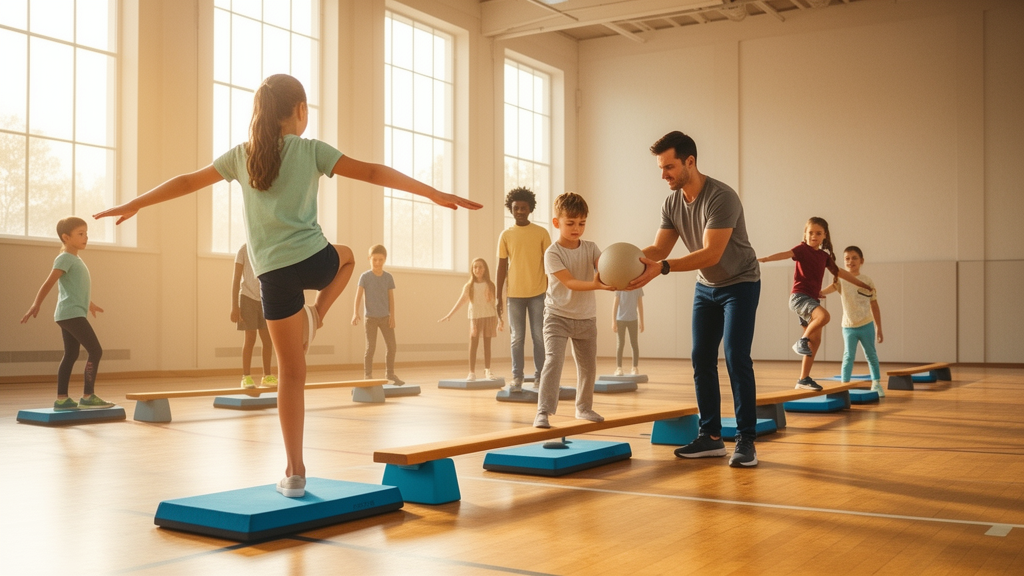
Resistance training may improve both static and dynamic balance in children and adolescents, according to a systematic review and meta-analysis published on 28 October 2026 in Frontiers in Physiology. The analysis pooled data from twelve randomized controlled trials involving 557 participants aged between 4 and 18 years and found statistically significant, though cautiously rated, benefits for both balance domains compared with non-resistance control conditions.
The research team, led by Sichen Zhou of the Sports & Medicine Integration Research Center at the Capital University of Physical Education and Sports in Beijing, searched PubMed, the Cochrane Library, Embase, Scopus and Web of Science from database inception to April 2026. They screened 653 records identified across the five databases, plus four additional records from previous meta-analyses and seven reports located through citation searching. After removing 270 duplicates and excluding 37 reports at full-text assessment for reasons including ineligible interventions, ineligible populations and missing data, twelve studies published between 2011 and 2025 met the inclusion criteria. The review protocol was registered in PROSPERO under identifier CRD420261375407.
To be included, studies had to compare a structured resistance training program, defined according to the International Consensus on Youth Resistance Training, against a non-resistance control condition such as standard rehabilitation, regular physical education or physical therapy. Interventions that mixed resistance exercise with balance training or other modalities were excluded so that the independent effect of resistance training could be isolated. Eligible trials also had to measure static or dynamic balance with validated assessment tools. The included studies spanned nine countries, including Egypt, Saudi Arabia, Turkey, the United Kingdom, Germany, Canada, South Korea, Tunisia and Iran, and covered preschool children, school-aged children and adolescents, with a mean intervention duration of 11.08 plus or minus 9.30 weeks and a mean training frequency of 2.75 plus or minus 0.87 sessions per week.
For static balance, five studies with 177 participants contributed to the pooled estimate. Because the various trials used different assessment instruments, the authors calculated standardized mean differences rather than raw unit changes. The pooled result showed a small-to-moderate effect in favor of resistance training, with a standardized mean difference of 0.36 and a 95 percent confidence interval of 0.06 to 0.65, corresponding to a p value of 0.02. Notably, between-study heterogeneity was absent for this outcome, with an I-squared value of 0 percent and a Q statistic of 2.54 with four degrees of freedom and a p value of 0.64, indicating that the five static balance trials produced remarkably consistent estimates despite differences in populations and protocols.
Dynamic balance told a different statistical story. All twelve trials measured dynamic balance, and the pooled estimate was larger, with a standardized mean difference of 0.56 and a 95 percent confidence interval of 0.23 to 0.89, at a p value below 0.001. However, heterogeneity was substantial, with an I-squared of 68 percent and a Q statistic of 34.02 across eleven degrees of freedom, meaning the individual trials varied considerably in the size of the effects they reported. This variability prompted the authors to run a series of preplanned subgroup and sensitivity analyses to identify potential sources of the inconsistency.
The most striking subgroup contrast involved training modality. Core resistance training produced a large pooled effect on dynamic balance, with a standardized mean difference of 1.41 and a 95 percent confidence interval of 0.60 to 2.21. Whole-body resistance training also showed a significant positive effect of 0.41, with a confidence interval of 0.17 to 0.66 and the lowest within-subgroup heterogeneity. Lower-limb resistance training, by contrast, yielded a smaller and non-significant estimate of 0.31, with a confidence interval spanning from minus 0.13 to 0.76. The test for between-subgroup differences across modalities was marginal, with a Q statistic of 5.90 and a p value of 0.05, and the authors cautioned that the limited number of studies within each modality subgroup makes it premature to declare any single approach definitively superior.
Intervention duration produced a counterintuitive pattern. Programs shorter than eight weeks showed the largest pooled effect, at 0.80 with a confidence interval of 0.24 to 1.36, while eight-week programs showed an effect of 0.71 with a confidence interval of 0.06 to 1.35. Interventions lasting longer than eight weeks showed a smaller, non-significant estimate of 0.33. The between-subgroup test was not statistically significant, however, and the authors noted that the longer-duration trials predominantly involved children younger than ten years, the same age subgroup in which the pooled effect itself failed to reach significance. They therefore could not confirm a genuine interaction between age and training duration and framed the duration finding as exploratory, suggesting that developmental stage may shape training responses in ways that future trials should test directly.
Population characteristics also appeared to matter. In trials involving children with special needs, such as those with Down syndrome or cerebral palsy, resistance training showed a relatively large and significant pooled effect on dynamic balance, at 0.89 with a confidence interval of 0.28 to 1.50, though within-subgroup heterogeneity was high at 75 percent. In healthy children and adolescents, including adolescent athletes, the pooled estimate was smaller at 0.30 and only approached statistical significance, with a confidence interval of minus 0.01 to 0.61. The formal between-subgroup difference test did not reach significance, with a p value of 0.09. Sensitivity analyses reinforced this pattern: when only clinical populations were retained the pooled effect remained significant, whereas excluding clinical populations attenuated it to non-significance. Comparator type mattered as well, with trials using conventional physical therapy as the control showing a larger, more homogeneous effect than trials using usual training or physical education classes.
The certainty of the evidence, assessed with the GRADE framework, was rated very low for both outcomes. For static balance, the rating was downgraded for risk of bias, indirectness and imprecision; for dynamic balance, it was downgraded for risk of bias, inconsistency, indirectness and imprecision. Methodological quality of the included trials, measured with the PEDro scale, ranged from 5 to 9 out of a possible 10, with one trial rated high quality, ten moderate and one low. Leave-one-out sensitivity analysis showed that no single study disproportionately influenced the pooled estimates, and excluding lower-quality trials did not materially change the results. Publication bias analyses, based on funnel plots and asymmetry tests, were treated as exploratory because the small number of studies limited their statistical power, and the authors acknowledged that publication bias cannot be completely excluded.
The authors concluded that resistance training may improve static and dynamic balance performance in children and adolescents, but emphasized that the findings remain preliminary given the methodological limitations, heterogeneity and very low certainty of evidence. They suggested that programs emphasizing core stability and whole-body coordination may align better with the multi-joint demands of postural control, and they proposed that short-term, goal-oriented training could serve as a feasible starting point in school-based and rehabilitation contexts, while individualized progressive programs may suit children with special needs. They called for further high-quality randomized controlled trials using standardized intervention protocols and consistent outcome measures to confirm which training characteristics most effectively support postural control development during childhood and adolescence.
Subject of Research: Effects of resistance training on static and dynamic balance in children and adolescents
Article Title: The effects of resistance training on postural control in children and adolescents: a systematic review and meta-analysis
Article References: Zhou, S., Kong, C., Shi, W., Zhou, T., Xu, Y., Yang, Y., Song, H., Yu, Y., & Zang, W. (2026). The effects of resistance training on postural control in children and adolescents: a systematic review and meta-analysis. Frontiers in Physiology, 17, Article 1928723. https://doi.org/10.3389/fphys.2026.1928723
Image Credits: AI Generated
DOI: 10.3389/fphys.2026.1928723
Keywords: resistance training, postural control, balance, children, adolescents, meta-analysis, systematic review, dynamic balance, static balance, pediatric exercise, GRADE certainty, randomized controlled trials
News Source: Drew Townsend. (October 29, 2026). Resistance Training May Sharpen Balance in Children and Adolescents, Review Finds. Scienmag.