


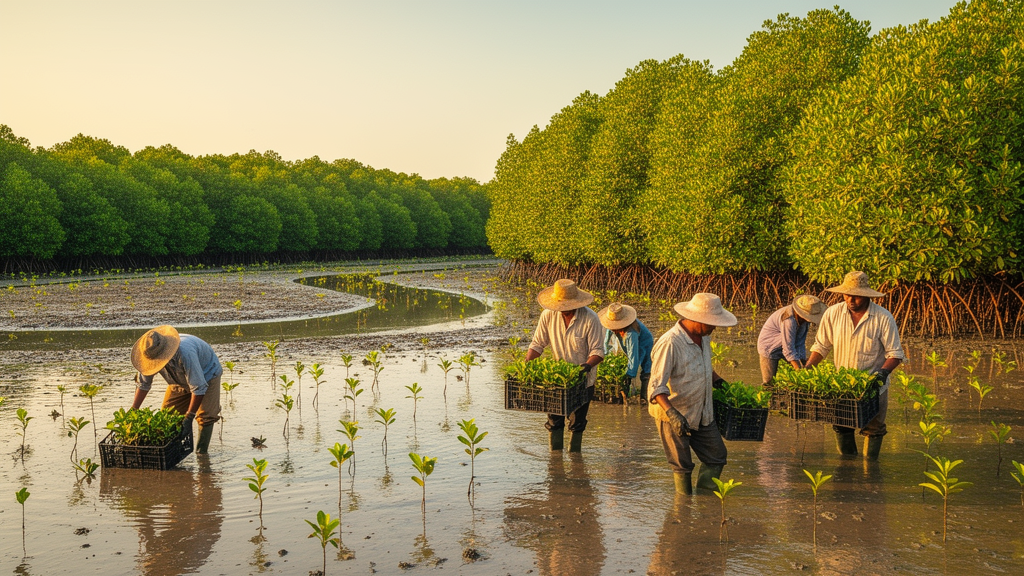
Mangrove restoration can generate real employment for coastal communities, but a new systematic review warns that most of those jobs evaporate once donor funding dries up. The analysis, published in Discover Life, examined 31 peer-reviewed studies and institutional reports from 2000 to 2024 and found that planting phases produce roughly 2 to 7 full-time-equivalent jobs per hectare, yet only about 27 percent of those positions survive beyond a year. When projects blend public grants with carbon-market revenue and ecosystem-service payments, however, job persistence climbs to around 60 percent, suggesting that financing structure, not ecology, is the decisive variable for durable green and blue livelihoods.
The review, led by Teklu Gebretsadik and Mário Paulo Falcão, followed PRISMA 2020 guidelines and screened more than 1,000 records from Scopus, Web of Science and institutional repositories before settling on the final evidence base of 22 journal articles, 4 book chapters and 5 reports from organizations such as UNEP, ILO and the World Bank. The authors deliberately excluded studies that dealt only with carbon sequestration or biodiversity without any socioeconomic component, a filter that narrowed a sprawling literature down to a thematically consistent core. Because the included studies varied widely in design and reporting, the team did not attempt a formal statistical meta-analysis; instead, they used a weighted descriptive synthesis, assigning greater influence to larger, peer-reviewed empirical work and treating the resulting figures as benchmarks rather than precise averages.
Those benchmarks paint a nuanced picture of the labor market that mangrove restoration creates. During planting, labor intensity averages about 4.5 full-time-equivalent jobs per hectare, dropping to roughly 1.0 FTE per hectare once forests are established and maintenance takes over. Wages typically run 80 to 150 percent above local minimums, though the higher end tends to appear in internationally funded projects with formal contracts. The distribution of planting-phase jobs is right-skewed: most medium and large projects cluster between 3 and 5 FTE per hectare, while the 6 to 7 FTE figures come from small, labor-intensive community schemes. Long-term maintenance needs, by contrast, show a narrow, symmetric spread centered near one FTE per hectare, indicating relatively steady staffing requirements once a site matures.
Job permanence is the review’s most striking finding. The distribution is bimodal, splitting projects into two distinct worlds: donor-funded, short-term initiatives where only 25 to 35 percent of jobs last more than 12 months, and hybrid-financed operations where 50 to 60 percent do. The combined midpoint of 40 percent therefore reflects two separate project archetypes rather than a single average. The authors attribute this split to governance and financial architecture rather than biophysical conditions. Hybrid models that combine grants, blue carbon earnings and fisheries-linked markets also generate local income multipliers of roughly 1.5 to 2.2 times, meaning restoration wages ripple through surrounding economies in secondary spending.
Gender patterns reveal persistent inequities. Women participate substantially in nurseries and monitoring work, with reported involvement of 25 to 40 percent, but hold fewer than 10 percent of leadership positions. The skew is somewhat right-shifted: most studies report 25 to 35 percent participation, while community-based or gender-targeted interventions reach 40 to 45 percent, showing that structural barriers remain even though targeted policies can shift outcomes. Initiatives that incorporated gender-sensitive training doubled women’s representation in decision-making roles, according to the synthesis. The review also flags that women, youth and indigenous groups remain underrepresented across restoration job structures generally, limiting the transformative potential of green-blue economy models.
Revenue distribution emerges as the most unequal dimension of all. Most projects allocate only 10 to 30 percent of carbon revenues to local communities, with the distribution heavily left-skewed, while a handful of equity-focused or participatory models reach shares of up to 60 percent. The authors argue that enforceable benefit-sharing agreements and escrow mechanisms could substantially alter local livelihoods, but note that without such safeguards, blue carbon markets risk funneling profits to outside parties. Carbon sequestration itself, the foundation of those revenues, typically ranges from 6 to 8 tonnes of CO2-equivalent per hectare annually, though the rate is inconsistent and depends on forest age, species composition and soil type. Younger restoration sites sequester less; mature ecosystems approach the higher end. Blue carbon revenue estimates range from US$200 to 600 per hectare per year, contingent on those same variables and on market prices.
Beyond direct planting work, the review documents a wider employment ecosystem. Restored mangroves support ecotourism ventures in Vietnam and the Philippines, sustainable forestry and non-timber products such as mangrove honey in the Niger Delta, and fisheries that improve by 15 to 30 percent within five years of restoration. In Bangladesh, communities near rehabilitated mangrove areas saw notable increases in artisanal fishing earnings, while restoration efforts in Ecuador bolstered local crab and shrimp fisheries. Integrated mangrove-aquaculture systems in Indonesia and Vietnam link restoration to certified value chains that pay above-average wages, though critics caution these models may marginalize smallholders if benefits concentrate among larger producers. Carbon monitoring, reporting and verification also creates skilled technical positions, from field technicians to data collectors, that professionalize conservation work.
The quality of those jobs varies sharply by sector. Ecotourism and carbon-finance positions tend to offer more stability and longer terms, while direct restoration work remains largely seasonal, informal and low-paid. Social protections such as healthcare, safety nets and labor rights are typically limited across the sector, leaving workers in fisheries and restoration vulnerable to economic and environmental shocks. The review notes that payment-for-ecosystem-services and carbon-finance roles pay better but are fewer in number, illustrating a trade-off between wage rate and job accessibility. Skill development opportunities concentrate in technical niches like carbon monitoring and eco-tourism, whereas hands-on planting jobs rarely offer career progression.
To integrate these findings, the authors propose a new conceptual framework they call the 3-C Model: Capability, Commons and Capital. Capability addresses skills, training and access to quality employment, calling for certified training and apprenticeship funding to be embedded in restoration budgets. Commons covers governance, tenure security and fair resource access, arguing that restoration finance should be contingent on legally enforceable benefit-sharing and recognized land tenure to prevent elite capture. Capital emphasizes diversified financing, blending public and philanthropic seed money for labor-intensive planting with private or market-based funding for monitoring and maintenance. The framework maps directly onto the review’s thematic clusters: blue carbon aligns with Capital, community restoration and tenure with Commons, and green jobs and gender inclusion with Capability.
The review acknowledges its own constraints. The evidence base of 31 studies is small, geographic and methodological heterogeneity limits comparability, and longitudinal data on job stability over multi-year horizons remain scarce. The authors also caution that improvements in mangrove mapping, such as the Global Mangrove Watch v4.0 estimate of about 147,000 square kilometers in 2020, partly reflect better remote-sensing techniques rather than actual ecosystem gains; net loss since 1996 is estimated at roughly 11,700 square kilometers, with one analysis reporting a 21.6 percent decline from 1985 to 2020. Despite these limitations, the synthesis offers policymakers a concrete set of indicators, including FTE per hectare, job permanence, community revenue share and gender parity, that can be tracked across projects. The core message is that mangrove restoration functions as a multidimensional economic strategy only when ecological goals are explicitly aligned with labor quality, inclusive governance and sustainable finance; otherwise, it risks producing a burst of seasonal planting work followed by little lasting benefit.
Subject of Research: Systematic review of mangrove restoration employment, financing pathways and sustainability outcomes in the green-blue economy
Article Title: Mangrove restoration advancing green–blue economy transition through employment creation, financing pathways, and sustainability outcomes
Article References: Gebretsadik, T., & Falcão, M. P. (2026). Mangrove restoration advancing green–blue economy transition through employment creation, financing pathways, and sustainability outcomes. Discover Life, 56(1), Article 31. https://doi.org/10.1007/s11084-026-09745-5
Image Credits: AI Generated
DOI: 10.1007/s11084-026-09745-5
Keywords: mangrove restoration, green-blue economy, blue carbon, job creation, hybrid financing, gender equity, benefit-sharing, coastal livelihoods, systematic review, ecosystem services, carbon markets, decent work
News Source: Drew Townsend. (October 30, 2026). Mangrove restoration creates jobs, but hybrid finance decides whether they last. Scienmag.



