• HOME
  • NEWS
  • EXPLORE
    • CAREER
      • Companies
      • Jobs
    • EVENTS
    • iGEM
      • News
      • Team
    • PHOTOS
    • VIDEO
    • WIKI
  • BLOG
  • COMMUNITY
    • FACEBOOK
    • INSTAGRAM
    • TWITTER
Monday, May 11, 2026
BIOENGINEER.ORG
No Result
View All Result
  • Login
  • HOME
  • NEWS
  • EXPLORE
    • CAREER
      • Companies
      • Jobs
        • Lecturer
        • PhD Studentship
        • Postdoc
        • Research Assistant
    • EVENTS
    • iGEM
      • News
      • Team
    • PHOTOS
    • VIDEO
    • WIKI
  • BLOG
  • COMMUNITY
    • FACEBOOK
    • INSTAGRAM
    • TWITTER
  • HOME
  • NEWS
  • EXPLORE
    • CAREER
      • Companies
      • Jobs
        • Lecturer
        • PhD Studentship
        • Postdoc
        • Research Assistant
    • EVENTS
    • iGEM
      • News
      • Team
    • PHOTOS
    • VIDEO
    • WIKI
  • BLOG
  • COMMUNITY
    • FACEBOOK
    • INSTAGRAM
    • TWITTER
No Result
View All Result
Bioengineer.org
No Result
View All Result
Home NEWS Science News Biology

Researchers trace 3,000 years of monsoons through shell fossils

Bioengineer by Bioengineer
April 25, 2019
in Biology
Reading Time: 3 mins read
0
IMAGE
Share on FacebookShare on TwitterShare on LinkedinShare on RedditShare on Telegram

IMAGE

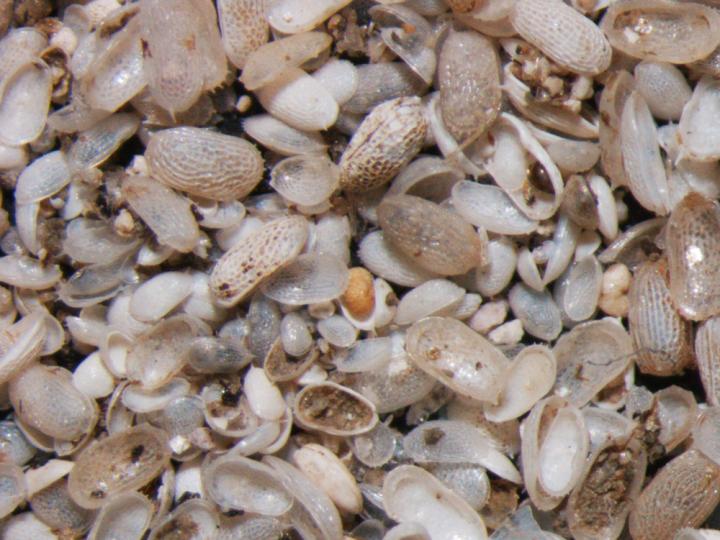
Credit: Katsura Yamada, Shinshu University, Japan

The tiny shells at the bottom of Lake Nakaumi in southwest Japan may contain the secrets of the East Asia Summer Monsoon. This rainy season is fairly predictable, ushering in air and precipitation conducive to growing crops, but – sometimes without any hint – the pattern fails. Some areas of East Asia are left without rainfall, and their crops die. Other areas are inundated with rain, and their crops and homes flood.

Ostracoda shells are smaller than the white wisp a fingernail grows over a month, yet they have recorded the effects of sunshine and climate shifts for almost 500 million years.

A team of researchers dug into the lake and the rich historical record in the shells to better understand why East Asian summer monsoons vary at the centennial scale, which should hold relatively steady. They published their results on March 22, 2019, in Scientific Reports.

“The mechanisms driving the variations in East Asian summer monsoons remain unclear, so we used the oxygen isotopes from adult ostracode shells to reconstruct the variations over the last 3,000 years in southwestern Japan,” said Katsura Yamada, paper author and a professor in the department of geology and faculty of science at Shinshu University.

Yamada and the team cored sections of the lake, retrieving shells from present day to 3,000 years ago. The scientists analyzed the shells, measuring a specific ratio between slightly different versions of oxygen, called isotopes. The isotope ratio can offer a glimpse into the atmosphere’s precise composition thousands of years ago. A higher rate of nitrogen in the atmosphere will produce a different isotope of oxygen than times when nitrogen is less abundant.

The researchers found that the primary factor of the centennial-scale variations in the East Asia summer monsoon was solar activity, also called insolation.

“Our results and compiled data propose that insolation variation was a primary factor of the centennial-scale East Asia summer monsoon variations,” Yamada said. “However, dominant factors affecting the variations can shift according to the solar insolation decreases.”

During sunny periods, the insolation dominates the East Asian monsoon pattern. During cooling off periods, usually around glacial ice ages, other factors – such as wind patterns – took over as the dominant influencer.

“Our next goal is to clarify the relationship between East Asian monsoon variations and other climatic phenomena,” Yamada said.

This work was supported by the Japan Society for the Promotion of Science and the cooperative research program for the Center for Advanced Marine Core Research at Kochi University.

Other authors Kazuma Kohara of the department of geology and Faculty of Science at Shinshu University; Minoru Ikehara of the Center for Advanced Marine Core Research at Kochi University; and Koji Seto of the Estuary Research Center at Shimane University.

###

About Shinshu University

Shinshu University is a national university in Japan founded in 1949 and working on providing solutions for building a sustainable society through interdisciplinary research fields: material science (carbon, fiber, composites), biomedical science (for intractable diseases, preventive medicine), and mountain science. We aim to boost research and innovation capability through collaborative projects with distinguished researchers from the world. For more information, please see: http://www.shinshu-u.ac.jp/english/

Media Contact
Nobuko Imanishi
[email protected]

Related Journal Article

http://dx.doi.org/10.1038/s41598-019-41359-y

Tags: Climate ChangeClimate ScienceEarth SciencePaleontology
Share12Tweet8Share2ShareShareShare2

Related Posts

Ancient Plant Populations Reveal Fresh Insights into Climate Resilience — Biology

Ancient Plant Populations Reveal Fresh Insights into Climate Resilience

May 8, 2026
Rare Brain Disorders in Children Linked to Mutations in Lesser-Known Protein Complex — Biology

Rare Brain Disorders in Children Linked to Mutations in Lesser-Known Protein Complex

May 8, 2026

From Odd Insect to Underwater Predator: The Remarkable Evolution of a Bloodthirsty Fruit Fly

May 8, 2026

SNU Professor Sangwoo Seo’s Team Develops Next-Generation CRISPR Biocontainment Technology to Control Microbial Survival Without DNA Cleavage

May 8, 2026
Please login to join discussion

POPULAR NEWS

  • Research Indicates Potential Connection Between Prenatal Medication Exposure and Elevated Autism Risk

    840 shares
    Share 336 Tweet 210
  • New Study Reveals Plants Can Detect the Sound of Rain

    727 shares
    Share 290 Tweet 181
  • Salmonella Haem Blocks Macrophages, Boosts Infection

    61 shares
    Share 24 Tweet 15
  • Breastmilk Balances E. coli and Beneficial Bacteria in Infant Gut Microbiomes

    57 shares
    Share 23 Tweet 14

About

We bring you the latest biotechnology news from best research centers and universities around the world. Check our website.

Follow us

Recent News

New Post-Hoc Analysis Explores Daily Oral Orforglipron Use in Adults Over 65 with Obesity, Regardless of Diabetes Status

Evaluating Digoxin Use in Patients with Symptomatic Rheumatic Heart Disease

Evaluating the Effectiveness and Safety of Digitalis Glycosides in Treating Heart Failure

Subscribe to Blog via Email

Enter your email address to subscribe to this blog and receive notifications of new posts by email.

Join 82 other subscribers
  • Contact Us

Bioengineer.org © Copyright 2023 All Rights Reserved.

Welcome Back!

Login to your account below

Forgotten Password?

Retrieve your password

Please enter your username or email address to reset your password.

Log In
No Result
View All Result
  • Homepages
    • Home Page 1
    • Home Page 2
  • News
  • National
  • Business
  • Health
  • Lifestyle
  • Science

Bioengineer.org © Copyright 2023 All Rights Reserved.