• HOME
  • NEWS
  • EXPLORE
    • CAREER
      • Companies
      • Jobs
    • EVENTS
    • iGEM
      • News
      • Team
    • PHOTOS
    • VIDEO
    • WIKI
  • BLOG
  • COMMUNITY
    • FACEBOOK
    • INSTAGRAM
    • TWITTER
Monday, May 11, 2026
BIOENGINEER.ORG
No Result
View All Result
  • Login
  • HOME
  • NEWS
  • EXPLORE
    • CAREER
      • Companies
      • Jobs
        • Lecturer
        • PhD Studentship
        • Postdoc
        • Research Assistant
    • EVENTS
    • iGEM
      • News
      • Team
    • PHOTOS
    • VIDEO
    • WIKI
  • BLOG
  • COMMUNITY
    • FACEBOOK
    • INSTAGRAM
    • TWITTER
  • HOME
  • NEWS
  • EXPLORE
    • CAREER
      • Companies
      • Jobs
        • Lecturer
        • PhD Studentship
        • Postdoc
        • Research Assistant
    • EVENTS
    • iGEM
      • News
      • Team
    • PHOTOS
    • VIDEO
    • WIKI
  • BLOG
  • COMMUNITY
    • FACEBOOK
    • INSTAGRAM
    • TWITTER
No Result
View All Result
Bioengineer.org
No Result
View All Result
Home NEWS Science News Chemistry

Researchers reveal relationship between magnetic field and supercapacitors

Bioengineer by Bioengineer
September 6, 2025
in Chemistry
Reading Time: 2 mins read
0
IMAGE
Share on FacebookShare on TwitterShare on LinkedinShare on RedditShare on Telegram

Since energy storage devices are often used in a magnetic field environment, scientists have often explored how an external magnetic field affects the charge storage of nonmagnetic aqueous carbon-based supercapacitor systems.

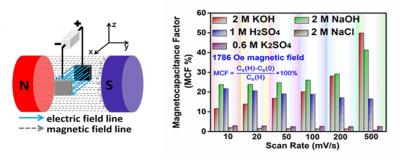
Recently, an experiment designed by Prof. YAN Xingbin’s group from the Lanzhou Institute of Chemical Physics (LICP) of the Chinese Academy of Sciences has revealed that applying an external magnetic field can induce capacitance change in aqueous acidic and alkaline electrolytes, but not in neutral electrolytes. The experiment also shows that the force field can explain the origin of the magnetic field effect.

This new discovery establishes a relationship between magnetic fields and supercapacitors, and provides insight into the transport behavior of ions in aqueous electrolytes.

Carbon-based supercapacitors are among the most prominent electrochemical energy storage devices because of their excellent power output and superior cycle life. During the charging/discharging process, the difference in electrical potential between the positive and negative electrodes generates a magnetic field based on Faraday’s law of electromagnetic induction.

Moreover, supercapacitors are often used in electronic equipment that generates a magnetic field as well. However, whether the magnetic field affects the charge storage of supercapacitors was not yet clear before this experiment.

In this work, the researchers first reported that the external magnetic field indeed affects the charge storage of a nonmagnetic aqueous carbon-based supercapacitor system, thus overcoming the negligible effect of the magnetic field on nonmagnetic electrochemical systems.

According to the researchers, the direction and intensity of the magnetic field, concentration of electrolytes and voltammetry sweep all affect the capacitance change in acidic and alkaline electrolytes.

In addition, a quantitative relationship among the limiting current density at the electrode/electrolyte interface, the intensity of the magnetic field, and the concentration and viscosity of the electrolytes was identified, which provided a completely new insight into the charge transport behavior of supercapacitors.

“By establishing the relationship between magnetic fields and supercapacitors, we were able to deeply understand the transport behavior of ions in aqueous electrolytes. We expect to apply magnetic field-enhanced electrochemistry to other energy storage devices,” said Prof. YAN.

The results were published online in Cell Reports Physical Science in an article entitled “Magnetic field induced capacitance change of aqueous carbon-based supercapacitors.”

###

This work was funded by the National Natural Science Foundation of China, the Chinese Academy of Sciences, the Postdoctoral Science Foundation of China and the Zhaoqing Municipal Science and Technology Bureau of China.

Media Contact
YAN Xingbin
[email protected]

Related Journal Article

http://dx.doi.org/10.1016/j.xcrp.2021.100455

Tags: Chemistry/Physics/Materials SciencesElectromagnetics
Share12Tweet8Share2ShareShareShare2

Related Posts

Unveiling Dark Matter Through Molecular Insights — Chemistry

Unveiling Dark Matter Through Molecular Insights

May 11, 2026
From Touch to Sight: A Bioinspired Multisensory Framework Endows Robots with Human-Like Perception — Chemistry

From Touch to Sight: A Bioinspired Multisensory Framework Endows Robots with Human-Like Perception

May 11, 2026

Announcing the 2026 Carbon Future Young Investigator Award Winners

May 11, 2026

Innovative Photocatalytic Approach Distinguishes Reactant Activation from Product Release

May 11, 2026
Please login to join discussion

POPULAR NEWS

  • Research Indicates Potential Connection Between Prenatal Medication Exposure and Elevated Autism Risk

    841 shares
    Share 336 Tweet 210
  • New Study Reveals Plants Can Detect the Sound of Rain

    728 shares
    Share 290 Tweet 182
  • Salmonella Haem Blocks Macrophages, Boosts Infection

    62 shares
    Share 25 Tweet 16
  • Breastmilk Balances E. coli and Beneficial Bacteria in Infant Gut Microbiomes

    57 shares
    Share 23 Tweet 14

About

We bring you the latest biotechnology news from best research centers and universities around the world. Check our website.

Follow us

Recent News

Medicaid Expansion Reduces Mortality in Young Adults with Kidney Failure

Innovative Dense Eutectic Zr-Ta-O/YSZ Core-Shell Double-Layer Coating Boosts CMAS Resistance Through Dynamic Sealing and Self-Removal

BESSY II Reveals How Intrinsic Oxygen Reduces the Lifespan of Solid-State Batteries

Subscribe to Blog via Email

Enter your email address to subscribe to this blog and receive notifications of new posts by email.

Join 82 other subscribers
  • Contact Us

Bioengineer.org © Copyright 2023 All Rights Reserved.

Welcome Back!

Login to your account below

Forgotten Password?

Retrieve your password

Please enter your username or email address to reset your password.

Log In
No Result
View All Result
  • Homepages
    • Home Page 1
    • Home Page 2
  • News
  • National
  • Business
  • Health
  • Lifestyle
  • Science

Bioengineer.org © Copyright 2023 All Rights Reserved.