• HOME
  • NEWS
  • EXPLORE
    • CAREER
      • Companies
      • Jobs
    • EVENTS
    • iGEM
      • News
      • Team
    • PHOTOS
    • VIDEO
    • WIKI
  • BLOG
  • COMMUNITY
    • FACEBOOK
    • INSTAGRAM
    • TWITTER
Friday, January 9, 2026
BIOENGINEER.ORG
No Result
View All Result
  • Login
  • HOME
  • NEWS
  • EXPLORE
    • CAREER
      • Companies
      • Jobs
        • Lecturer
        • PhD Studentship
        • Postdoc
        • Research Assistant
    • EVENTS
    • iGEM
      • News
      • Team
    • PHOTOS
    • VIDEO
    • WIKI
  • BLOG
  • COMMUNITY
    • FACEBOOK
    • INSTAGRAM
    • TWITTER
  • HOME
  • NEWS
  • EXPLORE
    • CAREER
      • Companies
      • Jobs
        • Lecturer
        • PhD Studentship
        • Postdoc
        • Research Assistant
    • EVENTS
    • iGEM
      • News
      • Team
    • PHOTOS
    • VIDEO
    • WIKI
  • BLOG
  • COMMUNITY
    • FACEBOOK
    • INSTAGRAM
    • TWITTER
No Result
View All Result
Bioengineer.org
No Result
View All Result
Home NEWS Science News Chemistry

Researchers reveal relationship between magnetic field and supercapacitors

Bioengineer by Bioengineer
September 6, 2025
in Chemistry
Reading Time: 2 mins read
0
IMAGE
Share on FacebookShare on TwitterShare on LinkedinShare on RedditShare on Telegram

Since energy storage devices are often used in a magnetic field environment, scientists have often explored how an external magnetic field affects the charge storage of nonmagnetic aqueous carbon-based supercapacitor systems.

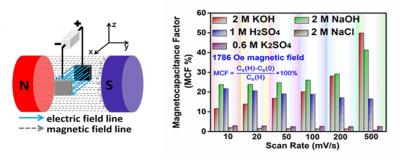
Recently, an experiment designed by Prof. YAN Xingbin’s group from the Lanzhou Institute of Chemical Physics (LICP) of the Chinese Academy of Sciences has revealed that applying an external magnetic field can induce capacitance change in aqueous acidic and alkaline electrolytes, but not in neutral electrolytes. The experiment also shows that the force field can explain the origin of the magnetic field effect.

This new discovery establishes a relationship between magnetic fields and supercapacitors, and provides insight into the transport behavior of ions in aqueous electrolytes.

Carbon-based supercapacitors are among the most prominent electrochemical energy storage devices because of their excellent power output and superior cycle life. During the charging/discharging process, the difference in electrical potential between the positive and negative electrodes generates a magnetic field based on Faraday’s law of electromagnetic induction.

Moreover, supercapacitors are often used in electronic equipment that generates a magnetic field as well. However, whether the magnetic field affects the charge storage of supercapacitors was not yet clear before this experiment.

In this work, the researchers first reported that the external magnetic field indeed affects the charge storage of a nonmagnetic aqueous carbon-based supercapacitor system, thus overcoming the negligible effect of the magnetic field on nonmagnetic electrochemical systems.

According to the researchers, the direction and intensity of the magnetic field, concentration of electrolytes and voltammetry sweep all affect the capacitance change in acidic and alkaline electrolytes.

In addition, a quantitative relationship among the limiting current density at the electrode/electrolyte interface, the intensity of the magnetic field, and the concentration and viscosity of the electrolytes was identified, which provided a completely new insight into the charge transport behavior of supercapacitors.

“By establishing the relationship between magnetic fields and supercapacitors, we were able to deeply understand the transport behavior of ions in aqueous electrolytes. We expect to apply magnetic field-enhanced electrochemistry to other energy storage devices,” said Prof. YAN.

The results were published online in Cell Reports Physical Science in an article entitled “Magnetic field induced capacitance change of aqueous carbon-based supercapacitors.”

###

This work was funded by the National Natural Science Foundation of China, the Chinese Academy of Sciences, the Postdoctoral Science Foundation of China and the Zhaoqing Municipal Science and Technology Bureau of China.

Media Contact
YAN Xingbin
[email protected]

Related Journal Article

http://dx.doi.org/10.1016/j.xcrp.2021.100455

Tags: Chemistry/Physics/Materials SciencesElectromagnetics
Share12Tweet8Share2ShareShareShare2

Related Posts

blank

Advancing Alkene Chemistry: Homologative Difunctionalization Breakthrough

January 8, 2026
Biocompatible Ligand Enables Safe In-Cell Protein Arylation

Biocompatible Ligand Enables Safe In-Cell Protein Arylation

January 8, 2026

Monovalent Pseudo-Natural Products Boost IDO1 Degradation

January 7, 2026

Catalytic Enantioselective [1,2]-Wittig Rearrangement Breakthrough

January 7, 2026
Please login to join discussion

POPULAR NEWS

  • Enhancing Spiritual Care Education in Nursing Programs

    154 shares
    Share 62 Tweet 39
  • PTSD, Depression, Anxiety in Childhood Cancer Survivors, Parents

    144 shares
    Share 58 Tweet 36
  • Impact of Vegan Diet and Resistance Exercise on Muscle Volume

    46 shares
    Share 18 Tweet 12
  • SARS-CoV-2 Subvariants Affect Outcomes in Elderly Hip Fractures

    45 shares
    Share 18 Tweet 11

About

We bring you the latest biotechnology news from best research centers and universities around the world. Check our website.

Follow us

Recent News

Mapping Prenatal Microbial Diversity in Amniotic Fluid

Latino Families Navigate Neonatal Intensive Care Adventures

Pt(O,O′-acac)(γ-acac)(DMS) Triggers Mitochondrial, Autophagy Damage in U251

Subscribe to Blog via Email

Enter your email address to subscribe to this blog and receive notifications of new posts by email.

Join 71 other subscribers
  • Contact Us

Bioengineer.org © Copyright 2023 All Rights Reserved.

Welcome Back!

Login to your account below

Forgotten Password?

Retrieve your password

Please enter your username or email address to reset your password.

Log In
No Result
View All Result
  • Homepages
    • Home Page 1
    • Home Page 2
  • News
  • National
  • Business
  • Health
  • Lifestyle
  • Science

Bioengineer.org © Copyright 2023 All Rights Reserved.