• HOME
  • NEWS
  • EXPLORE
    • CAREER
      • Companies
      • Jobs
    • EVENTS
    • iGEM
      • News
      • Team
    • PHOTOS
    • VIDEO
    • WIKI
  • BLOG
  • COMMUNITY
    • FACEBOOK
    • INSTAGRAM
    • TWITTER
Tuesday, July 7, 2026
BIOENGINEER.ORG
No Result
View All Result
  • Login
  • HOME
  • NEWS
  • EXPLORE
    • CAREER
      • Companies
      • Jobs
        • Lecturer
        • PhD Studentship
        • Postdoc
        • Research Assistant
    • EVENTS
    • iGEM
      • News
      • Team
    • PHOTOS
    • VIDEO
    • WIKI
  • BLOG
  • COMMUNITY
    • FACEBOOK
    • INSTAGRAM
    • TWITTER
  • HOME
  • NEWS
  • EXPLORE
    • CAREER
      • Companies
      • Jobs
        • Lecturer
        • PhD Studentship
        • Postdoc
        • Research Assistant
    • EVENTS
    • iGEM
      • News
      • Team
    • PHOTOS
    • VIDEO
    • WIKI
  • BLOG
  • COMMUNITY
    • FACEBOOK
    • INSTAGRAM
    • TWITTER
No Result
View All Result
Bioengineer.org
No Result
View All Result
Home NEWS Science News Chemistry

Researchers reveal new mechanism for optical phase amplification

Bioengineer by Bioengineer
November 29, 2022
in Chemistry
Reading Time: 2 mins read
0
Harmonics-assisted optical phase amplifier
Share on FacebookShare on TwitterShare on LinkedinShare on RedditShare on Telegram

Recently, a research team led by Prof. GUO Guangcan, Prof. SHI Baosen and Prof. ZHOU Zhiyuan from the University of Science and Technology of China (USTC), realized a harmonics-assisted optical phase amplifier. This work was published in Light: Science & Applications. 
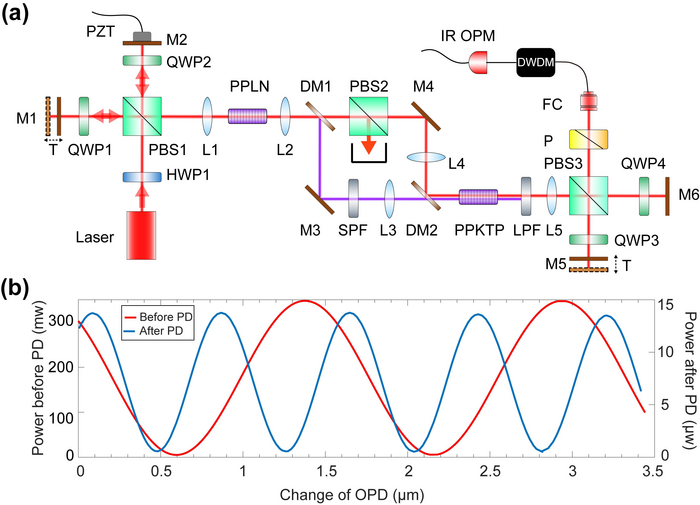
Harmonics-assisted optical phase amplifier

Credit: Li Wuzhen et al.

Recently, a research team led by Prof. GUO Guangcan, Prof. SHI Baosen and Prof. ZHOU Zhiyuan from the University of Science and Technology of China (USTC), realized a harmonics-assisted optical phase amplifier. This work was published in Light: Science & Applications. 

In modern physics, phase change is an important parameter for physical quantity measurement during interference. To improve measurement accuracy, amplifying the relative phase is a desirable way. Previously, researchers in quantum optics tended to utilize the multi-photon number and path-entangled state. Unfortunately, this approach faces difficulties in preparation and measurement. New principles to amplify the optical phase are in great need. 

In their previous study of optical interference based on non-linear effects, the researchers discovered that the relative phase between the superposed orbital angular momentum modes would double. Inspired by this discovery, they hypothesized and verified that in non-linear processes, the phase could also double based on other degrees of freedom, and that cascading could help realize the doubling. 

In the three-wave mixing process, annihilating two photons at a fundamental wavelength creates a photon at the second harmonic wavelength. The phase information carried by the two photons could be coherently transferred to the created photon so that the phase would be amplified. In principle, the phase can be amplified to any integral times by recycling and cascading the process. 

They further testified that the principle is independent of the wavelength, laying the foundation for amplifying the phase more times through recycling. 

Through cascading and recycling, the researchers were able to realize phase amplification even more times with a more intense laser, and the principle will be applied to optical precision measurement in the future.


Journal

Light Science & Applications

DOI

10.1038/s41377-022-01003-3

Article Title

Harmonics-assisted optical phase amplifier

Article Publication Date

27-Oct-2022

Share12Tweet8Share2ShareShareShare2

Related Posts

Salt adaptation linked to higher disease risk, Mizzou study finds

Salt adaptation linked to higher disease risk, Mizzou study finds

July 6, 2026
Intelligent Microgrid Management Promises Lower Household Energy Bills and Reduced Diesel Emissions — Chemistry

Intelligent Microgrid Management Promises Lower Household Energy Bills and Reduced Diesel Emissions

July 4, 2026

Graz University of Technology Deciphers the Structural Secrets of MOF Thin Films

July 2, 2026

Breaking Thermodynamic Limits: Wavelength-Driven Catalysis Advances Ammonia Synthesis

July 2, 2026

POPULAR NEWS

  • Detection of EDCs in Breast Milk and Infant Urine Up to Six Months Highlights Early Exposure Risks

    77 shares
    Share 31 Tweet 19
  • New Drug Candidate Developed at McMaster Shows Potential for Treating Brain Cancer

    58 shares
    Share 23 Tweet 15
  • Saying Goodbye to PGY-6: Pediatric Fellowship Realities

    103 shares
    Share 41 Tweet 26
  • KTU Researchers Explore Ultrasound’s Role in Enhancing Blood Flow Beyond Diagnostics

    53 shares
    Share 21 Tweet 13

About

We bring you the latest biotechnology news from best research centers and universities around the world. Check our website.

Follow us

Recent News

Flame retardant BDE-209 targets molecularly linked to ulcerative colitis

Ultra-high frequency particle impacts mimic rockbursts to shatter hard rock

Kidney transplant outcomes in older adults studied by German researchers

Subscribe to Blog via Email

Enter your email address to subscribe to this blog and receive notifications of new posts by email.

Join 83 other subscribers
  • Contact Us

Bioengineer.org © Copyright 2023 All Rights Reserved.

Welcome Back!

Login to your account below

Forgotten Password?

Retrieve your password

Please enter your username or email address to reset your password.

Log In
No Result
View All Result
  • Homepages
    • Home Page 1
    • Home Page 2
  • News
  • National
  • Business
  • Health
  • Lifestyle
  • Science

Bioengineer.org © Copyright 2023 All Rights Reserved.