• HOME
  • NEWS
  • EXPLORE
    • CAREER
      • Companies
      • Jobs
    • EVENTS
    • iGEM
      • News
      • Team
    • PHOTOS
    • VIDEO
    • WIKI
  • BLOG
  • COMMUNITY
    • FACEBOOK
    • INSTAGRAM
    • TWITTER
Friday, January 16, 2026
BIOENGINEER.ORG
No Result
View All Result
  • Login
  • HOME
  • NEWS
  • EXPLORE
    • CAREER
      • Companies
      • Jobs
        • Lecturer
        • PhD Studentship
        • Postdoc
        • Research Assistant
    • EVENTS
    • iGEM
      • News
      • Team
    • PHOTOS
    • VIDEO
    • WIKI
  • BLOG
  • COMMUNITY
    • FACEBOOK
    • INSTAGRAM
    • TWITTER
  • HOME
  • NEWS
  • EXPLORE
    • CAREER
      • Companies
      • Jobs
        • Lecturer
        • PhD Studentship
        • Postdoc
        • Research Assistant
    • EVENTS
    • iGEM
      • News
      • Team
    • PHOTOS
    • VIDEO
    • WIKI
  • BLOG
  • COMMUNITY
    • FACEBOOK
    • INSTAGRAM
    • TWITTER
No Result
View All Result
Bioengineer.org
No Result
View All Result
Home NEWS Science News Chemistry

Researchers reveal cause of Jupiter’s x-ray aurorae

Bioengineer by Bioengineer
July 16, 2021
in Chemistry
Reading Time: 2 mins read
0
IMAGE
Share on FacebookShare on TwitterShare on LinkedinShare on RedditShare on Telegram

IMAGE

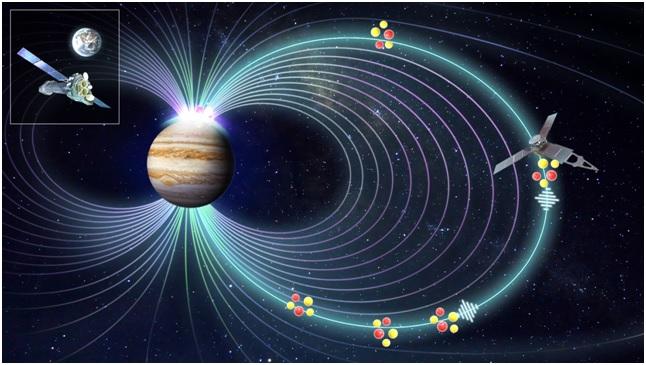
Credit: YAO Zhonghua’s group

An international research team led by YAO Zhonghua from the Institute of Geology and Geophysics of the Chinese Academy of Sciences (IGGCAS) has explained the cause of Jupiter’s X-ray aurorae, a mystery that has puzzled scientists for 40 years.

The findings were published in Science Advances on July 9.

It is the first time planetary researchers have described the entire causality chain for Jupiter’s X-ray auroral flares. The mechanism in producing X-ray auroral flares at Jupiter may have potential applications in X-ray astronomy.

The X-ray auroral spectra tell us these aurorae are produced by heavy ions with energies in the mega electron volt range. But how they are formed and why these ions enter Jupiter’s atmosphere was previously unknown.

To understand the energetic processes associated with Jupiter’s polar emissions, researchers organized, over the last four years, a series of paradigm-shifting observation campaigns from Earth in tandem with in situ measurements by ESA’s flagship X-ray observatory, XMM-Newton, and NASA’s Juno spacecraft. These efforts included the most extensive X-ray campaign and the most extensive Hubble Space Telescope campaign ever conducted for Jupiter.

Using these tools, the researchers were able to probe the physics behind the phenomenon and reveal the processes that lead planets to produce X-ray aurorae.

“These are strikingly similar to the processes of producing ion aurorae on Earth, suggesting that ion aurorae share common mechanisms across planetary systems, despite temporal, spatial and energetic scales varying by orders of magnitude,” said YAO Zhonghua, first author of the study.

“What we see in the Juno data is this beautiful chain of events. We knew that the auroral ions are stored in the magnetosphere, originated from the volcanic activities of Jupiter’s moon Io. In the magnetosphere, now we see the magnetic compression happen, the electromagnetic ion cyclotron wave triggered, the ions, and then a pulse of ions traveling along the field line. A few minutes later, XMM sees a burst of X-rays,” said William Dunn from University College London, who co-led the study.

It is noteworthy that Jupiter’s X-ray auroral flares are often correlated with ultraviolet auroral flares, which are the most common auroral form. Indeed, the study of the latter may benefit from the wealth of Hubble Space Telescope data acquired through this research. “The discovery of Jupiter’s X-ray processes may have implications for our understanding of stunning ultraviolet auroral flares,” said Denis Grodent from the University of Liege, a co-author of the study.

###

Media Contact
YAO Zhonghua
[email protected]

Related Journal Article

http://dx.doi.org/10.1126/sciadv.abf0851

Tags: AstronomyAstrophysicsPlanets/MoonsSpace/Planetary Science
Share13Tweet8Share2ShareShareShare2

Related Posts

Selective GlcNAc to GalNAc Epimerization via Kinetic Control

Selective GlcNAc to GalNAc Epimerization via Kinetic Control

January 15, 2026
blank

Thermal [2+2] Cycloaddition Builds Gem-Difluoro Bicycloalkanes

January 13, 2026

Cobalt-Catalyzed Thioester Coupling via Siloxycarbene

January 12, 2026

Advancing Alkene Chemistry: Homologative Difunctionalization Breakthrough

January 8, 2026
Please login to join discussion

POPULAR NEWS

  • Enhancing Spiritual Care Education in Nursing Programs

    155 shares
    Share 62 Tweet 39
  • PTSD, Depression, Anxiety in Childhood Cancer Survivors, Parents

    147 shares
    Share 59 Tweet 37
  • Robotic Ureteral Reconstruction: A Novel Approach

    77 shares
    Share 31 Tweet 19
  • Study Reveals Lipid Accumulation in ME/CFS Cells

    54 shares
    Share 22 Tweet 14

About

We bring you the latest biotechnology news from best research centers and universities around the world. Check our website.

Follow us

Recent News

Smart Energy Governance for Resilient Solar Data Centers

Advancing Research: Aging Meets Parkinson’s Disease Models

Phage Protein Screen Uncovers Bacterial Immune Triggers

Subscribe to Blog via Email

Enter your email address to subscribe to this blog and receive notifications of new posts by email.

Join 71 other subscribers
  • Contact Us

Bioengineer.org © Copyright 2023 All Rights Reserved.

Welcome Back!

Login to your account below

Forgotten Password?

Retrieve your password

Please enter your username or email address to reset your password.

Log In
No Result
View All Result
  • Homepages
    • Home Page 1
    • Home Page 2
  • News
  • National
  • Business
  • Health
  • Lifestyle
  • Science

Bioengineer.org © Copyright 2023 All Rights Reserved.