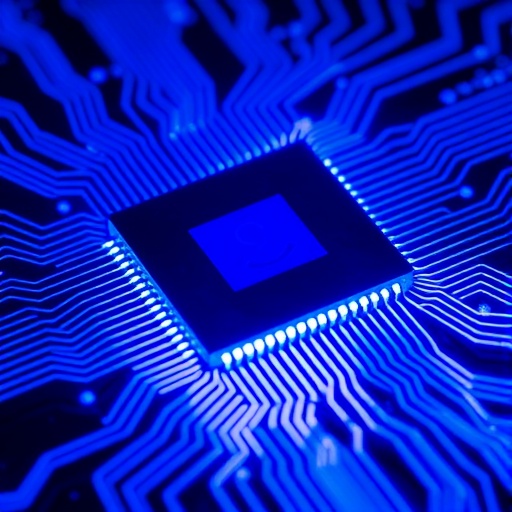
In a remarkable leap forward for the field of integrated photonics, researchers at Harvard University have engineered a lithium niobate photonic chip capable of producing ultraviolet (UV) light at power levels previously deemed unattainable on such a miniature platform. This ground-breaking achievement not only shatters prior limitations but promises to unlock a host of practical applications ranging from quantum computing to high-resolution sensing, setting a new benchmark for chip-scale UV light sources.
Ultraviolet light, with its unique energetic properties, is integral to myriad modern technologies. The broad spectrum of its uses includes sterilization, fluorescence microscopy, and the intricate photolithographic processes that underpin semiconductor manufacturing. As the miniaturization of optical components continues, the pressing challenge has been to create compact, efficient UV sources compatible with integrated photonic chips. The inherent difficulty lies in UV light’s propensity to attenuate quickly as it travels through conventional waveguides, substantially curtailing output power and thus utility at the microscale.
The Harvard team, led by Marko Lončar, Tiantsai Lin Professor of Electrical Engineering, harnessed thin-film lithium niobate—a versatile crystalline platform long celebrated for its optical nonlinearities and transparency at infrared wavelengths—to rewrite this narrative. Their innovation rests on a micron-scale device that converts readily available red light into UV photons directly on-chip, a process known as second harmonic generation or frequency upconversion. This method uses two lower-energy photons combining to form one higher-energy photon, effectively shifting the light from the red end of the spectrum into ultraviolet territory.
Lithium niobate’s nonlinear optical properties have positioned it as a mainstay material in integrated photonics, yet its application for UV generation had remained marginal. This stems from fabrication complexities and the difficulty of controlling the crystal’s ferroelectric domain orientation with precision over centimeter-scale devices. Recognizing this challenge, the team invented a new poling technique—termed “sidewall poling”—capable of periodically flipping these crystal domains with sub-50 nanometer accuracy directly adjacent to the waveguide sidewalls.
Poling is essential for enhancing nonlinear interactions by creating a spatially periodic inversion of the crystal’s polarization. This engineered pattern facilitates efficient coherent addition of generated UV light along the waveguide. Conventional poling methods faced a compromise between coverage and precision. Electrode placements atop the film allowed full area poling but limited control over domain uniformity, while poling after waveguide fabrication restricted domain inversion to peripheral regions, reducing efficiency. Harvard’s breakthrough involved lithographically patterning electrodes right alongside the waveguide sidewalls, ensuring complete domain inversion within the optical mode volume.
The electrode geometry demanded meticulous nano-fabrication techniques to achieve the tight tolerances necessary for uniform poling. Despite this complexity, the approach yielded a perfectly flipped crystalline structure throughout the waveguide cross-section. Such perfection ensures that the propagating red light consistently experiences the nonlinear environment needed for efficient UV conversion. Moreover, the researchers adapted poling periods dynamically along the waveguide length to compensate for slight variations in film thickness and waveguide geometry, further optimizing performance.
Experimentally, the device delivered on-chip UV output powers at 390 nanometers wavelength reaching an unprecedented 4.2 milliwatts. This output represents an approximate 120-fold increase over prior thin-film lithium niobate implementations, which typically produced mere microwatts of UV power insufficient for real-world applications. The milestone substantiates the viability of lithium niobate as a practical platform for high-power, compact UV sources—a critical advance for integrated photonics.
Such reliable milliwatt-scale UV generation on a chip has profound implications for emerging quantum technologies, particularly trapped-ion quantum computing. Quantum bits (qubits) in ion traps rely on specific near-UV atomic transitions for state manipulation and readout. Economical and scalable UV sources co-integrated with control electronics could dramatically shrink the size and complexity of quantum hardware, accelerating the pathway toward practical quantum machines. Additionally, compact UV photonics can enable highly sensitive environmental sensors monitoring greenhouse gases and pollutants, facilitating real-time field measurements with minimal footprints.
Analysis of the device’s nonlinear dynamics revealed intriguing phenomena beyond straightforward frequency doubling. Co-first author Kees Franken emphasized that the team observed additional nonlinear effects not yet fully characterized, signaling rich physics underlying the interaction between guided modes and the engineered crystal domains. These insights invite further investigation that could lead to new modalities of UV light control and generation on chip.
The success of this project can be attributed to the interdisciplinary strength of the Lončar lab, where theoretical modeling, experimental design, precision nanofabrication, and optical characterization coalesce under one roof. This holistic approach enabled rapid iteration and optimization of device architecture with direct feedback from performance metrics, exemplifying how integrated research environments accelerate breakthroughs in photonic science.
The study, published in Nature Communications, involved significant contributions from a diverse team of researchers, including co-authors C.C. Rodrigues, J. Yang, C.J. Xin, S. Lu, D. Witt, G. Joe, G.S. Wiederhecker, and K.-J. Boller. The multidisciplinary effort was supported by U.S. federal funding agencies such as the Department of the Air Force, Office of Naval Research, NASA, and the National Science Foundation, underscoring the strategic importance of advancements in photonic quantum technologies.
Looking forward, the implications of scalable, chip-integrated UV light sources extend into fields like high-precision atomic clocks, where UV transitions provide enhanced frequency stability, and advanced lithography techniques capable of pushing beyond current resolution limits. The intersection of materials science innovation, nanofabrication precision, and nonlinear optics showcased by this work points to a future where compact photonic chips harnessing ultraviolet light enable disruptive technologies across science and industry.
The ability to produce milliwatt-level UV light on a lithium niobate chip with tailored domain inversion patterns represents a paradigm shift in integrated optics, transforming a theoretical concept into a robust platform ready for technological deployment. As fabrication techniques mature and device architectures diversify, the horizon for UV photonic integration broadens, promising a wave of new applications that benefit from miniaturization, efficiency, and enhanced optical control.
Subject of Research: Not applicable
Article Title: Milliwatt-level UV generation using sidewall poled lithium niobate
News Publication Date: 21-Apr-2026
Web References: Nature Communications Article
References: 10.1038/s41467-026-68524-y
Image Credits: Loncar Lab / Harvard SEAS
Keywords
Applied sciences and engineering, Applied physics, Applied optics, Optical devices, Optical materials, Optoelectronics, Nanophotonics, Energy resources, Engineering, Electrical engineering, Network science, Physical sciences, Physics, Materials science, Materials engineering
Tags: chip-scale ultraviolet light generationfluorescence microscopy UV lighthigh-power UV light sourcehigh-resolution UV sensingintegrated photonics ultraviolet light chiplithium niobate photonic chipmicroscale UV waveguide technologyminiaturized UV optical componentsphotolithography semiconductor manufacturingquantum computing UV applicationsthin-film lithium niobate nonlinear opticsUV light sterilization technology