• HOME
  • NEWS
  • EXPLORE
    • CAREER
      • Companies
      • Jobs
    • EVENTS
    • iGEM
      • News
      • Team
    • PHOTOS
    • VIDEO
    • WIKI
  • BLOG
  • COMMUNITY
    • FACEBOOK
    • INSTAGRAM
    • TWITTER
Tuesday, June 2, 2026
BIOENGINEER.ORG
No Result
View All Result
  • Login
  • HOME
  • NEWS
  • EXPLORE
    • CAREER
      • Companies
      • Jobs
        • Lecturer
        • PhD Studentship
        • Postdoc
        • Research Assistant
    • EVENTS
    • iGEM
      • News
      • Team
    • PHOTOS
    • VIDEO
    • WIKI
  • BLOG
  • COMMUNITY
    • FACEBOOK
    • INSTAGRAM
    • TWITTER
  • HOME
  • NEWS
  • EXPLORE
    • CAREER
      • Companies
      • Jobs
        • Lecturer
        • PhD Studentship
        • Postdoc
        • Research Assistant
    • EVENTS
    • iGEM
      • News
      • Team
    • PHOTOS
    • VIDEO
    • WIKI
  • BLOG
  • COMMUNITY
    • FACEBOOK
    • INSTAGRAM
    • TWITTER
No Result
View All Result
Bioengineer.org
No Result
View All Result
Home NEWS Science News Chemistry

Researchers realize hydrogen formation by contact electrification of water microdroplets and its regulation

Bioengineer by Bioengineer
April 18, 2024
in Chemistry
Reading Time: 2 mins read
0
Researchers realize hydrogen formation by contact electrification of water microdroplets and its regulation
Share on FacebookShare on TwitterShare on LinkedinShare on RedditShare on Telegram

Direct utilization of water as a source of hydrogen atoms and molecules is fundamental to the evolution of the ecosystem and industry. However, liquid water is an unfavorable electron donor for forming these hydrogen species due to its redox inertness.
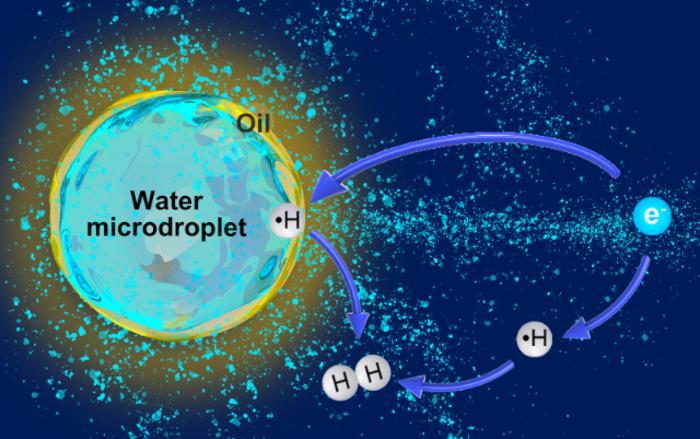
Researchers realize hydrogen formation by contact electrification of water microdroplets and its regulation

Credit: JACS

Direct utilization of water as a source of hydrogen atoms and molecules is fundamental to the evolution of the ecosystem and industry. However, liquid water is an unfavorable electron donor for forming these hydrogen species due to its redox inertness.

Recently, a research group led by Prof. WANG Feng and Assoc. Prof. JIA Xiuquan from the Dalian Institute of Chemical Physics (DICP) of the Chinese Academy of Sciences (CAS), in collaboration with Prof. Richard N. Zare’s group from Stanford University, has realized hydrogen formation by contact electrification at oil-water microdroplet interfaces and its regulation. This study was published in Journal of the American Chemical Society.

Water microdroplets have been shown to possess a high electric field at the interface of microdroplets, which is sufficient to ionize OH- to produce free electrons spontaneously. Subsequent charge transfer can lead to a variety of essential hydrogenation reactions.

In this study, the researchers found marked charge separation between oil-water microdroplets of different sizes through atomization. Compared with pure water microdroplets, the charge separation of oily aqueous microdroplets was improved due to the oil-mediated extraction of electrons from sprayed microdroplets, thus promoting the generation of hydrogen species. The hydrogen formation was proposed to proceed by contact electrification and charge neutralization at oil-water microdroplet interfaces.

This mechanism was verified by adding surfactants to disrupt the water-oil interfaces, which suppressed both charge separation and hydrogen evolution activity.

Besides, the researchers found that the reductive hydrogen species could further lead to an in-situ CO2 hydrogenation process run at normal temperature for selective CO formation using water as the hydrogen source.

Large amounts of water resources are subject to pollution caused by oil spills, oily wastewater discharge, etc. Traditional wastewater treatment technology always results in significant carbon emissions. This study indicated that it is possible to realize the upcycling of oil-containing wastewater by spraying an oil-water emulsion to generate H2 from water, which could transform the oily wastewater treatment process into a viable carbon sequestration pathway.


Journal

Journal of the American Chemical Society

DOI

10.1021/jacs.4c01455

Method of Research

Commentary/editorial

Subject of Research

Not applicable

Article Title

Sprayed Oil–Water Microdroplets as a Hydrogen Source

Article Publication Date

4-Apr-2024
Share12Tweet8Share2ShareShareShare2

Related Posts

Ultrathin Free-Standing Two-Dimensional Peptide Crystals — Chemistry

Ultrathin Free-Standing Two-Dimensional Peptide Crystals

June 2, 2026
Long-Term Use of Biochar Reduces Methane Emissions in Rice Fields — Chemistry

Long-Term Use of Biochar Reduces Methane Emissions in Rice Fields

June 2, 2026

New Study Reveals Saltier Soils Enhance Biochar Longevity

June 2, 2026

Two Decades of Data Reveal Climate Change Transforming Biscayne Bay, Study Finds

June 1, 2026

POPULAR NEWS

  • ESMO 2025: mRNA COVID Vaccines Enhance Efficacy of Cancer Immunotherapy

    320 shares
    Share 128 Tweet 80
  • Multi-Hospital Study Reveals Long Covid Burden Is Twice as High as Current Estimates

    85 shares
    Share 34 Tweet 21
  • Saying Goodbye to PGY-6: Pediatric Fellowship Realities

    63 shares
    Share 25 Tweet 16
  • Common Food Preservatives Associated with Elevated Blood Pressure and Increased Heart Disease Risk

    57 shares
    Share 23 Tweet 14

About

We bring you the latest biotechnology news from best research centers and universities around the world. Check our website.

Follow us

Recent News

Psychological, Functional Factors Shape Elderly Care Quality

Hybrid Deep Learning Enhances Pressure Analysis in Reservoirs

Ultrathin Free-Standing Two-Dimensional Peptide Crystals

Subscribe to Blog via Email

Enter your email address to subscribe to this blog and receive notifications of new posts by email.

Join 82 other subscribers
  • Contact Us

Bioengineer.org © Copyright 2023 All Rights Reserved.

Welcome Back!

Login to your account below

Forgotten Password?

Retrieve your password

Please enter your username or email address to reset your password.

Log In
No Result
View All Result
  • Homepages
    • Home Page 1
    • Home Page 2
  • News
  • National
  • Business
  • Health
  • Lifestyle
  • Science

Bioengineer.org © Copyright 2023 All Rights Reserved.