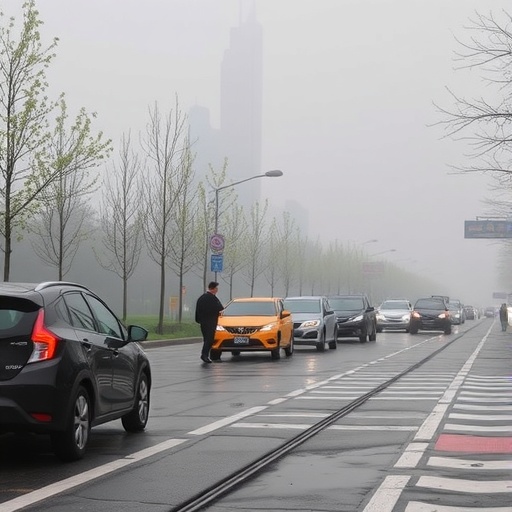
As electric vehicles spread across China and tailpipe pollution begins to decline, a different traffic-related threat is accelerating beneath the wheels. Tires are continuously shedding particles and chemical additives onto roads, and a new national-scale study has traced one of the most concerning compounds through China’s environment. The research examines emissions of 6PPD, a tire additive that protects rubber from ozone damage but can transform into the highly toxic compound 6PPD-quinone. By combining road-traffic data with a multimedia environmental fate model, the researchers mapped how tire-derived 6PPD is released, transported, stored, and redistributed across soil, water, air, and sediment. Their projections suggest that the problem could continue expanding through 2060, even as China transitions toward cleaner vehicles.
6PPD, formally known as N-(1,3-dimethylbutyl)-N′-phenyl-p-phenylenediamine, is used extensively in modern tires because it slows oxidation and helps prevent cracking caused by atmospheric ozone. The chemical is not designed to remain permanently locked inside rubber. As tires flex, heat up, and grind against road surfaces, they gradually lose tiny fragments known as tire-wear particles. These particles can contain 6PPD and other additives, which are released when exposed to sunlight, oxygen, moisture, and mechanical abrasion. One of the resulting transformation products, 6PPD-quinone, has attracted intense scientific attention because laboratory studies have shown that it can be acutely toxic to some fish and other aquatic organisms at very low concentrations.
The new assessment is described as the first to evaluate tire-derived 6PPD pollution across China at a national source-to-receptor scale. The researchers estimated emissions in 333 prefecture-level cities between 2000 and 2020 and linked those releases to 58 secondary river basins. Rather than treating roads as isolated pollution sources, the model followed the chemical through multiple environmental compartments. This approach is important because the initial location where 6PPD is released may be far from the place where aquatic organisms or people ultimately encounter it. Rainfall can wash tire particles from pavement into drainage systems, while chemicals deposited on roadside soils can remain stored for extended periods before being mobilized by storms, erosion, or changes in land use.
According to the study, China’s annual 6PPD emissions increased from approximately 0.0064 million metric tons in 2000 to about 0.045 million metric tons in 2020, representing roughly a sevenfold rise. The increase reflects the country’s rapid growth in vehicle ownership, road mileage, and cumulative travel over the two decades. Although the study focuses on 6PPD rather than every chemical present in tire wear, the trend illustrates the scale of non-exhaust emissions, which arise from tires, brakes, and road-surface abrasion rather than vehicle exhaust pipes. These sources can remain significant when vehicles are electrified, because electric cars still use tires and may generate substantial tire wear due to their greater mass and rapid acceleration.
One of the study’s most unexpected findings was the dominant contribution of rural roads. The researchers estimated that rural roads accounted for 56.5 percent of total tire-derived 6PPD emissions, exceeding the shares associated with urban roads and expressways. This result does not necessarily mean that an individual rural vehicle emits more chemical than an urban vehicle. Instead, it reflects the enormous extent of lower-grade road networks and the accumulated distance traveled across them. Rural roads may also receive less frequent sweeping, runoff treatment, or chemical monitoring, allowing tire-derived particles to build up in roadside soils and drainage channels. The finding challenges the assumption that traffic-related chemical pollution is primarily a high-density city problem.
The model showed that most of the released chemical did not enter rivers immediately. In 2020, an estimated 57.0 percent of 6PPD entered soil, while 32.2 percent was associated with sewer systems, 6.86 percent entered the atmosphere, and 3.95 percent reached surface water directly. These percentages describe modeled environmental pathways rather than a simple measure of final ecological exposure. Soil and sewer systems can act as temporary reservoirs, but they are not necessarily permanent sinks. During intense rainfall, accumulated tire particles can be flushed from roads and soils into stormwater networks, streams, and rivers. In sewer systems, discharge from urban drainage infrastructure can create additional pulses of contamination, particularly when treatment systems are not designed to remove tire-derived chemicals.
The geographic pattern of emissions followed China’s most heavily developed and densely trafficked regions. Major hotspots were identified in the Beijing-Tianjin-Hebei region, the Yangtze River Delta, and the Shandong Peninsula. River basins receiving runoff from populous eastern areas generally showed higher modeled 6PPD concentrations, reflecting the combined influence of traffic intensity, urbanization, industrial development, and hydrological connectivity. The researchers’ multimedia framework is designed to account for how a chemical partitions between environmental media. Depending on its physical and chemical properties, 6PPD may attach to particles, remain in soil, move with water, or undergo transformation. This makes the pollution difficult to manage with a single intervention because the chemical does not stay confined to the road where it was first emitted.
The danger becomes especially pronounced when 6PPD is converted into 6PPD-quinone. The transformation can occur on tire particles exposed to environmental conditions, and rainfall may transport the resulting compound into aquatic habitats. Research conducted in other settings has linked 6PPD-quinone exposure to severe toxicity in sensitive fish species, including rapid mortality at concentrations that can occur in stormwater runoff. The Chinese national assessment does not imply that every river basin is experiencing the same level of biological harm, and modeled concentrations are not a substitute for direct monitoring. However, it identifies where emissions and transport pathways are most likely to create exposure risks and where field sampling could provide the greatest public-health and ecological value.
Looking toward the future, the researchers project that 6PPD emissions could reach approximately 0.15 million metric tons per year by 2060 under the SSP2 baseline scenario. SSP2 represents a middle-of-the-road development pathway in which social, economic, and technological trends continue without an extreme shift toward either sustainability or resource-intensive growth. The projection highlights a central limitation of relying on vehicle electrification alone. Electric vehicles can eliminate or reduce exhaust pollutants such as carbon monoxide and nitrogen oxides, but they cannot eliminate contact between tires and roads. In some cases, heavier battery-powered vehicles may even intensify tire abrasion, although the actual effect depends on vehicle design, tire composition, driving behavior, road quality, and maintenance.
The study points toward a broader definition of clean transportation, one that includes the chemicals released after a vehicle leaves the factory and throughout its daily use. Possible responses include developing safer tire formulations, improving stormwater capture and treatment, controlling runoff from roads and parking areas, monitoring vulnerable river basins, and reducing the accumulation of tire particles in soil and drainage infrastructure. The researchers argue that source reduction will be particularly important because downstream treatment becomes more difficult once 6PPD and its transformation products are dispersed across multiple environmental compartments. As electric vehicles become more common, the most visible form of transportation pollution may fade, but the tire marks left behind by every journey could become an increasingly important environmental signal.
Subject of Research: Tire-derived 6PPD emissions, environmental fate, transport, and future pollution projections in China
Article Title: National-scale emissions, multimedia fate, and future projections of tire-derived 6PPD in China
News Publication Date: 13-Aug-2026
Web References: https://doi.org/10.66178/aie-0026-0016; Artificial Intelligence & Environment
References: Teng W, Yu X, Cai Y, et al. “National-scale emissions, multimedia fate, and future projections of tire-derived 6PPD in China.” AI Environ. 2026, 1(3): xx–xx. DOI: 10.66178/aie-0026-0016
Image Credits: Wentao Teng, Xiaoyi Yu, Yaya Cai, Qian-Qian Zhang, Jian-Liang Zhao, Guang-Guo Ying
Keywords
6PPD, 6PPD-quinone, tire wear particles, tire pollution, electric vehicles, non-exhaust emissions, stormwater runoff, environmental fate, river basins, China, aquatic toxicity, environmental chemistry
Tags: 6PPD tire additive environmental impactair and water contamination from tire wearchemical additives in tiresenvironmental fate of tire chemicalsimpact of electric vehicle adoption on pollution sourceslong-term chemical pollution projections in Chinaregulatory challenges of tire chemical emissionssoil and sediment contamination from tire chemicalsTire-derived chemical pollutiontoxic effects of 6PPD-quinonetransformation of 6PPD into toxic compoundsvehicle tire wear particles pollution