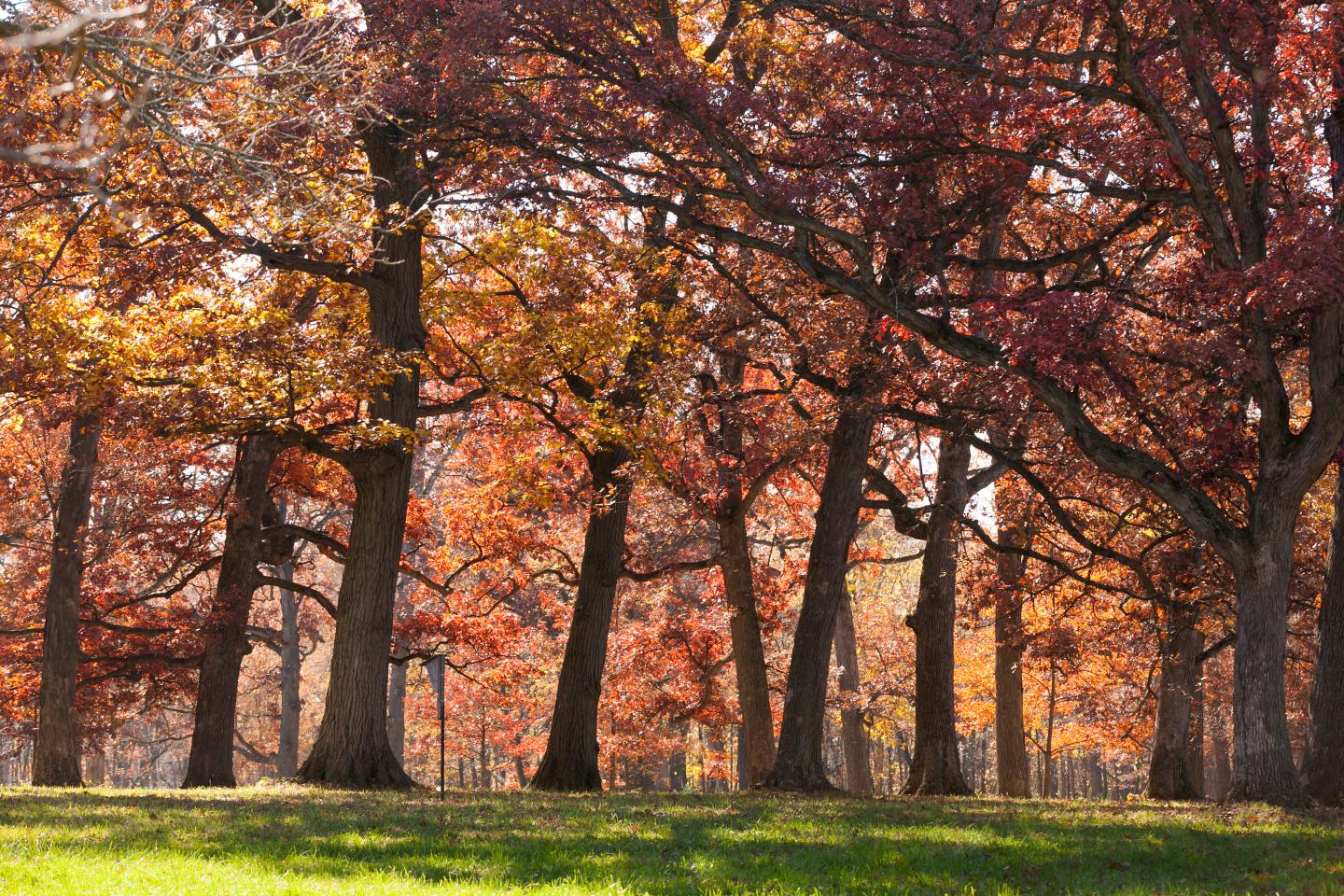
Credit: The Morton Arboretum
How oaks are related has long posed a challenge to scientists. Dr. Andrew Hipp, senior scientist at The Morton Arboretum, led an international team of 24 scientists to unravel the history of global oak diversity for the first time using DNA sequencing of 260 oak species, combined with genomic mapping and fossil data.
Fundamental questions about relationships between organisms and the genes that drive ecological diversification underlie the secrets of biodiversity. Understanding the past of this ecologically, economically and culturally important group provides a baseline of knowledge that will allow scientists to address additional questions about oaks and other trees, as well as help with conservation efforts.
“This paper demonstrates that oaks have repeatedly and globally diversified in response to ecological opportunity” says Hipp. “The changes in the global landscape have given us the gift of the oak diversity we observe today.”
Patchwork of Histories
The new paper, to be published in New Phytologist, is available free through an Early View online for one month beginning October 14. The study provides the most detailed account to date of the evolutionary history of the world’s oaks. Investigating which parts of the oak genome distinguish species from one another, researchers at The Morton Arboretum, in collaboration with 17 institutions around the world, discovered that each gene or stretch of DNA in the genome has the potential to record multiple histories; each section bears the history of speciation of one oak lineage, but it may record the history of hybridization for a different lineage. In other words, there is no one region of the genome that defines oaks: it is the patchwork of histories embedded in the genome that characterize the history of oak evolution.
In addition, this research shows that different oak lineages have repeatedly diversified in the same area. Red oaks, white oaks, ring-cupped oaks, turkey and cork oaks, and three of the other oak sections arose rapidly and segregated to either the Americas or Eurasia. All of these lineages can be found in part of their range with at least one other lineage. As oaks migrated, species interbred, hybridized and diversified opportunistically in response to changes in the landscape. The highest rates of species diversification have been in response to migrations into new territory. Over and over, oaks have taken advantage of ecological opportunity to produce the diversity we see today, providing humans with ships, homes, wine barrels, furniture and acorns to eat, and providing food and homes for countless insects, mammals, birds and fungi.
“For the first time, this paper demonstrates that the history of different [oak] lineages is driven by different sets of genes,” said co-author Dr. Antoine Kremer from the French National Institute for Agricultural Research. “The story of oak evolution is especially fascinating due to the ecological and morphological convergence in different oak lineages that cohabit on the same continent.”
The importance of oaks
Oaks support the planet’s ecosystem like very few other tree species do. As both stately trees and dry-land shrubs, oaks are fundamental to the health of forests, providing critical food, habitat and shelter for animals, birds and insects, and have the highest amount of biomass compared to any other tree species in the forest, working harder to clean the air than many other tree species. Today, oaks need the help of people. Around the world, oaks are under threat, due to pests, diseases and loss of habitat. If oaks are lost, it will upset the delicate balance of forest ecosystems and leave humans without their benefits. Researchers and conservationists at The Morton Arboretum are committed to ensuring oaks thrive. Learn more about what The Morton Arboretum is doing to conserve oaks globally.
###
About The Morton Arboretum
The Morton Arboretum is an internationally recognized outdoor tree museum and tree research center located in Lisle, Illinois. As the champion of trees, the Arboretum is committed to scientifically-informed action, both locally and globally, and encouraging the planting and conservation of trees for a greener, healthier, and more beautiful world. On 1,700 acres are 222,000 plant specimens representing 4,500 different kinds of plants, along with specialty gardens, educational exhibits, the award-winning Children’s Garden, 16 miles of hiking trails and the Visitor Center, featuring The Arboretum Store and the Ginkgo Restaurant and Café. The Morton Arboretum is a not-for-profit 501(c)(3) charitable organization, welcoming 1.3 million visitors annually and serving 53,000 member households in 2018. Learn more at mortonarb.org.
Media Contact
Tari Marshall
[email protected]
708-557-6824
Related Journal Article
http://dx.