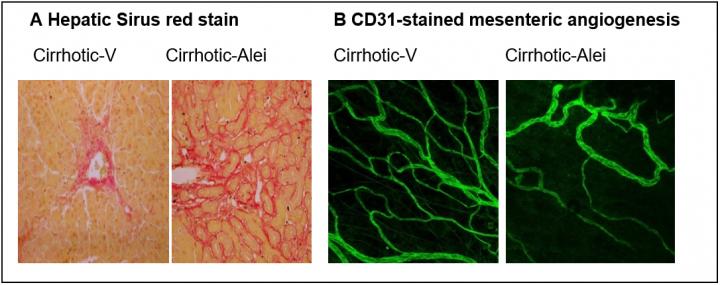
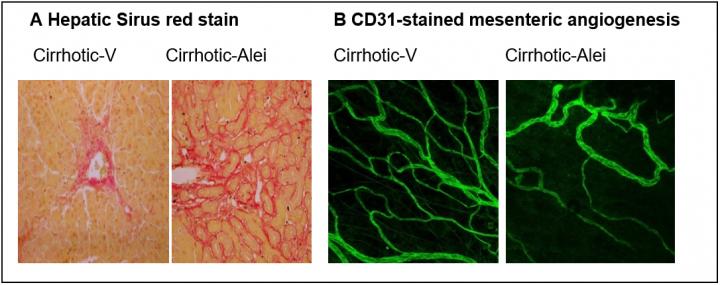
Credit: Ying-Ying Yang, National Yang-Ming University School of Medicine, Taiwan.
Philadelphia, June 18, 2018 – Increased pressure in the veins leading to the liver, known as portal hypertension (PH), accounts for the majority of medical complications and deaths associated with cirrhosis. Therefore, a tremendous need exists to find drugs that simultaneously treat the multiple pathologies associated with chronic PH. In a study in The American Journal of Pathology, investigators report that treatment with aleglitazar, a dual peroxisome proliferator-activated receptor-alpha/gamma (PPARα/γ) agonist, reduced inflammation, vasoconstriction, angiogenesis, mucosal disruption, and tumor necrosis factor (TNF)-α overproduction in cirrhotic rats with PH. This suggests a promising new approach for treating liver cirrhosis.
"Increased portal inflow resistance and splanchnic (related to internal organs) hyperdynamic circulation are the primary factors in the pathophysiology of PH," explained Ying-Ying Yang, MD, PhD, MPH, of the Division of Gastroenterology and Hepatology, Department of Medicine of the National Yang-Ming University School of Medicine, Taiwan. "Nonselective beta-blockers, which lack splanchnic and intestinal effects, have been the mainstay of drug therapy for PH but are limited by their potential for adverse effects. We have found that a newly developed PPARα/γ agonist, aleglitazar, is able to suppress the inflammation, angiogenesis, tissue damage, and fibrosis associated with cirrhosis in the splanchnic, intestinal, as well as the hepatic circulations of cirrhotic rats with PH syndrome."
Cirrhosis of the liver is a serious condition in which the liver is permanently scarred, often as a result of liver disease, hepatitis C virus, or alcohol or drug use. Liver cirrhosis was the 12th leading cause of death in the United States in 2013, and between 2000 and 2015, death rates for chronic liver disease and cirrhosis in the US increased by 31 percent. Cirrhosis is the most common cause of PH and can result in fluid accumulation (ascites), increased spleen size, and swollen veins around the esophagus and intestines.
Researchers found that treatment with aleglitazar for 21 days produced a number of beneficial changes in cirrhotic rats. In the liver, aleglitazar suppressed hepatic fibrogenesis, neoangiogenesis, and vasoconstrictor responsiveness. In the splanchnic system, aleglitazar reduced neoangiogenesis, vasodilatation, and portosystemic shunts. It also decreased intestinal mucosal injury and hyper-permeability.
The dual composition of aleglitazar appears to expand its effectiveness. PPARγ is activated in the liver, PPARα is activated in the intestine, and both PPARα and PPARγ mediate effects in the splanchnic system.
"We know that PH in patients with cirrhosis is primarily initiated through increased levels of circulating soluble TNF receptors and TNF-α. Overall, the therapeutic effects of aleglitazar can be attributed to its anti-inflammatory and anti-TNF-α actions," explained Dr. Yang. "Our findings as a whole imply that treatment with a dual PPARα/β agonist may be a promising approach to simultaneously control the multifaceted abnormalities of PH syndromes in cirrhosis with a low side effects profile."
###
Media Contact
Eileen Leahy
[email protected]
732-238-3628
@elseviernews
http://www.elsevier.com
Related Journal Article
http://dx.doi.org/10.1016/j.ajpath.2018.03.018