Credit: Kiehn Lab, University of Copenhagen.
In experiments with mice, researchers have studied neuronal mechanisms and found a way to by and large prevent spasticity from developing after spinal cord injuries. A new study from the University of Copenhagen shows that the researchers have done this by using already approved medicine for high blood pressure.
Spinal cord injury can be highly debilitating and affect motor skills, the sensation as well as autonomic brain functions. Besides, the injury will often lead to the development of spasticity which manifests itself in involuntary, sustained or rhythmic muscle contractions. It is estimated that 70 percent of those who have a spinal cord injury will develop spasticity.
Now, researchers from the University of Copenhagen have discovered a possible treatment – tested on mice – against the development of spasticity following a spinal cord injury. After the treatment, the mice showed no or only modest signs of spasticity.
The researchers treated the mice with the drug nimodipine, which is an already approved drug that has been used since the 1980s.
‘We show that nimodipine by and large can prevent the development of spasticity after a spinal cord injury if administered soon after the injury and for an extended period of time. One of the most surprising and interesting elements in the study is that the effect continues, even after treatment has stopped’, says co-author Ole Kiehn, Professor at the Department of Neuroscience.
The new results have been published in the scientific journal Science Translational Medicine.
The Effect is Long-Lasting
Nimodipine is a drug that is used, among other things, against high blood pressure. The researchers’ experiments showed that treatment with nimodipine must be started immediately after the spinal cord injury has occurred, otherwise it will not work.
In addition, the treatment must continue for an extended period of time. In the experiment, the mice were treated with the drug for six weeks and then observed for nine weeks, where they developed no or only mild signs of spasticity.
The most surprising thing to the researchers was that the effect was long-lasting.
‘We had guessed that the spasticity would be blocked for as long as the pharmacological treatment was ongoing. But we were positively surprised to see that the development of spasticity remained blocked even after we stopped the pharmacological treatment’, says co-author Carmelo Bellardita, Postdoc at the Department of Neuroscience.
Blocked Calcium Channel
Nimodipine works by blocking calcium channels – which belong to the group of so-called L-type calcium channels – found in many nerve cells in the spinal cord.
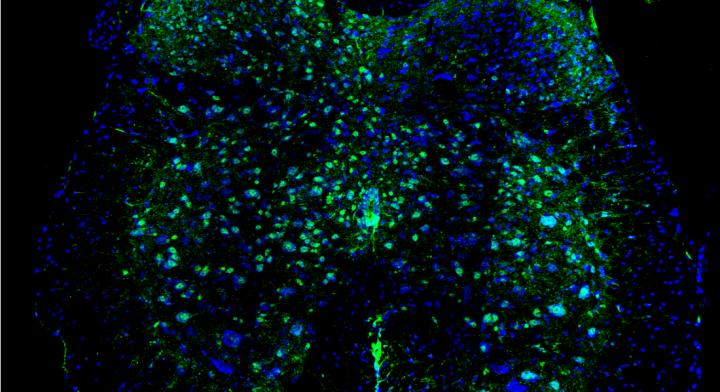
In the study, the researchers show that the effect of nimodipine is due to the blocking of one specific L-type calcium channel, the so-called CaV1.3 channel. By genetically removing that type of calcium channels in the spinal cord of mice, they achieved the same result: the development of spasticity was blocked.
According to the researchers, the results could potentially also be relevant to other diseases where spasticity may develop. For example, in connection with multiple sclerosis and stroke.
It is still uncertain whether nimodipine will have the same effect on human spasticity as all experiments have been done on mice. The researchers will now study this question.
‘We are quite optimistic that nimodipine will have the same effect in humans. But we cannot be certain. Nimodipine is an approved drug that easily enters the brain, and we will now begin trials together with other researchers where we test nimodipine on healthy test subjects to study the effect on various reflexes and motor skills. Subsequently, it may potentially be possible to test the drug on people with spasticity’, says Ole Kiehn.
###
Media Contact
Cecilie Krabbe
[email protected]
Original Source
https:/
Related Journal Article
http://dx.