• HOME
  • NEWS
  • EXPLORE
    • CAREER
      • Companies
      • Jobs
    • EVENTS
    • iGEM
      • News
      • Team
    • PHOTOS
    • VIDEO
    • WIKI
  • BLOG
  • COMMUNITY
    • FACEBOOK
    • INSTAGRAM
    • TWITTER
Thursday, June 25, 2026
BIOENGINEER.ORG
No Result
View All Result
  • Login
  • HOME
  • NEWS
  • EXPLORE
    • CAREER
      • Companies
      • Jobs
        • Lecturer
        • PhD Studentship
        • Postdoc
        • Research Assistant
    • EVENTS
    • iGEM
      • News
      • Team
    • PHOTOS
    • VIDEO
    • WIKI
  • BLOG
  • COMMUNITY
    • FACEBOOK
    • INSTAGRAM
    • TWITTER
  • HOME
  • NEWS
  • EXPLORE
    • CAREER
      • Companies
      • Jobs
        • Lecturer
        • PhD Studentship
        • Postdoc
        • Research Assistant
    • EVENTS
    • iGEM
      • News
      • Team
    • PHOTOS
    • VIDEO
    • WIKI
  • BLOG
  • COMMUNITY
    • FACEBOOK
    • INSTAGRAM
    • TWITTER
No Result
View All Result
Bioengineer.org
No Result
View All Result
Home NEWS Science News Chemistry

Researchers discover semiconducting nanotubes that form spontaneously

Bioengineer by Bioengineer
July 8, 2019
in Chemistry
Reading Time: 2 mins read
0
IMAGE
Share on FacebookShare on TwitterShare on LinkedinShare on RedditShare on Telegram

IMAGE

Credit: EPFL

If scientists could find a way to control the process for making semiconductor components on a nanometric scale, they could give those components unique electronic and optical properties – opening the door to a host of useful applications.

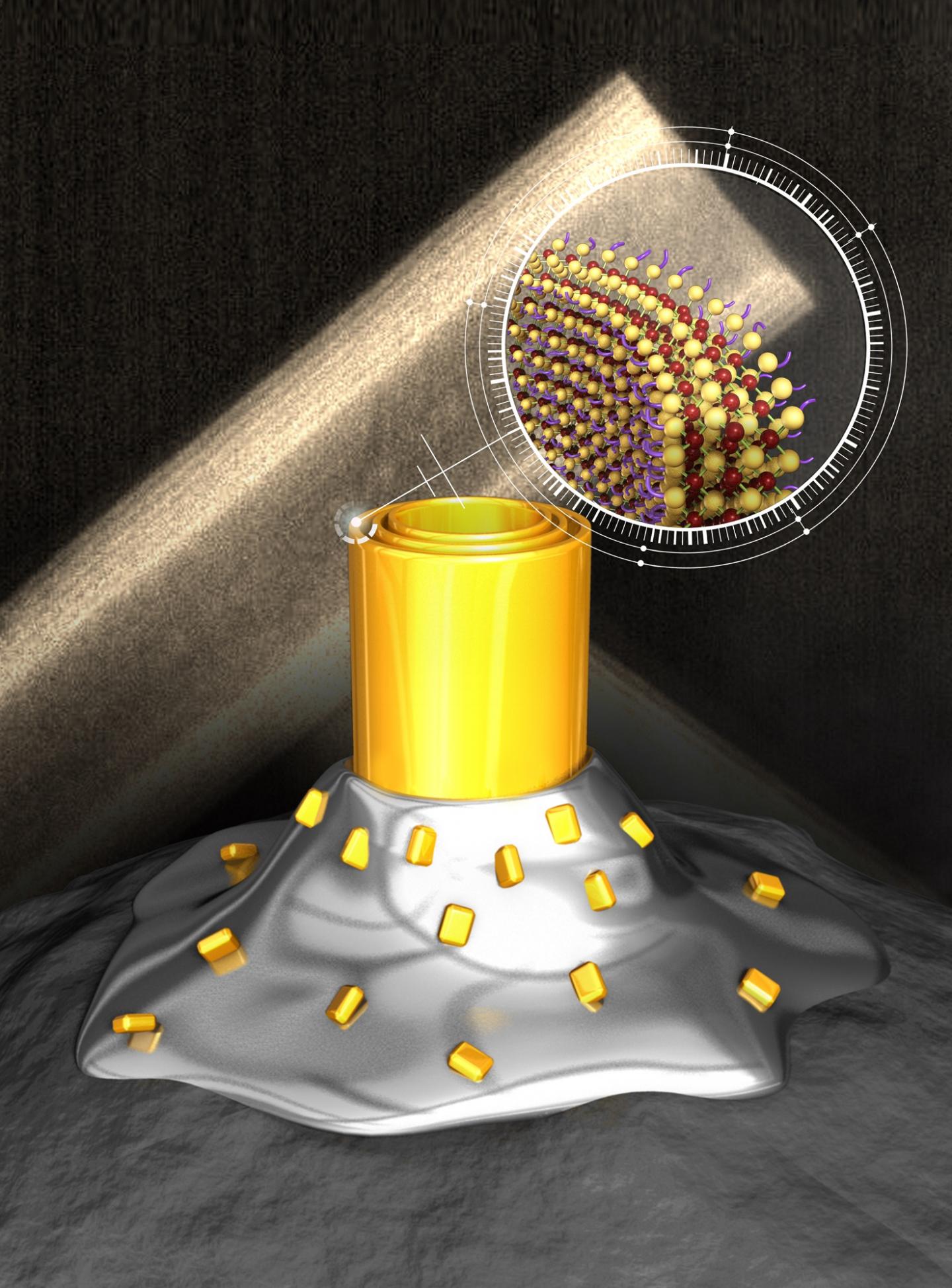
Researchers at the Laboratory of Microsystems, in EPFL’s School of Engineering, have taken an important step towards that goal with their discovery of semiconducting nanotubes that assemble automatically in solutions of metallic nanocrystals and certain ligands. The tubes have between three and six walls that are perfectly uniform and just a few atoms thick – making them the first such nanostructures of their kind.

What’s more, the nanotubes possess photoluminescent properties: they can absorb light of a specific wavelength and then send out intense light waves of a different color, much like quantum dots and quantum wells. That means they can be used as fluorescent markers in medical research, for example, or as catalysts in photoreduction reactions, as evidenced by the removal of the colors of some organic dyes, based on the results of initial experiments. The researchers’ findings have made the cover of ACS Central Science.

An accidental discovery

But the unique feature of these semiconducting nanotubes is how they are formed. “Our discovery happened almost by chance. We had set out to study the role that certain ligands play in making 2D semiconducting nanometric crystals,” says Xiaopeng Huang, the study’s lead author. But the research team found that some ligands caused molecules to spontaneously come together in precise cylindrical structures which until then had been impossible to create.

Investigating new properties

The researchers will now investigate the other physical and electrical properties of their nanotubes and look into methods for making nanotubes with just a single wall.

###

References

Xiaopeng Huang, Virendra K. Parashar and Martin A.M. Gijs, “Spontaneous Formation of CdSe Photoluminescent Nanotubes with Visible-light Photocatalytic Performance,” ACS Central Science. DOI: 10.1021/acscentsci.9b00184

Media Contact
Martin Gijs
[email protected]

Original Source

https://actu.epfl.ch/news/researchers-discover-semiconducting-nanotubes-that/

Related Journal Article

http://dx.doi.org/10.1021/acscentsci.9b00184

Tags: Atomic/Molecular/Particle PhysicsElectrical Engineering/ElectronicsElectromagneticsMaterialsNanotechnology/MicromachinesSuperconductors/SemiconductorsTechnology/Engineering/Computer Science
Share12Tweet8Share2ShareShareShare2

Related Posts

AI and Physics Collaborate to Design Advanced Hydrogen Storage Materials

June 25, 2026

International Team Including Dresden Scientists Develops Novel Designer Proteins for Advanced Study of Living Tissue

June 25, 2026

New Study Uncovers Key Factors Driving Water Chemistry in Nanoscale Environments

June 25, 2026

Plasma Technology Extends Catalyst Lifespan in Hydrogen Production

June 24, 2026
Please login to join discussion

POPULAR NEWS

  • Saying Goodbye to PGY-6: Pediatric Fellowship Realities

    103 shares
    Share 41 Tweet 26
  • Multi-Hospital Study Reveals Long Covid Burden Is Twice as High as Current Estimates

    92 shares
    Share 36 Tweet 23
  • Detection of EDCs in Breast Milk and Infant Urine Up to Six Months Highlights Early Exposure Risks

    77 shares
    Share 31 Tweet 19
  • New Drug Candidate Developed at McMaster Shows Potential for Treating Brain Cancer

    58 shares
    Share 23 Tweet 15

About

We bring you the latest biotechnology news from best research centers and universities around the world. Check our website.

Follow us

Recent News

Tracking Lanthanide-Labeled Microplastics in Plants

POSTECH Researchers Slash Cost of Reconstituted Cell-Free Systems by 95%

AI and Physics Collaborate to Design Advanced Hydrogen Storage Materials

Subscribe to Blog via Email

Success! An email was just sent to confirm your subscription. Please find the email now and click 'Confirm' to start subscribing.

Join 82 other subscribers
  • Contact Us

Bioengineer.org © Copyright 2023 All Rights Reserved.

Welcome Back!

Login to your account below

Forgotten Password?

Retrieve your password

Please enter your username or email address to reset your password.

Log In
No Result
View All Result
  • Homepages
    • Home Page 1
    • Home Page 2
  • News
  • National
  • Business
  • Health
  • Lifestyle
  • Science

Bioengineer.org © Copyright 2023 All Rights Reserved.