• HOME
  • NEWS
  • EXPLORE
    • CAREER
      • Companies
      • Jobs
    • EVENTS
    • iGEM
      • News
      • Team
    • PHOTOS
    • VIDEO
    • WIKI
  • BLOG
  • COMMUNITY
    • FACEBOOK
    • INSTAGRAM
    • TWITTER
Sunday, May 10, 2026
BIOENGINEER.ORG
No Result
View All Result
  • Login
  • HOME
  • NEWS
  • EXPLORE
    • CAREER
      • Companies
      • Jobs
        • Lecturer
        • PhD Studentship
        • Postdoc
        • Research Assistant
    • EVENTS
    • iGEM
      • News
      • Team
    • PHOTOS
    • VIDEO
    • WIKI
  • BLOG
  • COMMUNITY
    • FACEBOOK
    • INSTAGRAM
    • TWITTER
  • HOME
  • NEWS
  • EXPLORE
    • CAREER
      • Companies
      • Jobs
        • Lecturer
        • PhD Studentship
        • Postdoc
        • Research Assistant
    • EVENTS
    • iGEM
      • News
      • Team
    • PHOTOS
    • VIDEO
    • WIKI
  • BLOG
  • COMMUNITY
    • FACEBOOK
    • INSTAGRAM
    • TWITTER
No Result
View All Result
Bioengineer.org
No Result
View All Result
Home NEWS Science News Chemistry

Researchers develop magnetic thin film for spin-thermoelectric energy conversion

Bioengineer by Bioengineer
May 11, 2021
in Chemistry
Reading Time: 2 mins read
0
IMAGE
Share on FacebookShare on TwitterShare on LinkedinShare on RedditShare on Telegram

IMAGE

Credit: UNIST

A team of researchers, affiliated with UNIST has recently introduced a new class of magnetic materials for spin caloritronics. Published in the February 2021 issue of Nature Communications, the demonstrated STE applications of a new class of magnets will pave the way for versatile recycling of ubiquitous waste heat. This breakthrough has been led by Professor Jung-Woo Yoo and his research team in the Department of Materials Science and Engineering at UNIST.

Spin thermoelectrics is an emerging thermoelectric technology that offers energy harvesting from waste heat. This has attracted substantial research interest with the potential advantages of scalability and energy conversion efficiency, thanks to orthogonal paths for heat and charge flow. However, magnetic insulators previously used for spin thermoelectrics pose challenges for scale-up due to high-temperature processing and difficulty in large-area deposition, noted the research team.

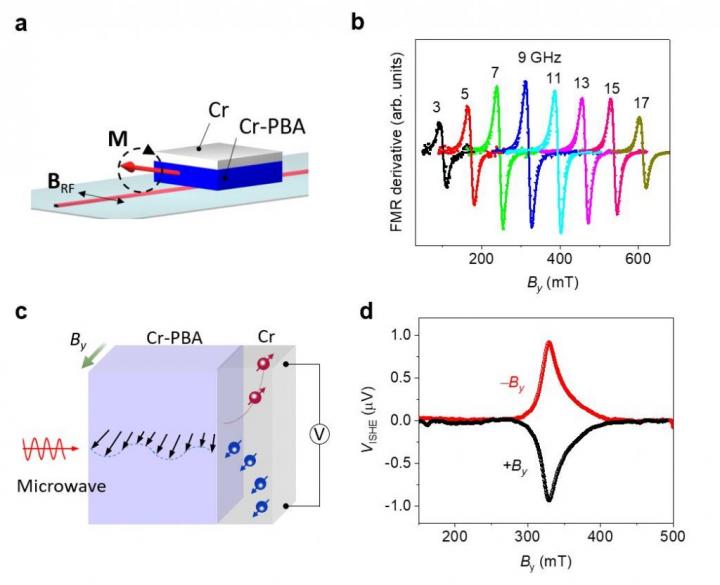
In this study, the research team introduced a molecule-based magnet, Cr-PBA, as an alternative magnetic insulator for the magnon-mediated thermal-to-electrical energy conversion. According to the research team, the studied molecular magnetic film has several advantageous characteristics over inorganic magnetic insulators in terms of spin TE (STE) applications. Indeed, it entails versatile synthetic routes amenable for large area deposition at room temperature, in addition to weak spin-lattice interaction and low thermal conductivity.

“The growth of Cr-PBA was done at room temperature by employing the electrochemical deposition (ECD) method, which could offer scalable production of thin films,” noted the research team. “This deposition technique can be easily adapted for the large area and mass production of thin-film, which can boast an important merit of STE, that is, large-area scalability.”

According to the research team, various other methodologies, such as painting and printing, can be also utilized for developing the PBA film. They also noted that the generation and transfer of magnons are essential processes for STE energy harvesting, as well as magnon information technology. Experimental results also indicated that the excitations of low-energy magnons in this class of magnet were much stronger than those in the typical inorganic magnets. Besides, the ferromagnetic resonance studies exhibited an extremely low Gilbert damping constant, which indicates a low loss of heat-generated magnons. Furthermore, the determined low thermal conductivity in the studied molecule-based magnetic film is an accessory benefit for STE energy harvesting because it assists in maintaining a higher temperature gradient across the film, noted the research team.

“Our study shows excitations and transfers of magnons in this hybrid magnet are very efficient, suggesting molecule-based magnets, along with their synthetic versatility, could be outstanding alternatives for various applications of spin caloritronics as well as magnon spintronics,” said the research team.

The findings of this research have been published in the February 2021 issue of Nature Communications. This study has been jointly participated by Professor Joonki Suh (Department of Materials Science and Engineering, UNIST), Professor Byoung-Chul Min (Korea Institute of Science and Technology, KIST), and two graduates from UNIST’s Department of Materials Science and Engineering – Dr. Jungmin Park (KBSI) and Professor Mi-Jin Jin (Dankook University).

###

Media Contact
JooHyeon Heo
[email protected]

Original Source

https://news.unist.ac.kr/researchers-develop-magnetic-thin-film-for-spin-thermoelectric-energy-conversion/

Tags: Chemistry/Physics/Materials SciencesElectrical Engineering/ElectronicsElectromagneticsMaterialsPolymer ChemistryResearch/DevelopmentSuperconductors/Semiconductors
Share12Tweet8Share2ShareShareShare2

Related Posts

Miniature Sensor Uses Light to Detect Touch — Chemistry

Miniature Sensor Uses Light to Detect Touch

May 8, 2026
Iron Minerals Determine Whether Dissolved Organic Matter Fuels Microbes or Becomes Long-Term Carbon Storage — Chemistry

Iron Minerals Determine Whether Dissolved Organic Matter Fuels Microbes or Becomes Long-Term Carbon Storage

May 8, 2026

Kate Evans Appointed Associate Lab Director for Biological and Environmental Systems Science at ORNL

May 8, 2026

Advancing Multiscale Modeling and Overcoming Operational Challenges in Autothermal COâ‚‚-to-Methanol Reactors

May 8, 2026
Please login to join discussion

POPULAR NEWS

  • Research Indicates Potential Connection Between Prenatal Medication Exposure and Elevated Autism Risk

    840 shares
    Share 336 Tweet 210
  • New Study Reveals Plants Can Detect the Sound of Rain

    727 shares
    Share 290 Tweet 181
  • Scientists Investigate Possible Connection Between COVID-19 and Increased Lung Cancer Risk

    68 shares
    Share 27 Tweet 17
  • Salmonella Haem Blocks Macrophages, Boosts Infection

    61 shares
    Share 24 Tweet 15

About

We bring you the latest biotechnology news from best research centers and universities around the world. Check our website.

Follow us

Recent News

Evaluating Digoxin Use in Patients with Symptomatic Rheumatic Heart Disease

Evaluating the Effectiveness and Safety of Digitalis Glycosides in Treating Heart Failure

Urdu Fall Risk Questionnaire Adapted for Elderly

Subscribe to Blog via Email

Enter your email address to subscribe to this blog and receive notifications of new posts by email.

Join 82 other subscribers
  • Contact Us

Bioengineer.org © Copyright 2023 All Rights Reserved.

Welcome Back!

Login to your account below

Forgotten Password?

Retrieve your password

Please enter your username or email address to reset your password.

Log In
No Result
View All Result
  • Homepages
    • Home Page 1
    • Home Page 2
  • News
  • National
  • Business
  • Health
  • Lifestyle
  • Science

Bioengineer.org © Copyright 2023 All Rights Reserved.