• HOME
  • NEWS
  • EXPLORE
    • CAREER
      • Companies
      • Jobs
    • EVENTS
    • iGEM
      • News
      • Team
    • PHOTOS
    • VIDEO
    • WIKI
  • BLOG
  • COMMUNITY
    • FACEBOOK
    • INSTAGRAM
    • TWITTER
Monday, May 11, 2026
BIOENGINEER.ORG
No Result
View All Result
  • Login
  • HOME
  • NEWS
  • EXPLORE
    • CAREER
      • Companies
      • Jobs
        • Lecturer
        • PhD Studentship
        • Postdoc
        • Research Assistant
    • EVENTS
    • iGEM
      • News
      • Team
    • PHOTOS
    • VIDEO
    • WIKI
  • BLOG
  • COMMUNITY
    • FACEBOOK
    • INSTAGRAM
    • TWITTER
  • HOME
  • NEWS
  • EXPLORE
    • CAREER
      • Companies
      • Jobs
        • Lecturer
        • PhD Studentship
        • Postdoc
        • Research Assistant
    • EVENTS
    • iGEM
      • News
      • Team
    • PHOTOS
    • VIDEO
    • WIKI
  • BLOG
  • COMMUNITY
    • FACEBOOK
    • INSTAGRAM
    • TWITTER
No Result
View All Result
Bioengineer.org
No Result
View All Result
Home NEWS Science News Health

Researchers create first portable tech for detecting cyanotoxins in water

Bioengineer by Bioengineer
June 25, 2019
in Health
Reading Time: 2 mins read
0
IMAGE
Share on FacebookShare on TwitterShare on LinkedinShare on RedditShare on Telegram

IMAGE

Credit: Qingshan Wei, NC State University

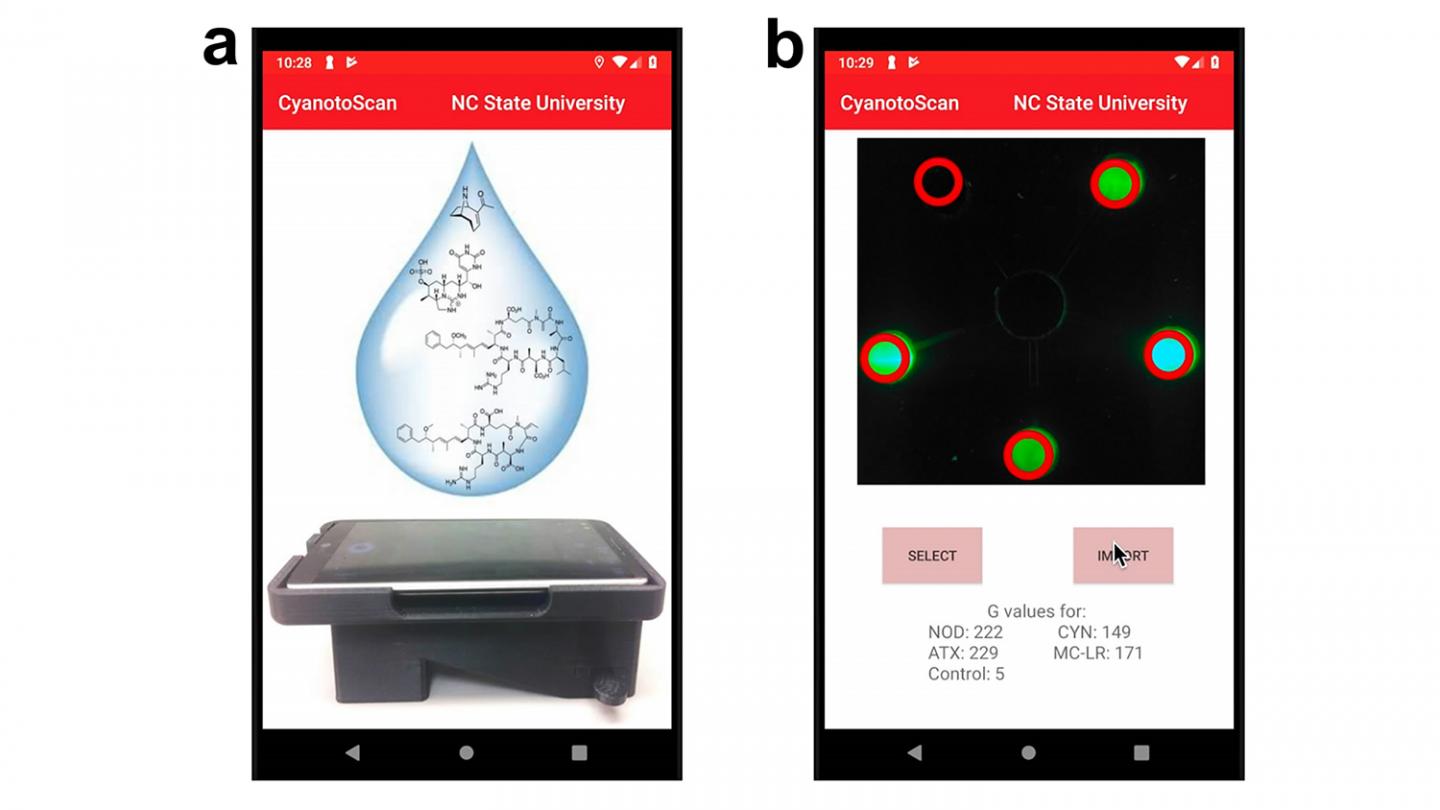
North Carolina State University researchers have developed the first portable technology that can test for cyanotoxins in water. The device can be used to detect four common types of cyanotoxins, including two for which the U.S. Environmental Protection Agency (EPA) recently finalized recreational water quality criteria.

Cyanotoxins are toxic substances produced by cyanobacteria. At high enough levels, cyanotoxins can cause health effects ranging from headache and vomiting to respiratory paralysis and death.

The new technology is capable of detecting four common types of cyanotoxins: anatoxin-a, cylindrospermopsin, nodularin and microcystin-LR. One reason the portable technology may be particularly useful is that EPA finalized water quality criteria this month for both microcystin-LR and cylindrospermopsin in recreational waters.

“Our technology is capable of detecting these toxins at the levels EPA laid out in its water quality criteria,” says Qingshan Wei, an assistant professor of chemical and biomolecular engineering at NC State and corresponding author of a paper on the work.

“However, it’s important to note that our technology is not yet capable of detecting these cyanotoxins at levels as low as the World Health Organization’s drinking water limit. So, while this is a useful environmental monitoring tool, and can be used to assess recreational water quality, it is not yet viable for assessing drinking water safety.”

To test for cyanotoxins, users place a drop of water on a customized chip developed in Wei’s lab, then insert it into a reader device, also developed in Wei’s lab, which connects to a smartphone. The technology is capable of detecting and measuring organic molecules associated with the four cyanotoxins, ultimately providing the user’s smartphone with the cyanotoxin levels found in the relevant water sample. The entire process takes five minutes.

“The reader cost us less than $70 to make, each chip cost less than a dollar, and we could make both even less expensive if we scaled up production,” says Zheng Li, a postdoctoral researcher at NC State and first author of the paper.

“Our current focus with this technology is to make it more sensitive, so that it can be used to monitor drinking water safety,” Wei says. “More broadly, we believe the technology could be modified to look for molecular markers associated with other contaminants.”

###

The paper, “Aptamer-Based Fluorescent Sensor Array for Multiplexed Detection of Cyanotoxins on a Smartphone,” is published in the journal Analytical Chemistry. The paper was co-authored by Shengwei Zhang, a Ph.D. student at NC State; Tao Yu, a postdoctoral researcher at NC State; and Zhiming Dai, an undergraduate at NC State.

Media Contact
Matt Shipman
[email protected]

Original Source

https://news.ncsu.edu/2019/06/portable-tech-to-detect-cyanotoxins/

Related Journal Article

http://dx.doi.org/10.1021/acs.analchem.9b00750

Tags: BacteriologyBiologyChemistry/Physics/Materials SciencesEcology/EnvironmentEnvironmental HealthMarine/Freshwater BiologyMedicine/HealthPollution/RemediationTechnology/Engineering/Computer Science
Share12Tweet8Share2ShareShareShare2

Related Posts

Medicaid Expansion Reduces Mortality in Young Adults with Kidney Failure

May 11, 2026

CRISPR Technology Shows Promise in Inhibiting Hepatitis E Virus

May 11, 2026

Mapping Ocular Bioenergetics: Insights into TCA Cycle Intermediates and Gender Differences in Eye Tissues

May 11, 2026

Telemedicine Does Not Drive Higher Medical Utilization or Health Care Costs, Study Finds

May 11, 2026
Please login to join discussion

POPULAR NEWS

  • Research Indicates Potential Connection Between Prenatal Medication Exposure and Elevated Autism Risk

    841 shares
    Share 336 Tweet 210
  • New Study Reveals Plants Can Detect the Sound of Rain

    728 shares
    Share 290 Tweet 182
  • Salmonella Haem Blocks Macrophages, Boosts Infection

    62 shares
    Share 25 Tweet 16
  • Breastmilk Balances E. coli and Beneficial Bacteria in Infant Gut Microbiomes

    57 shares
    Share 23 Tweet 14

About

We bring you the latest biotechnology news from best research centers and universities around the world. Check our website.

Follow us

Recent News

Humans and Zebra Finches Share Similar Speech Learning Techniques #ASA190

New Study Uncovers How Fungal Parasites Attack Strawberries and Raspberries

City of Hope Researchers to Present Groundbreaking Immunotherapy and Precision Medicine Advances Across Multiple Cancer Types at ASCO 2026

Subscribe to Blog via Email

Enter your email address to subscribe to this blog and receive notifications of new posts by email.

Join 82 other subscribers
  • Contact Us

Bioengineer.org © Copyright 2023 All Rights Reserved.

Welcome Back!

Login to your account below

Forgotten Password?

Retrieve your password

Please enter your username or email address to reset your password.

Log In
No Result
View All Result
  • Homepages
    • Home Page 1
    • Home Page 2
  • News
  • National
  • Business
  • Health
  • Lifestyle
  • Science

Bioengineer.org © Copyright 2023 All Rights Reserved.