• HOME
  • NEWS
  • EXPLORE
    • CAREER
      • Companies
      • Jobs
    • EVENTS
    • iGEM
      • News
      • Team
    • PHOTOS
    • VIDEO
    • WIKI
  • BLOG
  • COMMUNITY
    • FACEBOOK
    • INSTAGRAM
    • TWITTER
Sunday, May 10, 2026
BIOENGINEER.ORG
No Result
View All Result
  • Login
  • HOME
  • NEWS
  • EXPLORE
    • CAREER
      • Companies
      • Jobs
        • Lecturer
        • PhD Studentship
        • Postdoc
        • Research Assistant
    • EVENTS
    • iGEM
      • News
      • Team
    • PHOTOS
    • VIDEO
    • WIKI
  • BLOG
  • COMMUNITY
    • FACEBOOK
    • INSTAGRAM
    • TWITTER
  • HOME
  • NEWS
  • EXPLORE
    • CAREER
      • Companies
      • Jobs
        • Lecturer
        • PhD Studentship
        • Postdoc
        • Research Assistant
    • EVENTS
    • iGEM
      • News
      • Team
    • PHOTOS
    • VIDEO
    • WIKI
  • BLOG
  • COMMUNITY
    • FACEBOOK
    • INSTAGRAM
    • TWITTER
No Result
View All Result
Bioengineer.org
No Result
View All Result
Home NEWS Science News Chemistry

Researchers build a soft robot with neurologic capabilities

Bioengineer by Bioengineer
October 15, 2019
in Chemistry
Reading Time: 3 mins read
0
IMAGE
Share on FacebookShare on TwitterShare on LinkedinShare on RedditShare on Telegram

Device is first step toward a more sophisticated artificial nervous system
IMAGE

Credit: University of Houston


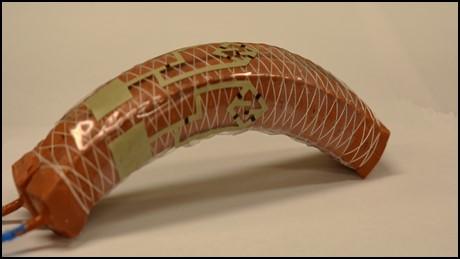
In work that combines a deep understanding of the biology of soft-bodied animals such as earthworms with advances in materials and electronic technologies, researchers from the United States and China have developed a robotic device containing a stretchable transistor that allows neurological function.

Cunjiang Yu, Bill D. Cook Associate Professor of Mechanical Engineering at the University of Houston, said the work represents a significant step toward the development of prosthetics that could directly connect with the peripheral nerves in biological tissues, offering neurological function to artificial limbs, as well as toward advances in soft neurorobots capable of thinking and making judgments. Yu is corresponding author for a paper describing the work, published in Science Advances.

He is also a principal investigator with the Texas Center for Superconductivity at the University of Houston.

“When human skin is touched, you feel it,” Yu said to describe the human capabilities the new device can mimic. “The feeling originates in your brain, through neural pathways from your skin to the brain.”

The findings have implications for neuroprosthetics, as well as for neuromorphic computing, an emerging technology with the potential to allow high volume information processing using small amounts of energy through devices that mimic the electric behavior of neural networks.

Inspired by Nature

Inspired by nature, the researchers designed artificial synaptic transistors – that is, transistors that function similarly to neurons – which continue to work even after being stretched as much as 50%. While the resulting neurological function is less sophisticated than that exhibited by those of its living counterparts, they said it marks an important first step toward more powerful engineering systems in the future.

The transistor, described by researchers as having stretching characteristics similar to those in a rubber band, exhibited functions similar to those of biological synapses, including excitatory postsynaptic potential, current, facilitation, and short-term memory and long-term memory.

The soft neurorobot was equipped with a neurologically integrated tactile sensory skin, allowing it to sense the interaction with the external environment and respond accordingly. “The neurorobot senses physical tapping and locomotes adaptively in a programmed manner through synapse memory encoded signals,” the researchers wrote.

###

In addition to Yu, the research team included Hyunseok Shim, Kyoseung Sim, Faheem Ershad, Pinyi Yang, Anish Thukral, Zhoulyu Rao, Hae-Jin Kim and Xu Wang, all affiliated with the University of Houston; Yanghui Liu and Yang Chai, both with Hong Kong Polytechnic University; Guoying Gu of Shanghai Jiao Tong University; Li Gao of Nanjing University of Posts and Telecommunications; and Xinran Wang of Nanjing University.

About the University of Houston

The University of Houston is a Carnegie-designated Tier One public research university recognized with a Phi Beta Kappa chapter for excellence in undergraduate education. UH serves the globally competitive Houston and Gulf Coast Region by providing world-class faculty, experiential learning and strategic industry partnerships. Located in the nation’s fourth-largest city and one of the most ethnically and culturally diverse regions in the country, UH is a federally designated Hispanic- and Asian-American-Serving institution with enrollment of more than 46,000 students.

Media Contact
Jeannie Kever
[email protected]
713-743-0778

Original Source

http://www.uh.edu/news-events/stories/2019/october-2019/10142019-yu-neurorobot.php

Tags: Disabled PersonsElectrical Engineering/ElectronicsMaterialsMultimedia/Networking/Interface DesignPhysiologyRehabilitation/Prosthetics/Plastic SurgeryResearch/DevelopmentTechnology/Engineering/Computer Science
Share12Tweet8Share2ShareShareShare2

Related Posts

Miniature Sensor Uses Light to Detect Touch — Chemistry

Miniature Sensor Uses Light to Detect Touch

May 8, 2026
Iron Minerals Determine Whether Dissolved Organic Matter Fuels Microbes or Becomes Long-Term Carbon Storage — Chemistry

Iron Minerals Determine Whether Dissolved Organic Matter Fuels Microbes or Becomes Long-Term Carbon Storage

May 8, 2026

Kate Evans Appointed Associate Lab Director for Biological and Environmental Systems Science at ORNL

May 8, 2026

Advancing Multiscale Modeling and Overcoming Operational Challenges in Autothermal COâ‚‚-to-Methanol Reactors

May 8, 2026
Please login to join discussion

POPULAR NEWS

  • Research Indicates Potential Connection Between Prenatal Medication Exposure and Elevated Autism Risk

    840 shares
    Share 336 Tweet 210
  • New Study Reveals Plants Can Detect the Sound of Rain

    727 shares
    Share 290 Tweet 181
  • Scientists Investigate Possible Connection Between COVID-19 and Increased Lung Cancer Risk

    68 shares
    Share 27 Tweet 17
  • Salmonella Haem Blocks Macrophages, Boosts Infection

    61 shares
    Share 24 Tweet 15

About

We bring you the latest biotechnology news from best research centers and universities around the world. Check our website.

Follow us

Recent News

Evaluating Digoxin Use in Patients with Symptomatic Rheumatic Heart Disease

Evaluating the Effectiveness and Safety of Digitalis Glycosides in Treating Heart Failure

Urdu Fall Risk Questionnaire Adapted for Elderly

Subscribe to Blog via Email

Success! An email was just sent to confirm your subscription. Please find the email now and click 'Confirm' to start subscribing.

Join 82 other subscribers
  • Contact Us

Bioengineer.org © Copyright 2023 All Rights Reserved.

Welcome Back!

Login to your account below

Forgotten Password?

Retrieve your password

Please enter your username or email address to reset your password.

Log In
No Result
View All Result
  • Homepages
    • Home Page 1
    • Home Page 2
  • News
  • National
  • Business
  • Health
  • Lifestyle
  • Science

Bioengineer.org © Copyright 2023 All Rights Reserved.