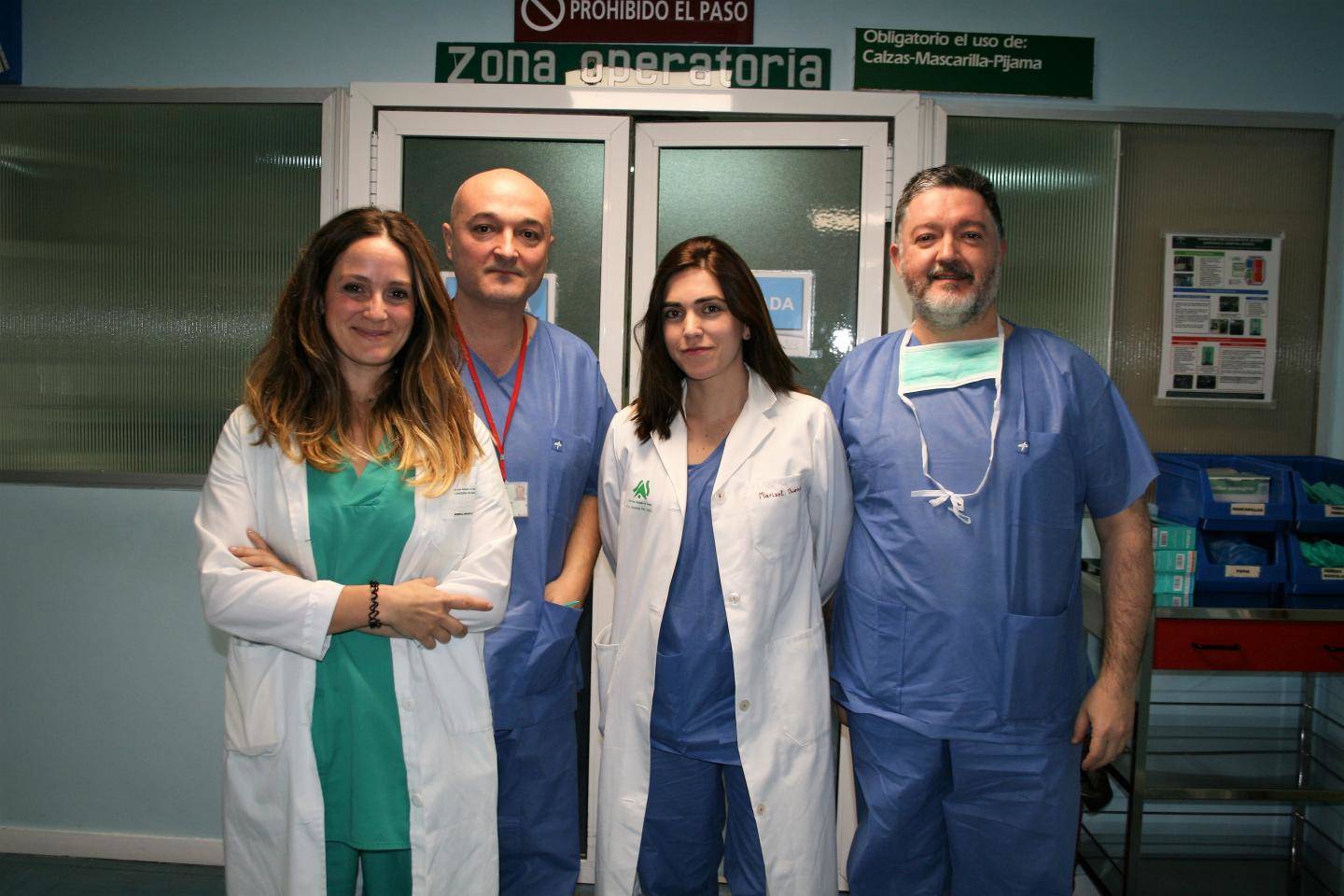
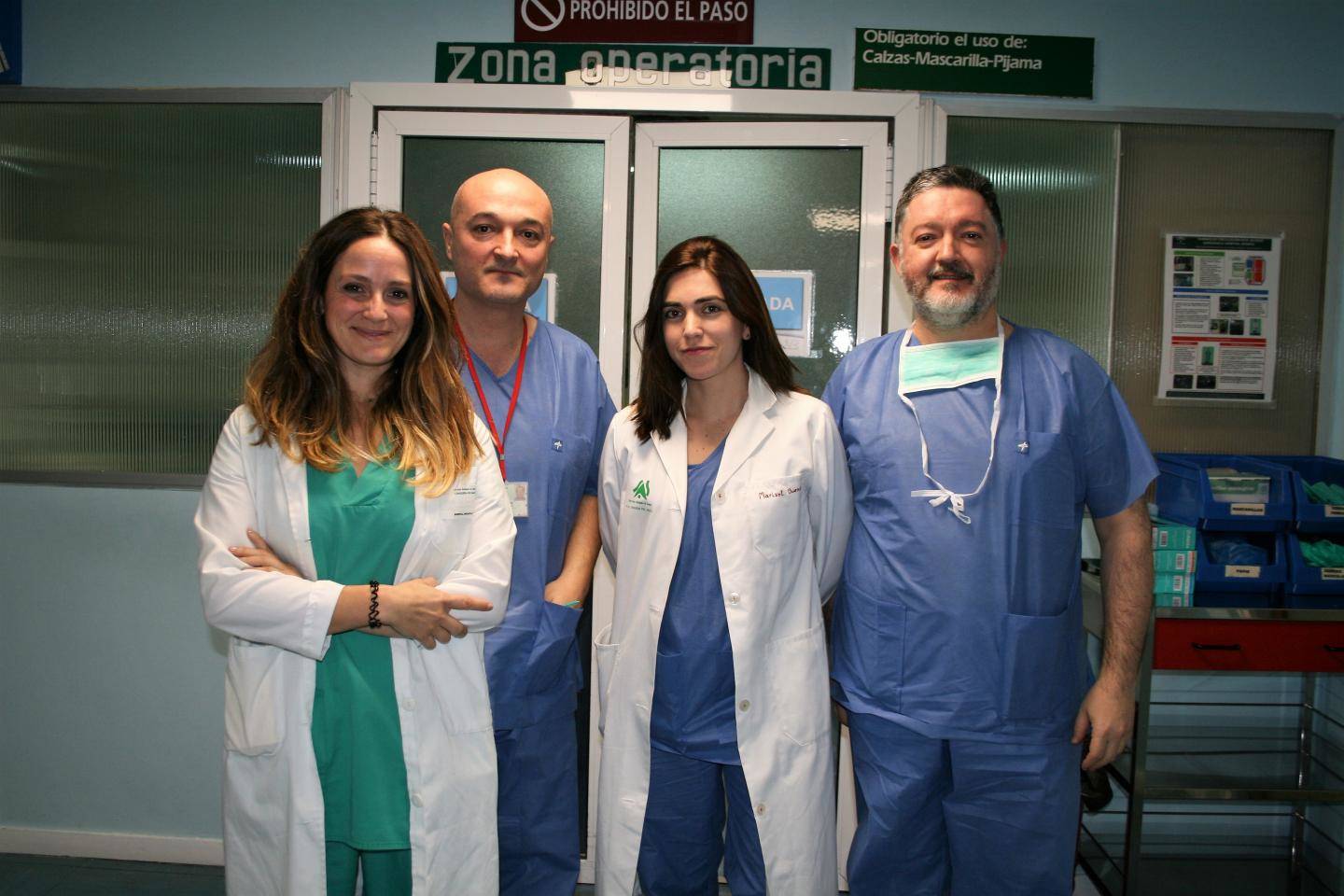
Credit: University of Seville / Hospital Virgen del Rocío
Although the problem of whether foetuses are able to feel pain or not is still controversial, experts at the University Hospital Virgen del Rocío in Seville have recently published a study in which they confirm that from the second trimester of pregnancy, the future baby already shows signs of pain when given a harmful stimulus or as a response to stress. In response to this confirmation, the researchers indicate the need to anaesthetise the foetus during open foetal surgery, OFS.
There is a school of thought that believes that in the case of foetal interventions, it is sufficient to administer anaesthesia to the mother as this passes through the foetus through the umbilical cord. Now, the experts have shown that this might not be sufficient and that from 21 weeks, the foetus can feel pain, so it also needs to be anaesthetised.
"At the Hospital Virgen del Rocío, we have spent a decade doing open foetal surgery. In 2007, we did the first intrauterine spina bifida operation in Europe, and in only one case was the foetus unable to receive intravenously administered anaesthesia from the start of the operation. It was at that moment that our monitoring teams detected anomalies in the behaviour of the foetus, which led us to believe that this was effectively a reaction to the stress caused by the pain. We quickly out in place the anaesthesia protocol and the spinal reconstruction was possible and the post-op period passed without any problems", explains Doctor Javier Márquez Rivas, Heat of the Infant Neurosurgery Unit and the Neurosurgery Service at the hospital.
For her part, Doctor María J. Mayorga Buiza, paediatric anaesthetist and first signatory of the article, adds that one of the key aspects of anaesthesia in open foetal surgery is to help uterine relaxation, to keep foetal circulation stable and, once surgery is complete, to offer adequate management of the patient to avoid contractions among other complications, which helps to reduce the incidence of premature birth in these cases.
Open foetal surgery (OFS) is still a serious procedure for the mother and the foetus. In such cases, anaesthesia given directly to the foetus can be provided by different means, but in the opinion of these experts, direct administration is "obligatory" for reduce foetal stress and also release the incidence of foetal mortality.
Even though current models do not prove the perception of foetal pain before the third trimester and there is little evidence of the effectiveness of direct foetal analgesic and anaesthetic techniques, it is a confirmed fact that foetal mortality is higher than 20% in the case of non-anaesthetised foetuses. This rate drops to 0% in operations carried out until now at the University Hospital Virgen del Rocío in Seville.
"The response of foetal stress to harmful stimulation that our monitoring teams observed in this case, does not completely prove that the foetus can feel pain. However, it is very improbable that there can be a perception of pain without a response to stress, and so these signals are often used as a substitute pain indicator", explains the University of Seville researcher and co-author of this study, The Applied Physics professor Emilio Gómez González.
The research team that Professor Gómez Gonzalez leads works on the development of optical and neurophotonic techniques which are capable of evaluating the state and characteristics of the areas where surgery is taking place during complicated procedures.
"To advance in the area of anaesthesia is to advance in surgery. Formerly, there were patients who died from pain, therefore, the better our knowledge and training in anaesthesia and the greater the abilities of the monitoring teams, the more complex surgery can be", states Doctor Mayorga Buiza.
###
Media Contact
Emilio Gómez
[email protected]
@unisevilla
http://www.us.es
Original Source
https://link.springer.com/article/10.1007%2Fs00381-017-3677-6 http://dx.doi.org/10.1007/s00381-017-3677-6