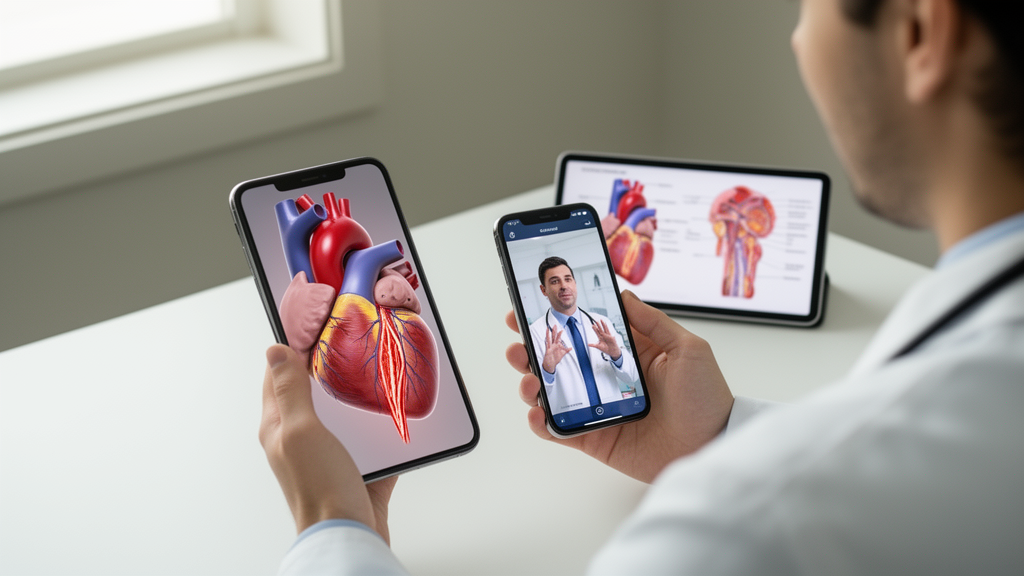
The videos, drawn from the highest-ranked search results for the disease, received a median Global Quality Score of 3 out of 5 and a median Video Information Quality Instrument score of 13 out of 20. Their median modified DISCERN and JAMA benchmark scores were both 2, indicating weaknesses in reliability, evidence support and disclosure. Engagement indicators were weakly related, or not significantly related, to the instruments used to assess quality; the study did not independently verify individual medical claims against clinical guidelines.
Researchers searched both platforms on August 2, 2026, using the Chinese term “A型主动脉夹层,” intended to retrieve material specifically concerning Stanford type A aortic dissection. They screened the top 250 videos in each platform’s default comprehensive ranking, then excluded unrelated videos, duplicates, advertisements and files without visual content. The final sample contained 193 Bilibili videos and 198 TikTok videos.
Videos uploaded during the preceding seven days were excluded to reduce the influence of short-term fluctuations in engagement. The fixed sampling frame was designed to characterize highly visible search results rather than the full body of disease-related content on either platform. Standardized procedures were used to reduce the influence of previous browsing and location-based personalization.
Searches were performed on the same computer and network on the same day by one investigator using newly created, logged-in accounts with no prior search, viewing, following, liking or commenting history. The browser cache was cleared and location services disabled. These procedures standardized retrieval conditions, but the researchers cautioned that algorithm-dependent ranking and residual personalization could not be completely excluded.
Two medical students independently rated all 391 videos using four established instruments. The five-point Global Quality Score examined comprehensiveness, usability and overall presentation. The five-point modified DISCERN tool assessed clarity, relevance, traceability, robustness and fairness.
The four-point JAMA benchmark covered authorship attribution, disclosure, currency and peer-review status, while the 20-point Video Information Quality Instrument evaluated multiple dimensions of video information quality. The raters were trained in the scoring criteria and could not see one another’s ratings, although platform and uploader information visible in the original videos was not blinded. Inter-rater agreement was high: quadratic weighted kappa values were 0.894 for GQS, 0.892 for modified DISCERN and 0.937 for JAMA, and the intraclass correlation coefficient for VIQI was 0.965.
Across the full sample, the median video duration was 107 seconds, with an interquartile range from 49 to 273.5 seconds. Median engagement was 129 likes, 42 collections, 18 comments and 17 shares. Treatment was the most frequently represented subject, appearing in 295 videos, or 75.4%, followed by diagnosis in 262 videos, or 67.0%.
Etiology appeared in 48.6%, clinical presentation in 46.3%, prognosis in 39.6% and epidemiology in 28.4%. Prevention was the least common topic, covered in only 61 videos, or 15.6%. These distributions show an emphasis on treatment and diagnosis, with comparatively limited attention to prevention and prognosis.
Bilibili and TikTok presented different combinations of content, engagement and uploader participation. Bilibili videos were longer, with a median duration of 213 seconds, compared with 77 seconds on TikTok. TikTok videos generated more interaction: median likes were 245.5 on TikTok and 33 on Bilibili, while median comments were 51 and 4, respectively.
TikTok also had more shares, with a median of 24 versus 14, but the difference in collections was not statistically significant. After false-discovery-rate correction, Bilibili videos more often covered epidemiology, etiology and clinical presentation. No significant adjusted platform differences were found for diagnosis, treatment, prevention or prognosis coverage.
The platforms also differed in who uploaded the content. Medical practitioners supplied 148 of 198 TikTok videos, or 74.7%, and 79 of 193 Bilibili videos, or 40.9%. Individual users were the largest uploader group on Bilibili, accounting for 96 videos, or 49.7%, compared with 40 TikTok videos, or 20.2%.
Institutions contributed 18 Bilibili videos and 10 TikTok videos. In unadjusted comparisons, TikTok had a slightly higher median VIQI score than Bilibili, 13 rather than 12, and the platform association remained after adjustment for uploader type, log-transformed duration and content coverage. The adjusted coefficient was 0.819, with a 95% confidence interval of 0.512 to 1.127 and a false-discovery-rate-adjusted P value below 0.001.
That platform association did not extend to every assessment instrument. Platform was not independently associated with GQS, modified DISCERN or JAMA scores after adjustment. Although unadjusted GQS and modified DISCERN comparisons were statistically significant, the median values and interquartile ranges were identical for both platforms, limiting the practical interpretation of those differences.
Uploader type showed clearer associations with selected quality measures. Relative to individual users, videos from institutions had an adjusted VIQI coefficient of 1.585, with a 95% confidence interval of 1.013 to 2.157, while those from medical practitioners had a coefficient of 1.701, with a 95% confidence interval of 1.381 to 2.022. Both had false-discovery-rate-adjusted P values below 0.001.
Medical-practitioner videos also had higher odds of receiving a higher GQS score, with an odds ratio of 4.041. Professional participation did not guarantee stronger performance on every measure of reliability. Institutions and medical practitioners generally scored higher than individual users on the JAMA benchmark, which emphasizes attribution and disclosure, but modified DISCERN scores did not differ significantly among uploader types.
The same broad pattern appeared in platform-specific analyses: professional and institutional content often performed better on VIQI, GQS or JAMA, while modified DISCERN results remained similar. Video duration and topic coverage were also associated with VIQI scores. The log-transformed duration coefficient was 0.528, with a 95% confidence interval of 0.401 to 0.656, and the content coverage coefficient was 0.212, with a 95% confidence interval of 0.125 to 0.299; both remained significant after false-discovery-rate correction.
These observational associations do not show that length or breadth causes higher scores. Engagement measures did not closely track the dimensions captured by the four quality instruments. Likes, collections, comments and shares were strongly correlated with one another, indicating that videos performing well on one interaction measure often performed well on others.
The quality tools were also positively correlated with one another, suggesting that they captured related but distinct properties. In contrast, correlations between engagement indicators and assessed quality or reliability scores were weak or not statistically significant. A video with many likes or shares was therefore not necessarily more comprehensive, better sourced or more transparent under the study’s scoring system.
This result concerns measured information attributes, not a direct assessment of clinical accuracy or misinformation, because individual statements were not checked against authoritative evidence. The findings are limited by the cross-sectional design and the selected search sample. This was a snapshot of highly ranked Chinese-language videos, not a longitudinal analysis, an examination of all available content or a study of how viewers used the information.
A single search term and platform ranking systems may have affected which videos entered the sample. Variations in uploader composition may also have contributed to platform contrasts, while the regressions could not account for all unmeasured confounding. Absolute engagement counts may be affected by differences in exposure time, and several comparative and correlation analyses were exploratory.
The content assessment covered broad disease-related domains but did not use a checklist for time-critical details such as symptom recognition, emergency care and timely referral. The results therefore characterize the quality, reliability, completeness and transparency of the sampled videos, rather than establishing the prevalence of false medical claims or measuring any effect on patient behavior.
Subject of Research: Quality and reliability of type A aortic dissection short videos on Bilibili and TikTok
Article Title: Quality and reliability of short videos about type A aortic dissection on Bilibili and TikTok: a cross-sectional study
Article References: Wei, K., Liu, M., Yan, Y., Lan, R., Zhang, Y., Han, X., Wang, Y., He, W., Tang, X., Zhang, N., Gao, X., Tian, C., & Wang, X. (2026). Quality and reliability of short videos about type A aortic dissection on Bilibili and TikTok: a cross-sectional study. Frontiers in Digital Health, 8, Article 1964412. https://doi.org/10.3389/fdgth.2026.1964412
Image Credits: AI Generated
DOI: 10.3389/fdgth.2026.1964412
Keywords: Type A aortic dissection, Short-form video, Bilibili, TikTok, Health information quality, Content reliability, Digital health communication, Uploader characteristics, Audience engagement, Content coverage, Quality, reliability
News Source: Ophelia Keating. (October 21, 2026). Research report: Quality and reliability of short videos about type A aortic dissection on Bilibili and TikTok: a cross-sectional study. Scienmag.