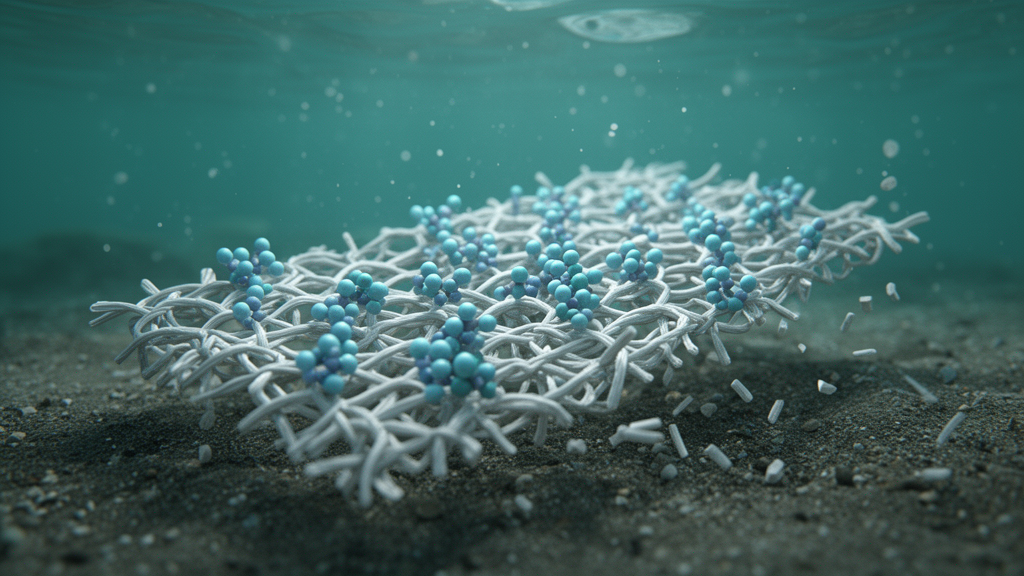
Compostable polyester films and microbeads containing tiny amounts of embedded enzymes degraded substantially faster than enzyme-free controls in coastal and deep-sea experiments, according to a laboratory and field study in Nature. Researchers tested poly(butylene succinate), poly(butylene succinate-co-adipate), poly(ε-caprolactone) and poly(butylene adipate-co-terephthalate) at marine sites ranging from 2–6 metres to 5,503 metres deep. At 757 metres, PBS, PBSA and PCL films containing the enzyme HiC achieved near-complete degradation within five months, while enzyme-containing materials also showed moderate biodegradation on the floor of the deepest tested site.
Many commercially available compostable plastics are designed to degrade efficiently under industrial composting conditions, but their degradation in marine environments remains limited. The experiments examined whether thermally embedding one of two enzymes directly into polyester films and microbeads could change their behavior in seawater. CaLB and HiC were incorporated at loadings as low as 0.1 wt%, with some deep-sea deployments using up to 3 wt%. The results support enzyme embedding as a material-level approach for accelerating the degradation of the four tested polyesters, rather than evidence that the strategy can eliminate marine plastic pollution or has been validated for every product, polymer and deployment scenario.
To prepare the materials, the team dried commercial polymer pellets and melt-processed them in a counter-rotating twin-screw micro-extruder. Processing temperatures varied by polymer: 90 °C for PCL, 100 °C for PBSA, 130 °C for PBS and PBAT, and 180 °C for poly(3-hydroxybutyrate), which was included among the materials examined in some experiments but was not among the four polyesters highlighted in the conclusions. The combined extrusion and compression-moulding time was limited to 3.5 minutes to reduce thermal degradation and enzyme denaturation. Most films and coastal samples contained 0.1 wt% enzyme, and the resulting films were approximately 100–300 micrometres thick. Selected polymers were also made into microbeads, although the homogenization procedure used to prepare them in silicone oil did not produce PCL microbeads.
For exposure testing, film samples and microbeads were sealed in polyethylene mesh and placed in PET chambers with holes. The 55-micrometre mesh used for microbeads was selected to balance particle retention against diffusion limitation and enclosure artefacts during long exposures. Because the particles were smaller than the mesh apertures, some could escape, which prevented reliable gravimetric determination of mass loss for microbeads. Deep-sea samples were carried and recovered with either the HOV Shinkai 6500 or the Kaimei remotely operated vehicle. During descent, the chambers were held in a lid-covered box to avoid contact with upper-layer seawater. Enzyme-free and enzyme-containing samples were stored separately, as were different enzyme-containing formulations when tested simultaneously, to reduce cross-contamination.
Each sample type generally had five or six independent specimens, with four or five used for quantitative measurements and one reserved for additional analysis. The principal measure of degradation was mass loss, calculated by subtracting recovered mass from initial mass and dividing by initial mass. Recovered specimens were also inspected by scanning electron microscopy, while separate material was used for physicochemical and 16S rRNA gene analyses. At 757 metres, the clearest field result was recorded for HiC-containing PBS, PBSA and PCL: each reached nearly complete degradation within five months and substantially outperformed its enzyme-free counterpart. At the deepest site, on the seafloor at 5,503 metres, enzyme-embedded polyesters showed moderate biodegradation rather than the near-complete breakdown observed at 757 metres.
Chemical analysis supported the formation of soluble, low-molecular-mass products during enzymatic breakdown. In a laboratory incubation, PBAT films containing 0.5 wt% HiC were held in phosphate buffer at 45 °C for 96 hours. High-performance liquid chromatography identified mono(4-hydroxybutyl) terephthalate, bis(4-hydroxybutyl) terephthalate and terephthalic acid, while adipic acid was quantified by ion-exclusion chromatography. These observations provide chemical evidence that the enzyme cleaved polyester chains into smaller compounds, rather than merely producing surface damage that could be mistaken for substantial degradation.
Separate biochemical oxygen demand measurements provided complementary evidence for microbial mineralization. Aerobic tests in a seawater-based medium were conducted at 25 °C for one month, with three independent bottles per condition and 0.1 wt% HiC embedded in PBS, PBSA, PCL and PBAT films. Enzyme-free polyester films, cellulose filter paper and blank seawater measurements served as controls. Biodegradability was calculated as the oxygen demand of the test solution minus the blank value, divided by the theoretical oxygen demand of the sample. The formation of soluble degradation products together with the oxygen-demand results is consistent with a two-stage process in which enzymatic hydrolysis opens the polymer structure and microorganisms subsequently metabolize the released compounds. The study did not directly observe every step of that pathway in the deep sea.
Embedding the enzymes did not produce a major loss of mechanical performance in the films tested. Tensile measurements on five independent dumbbell-shaped specimens per condition found that the mechanical properties of enzyme-embedded polyesters were similar to those of corresponding enzyme-free materials. The 0.1 wt% loading had almost no effect on the measured mechanical properties, including elongation at break, Young’s modulus and maximum tensile strength. This comparison supports the conclusion that the low enzyme loading preserved the functional performance of the tested polymers. It does not, however, establish long-term manufacturing performance, storage stability or suitability for particular commercial applications, none of which was evaluated in the reported experiments.
The study also tested how the materials behaved under deep-sea pressure and temperature. In laboratory pressure-vessel simulations, PBSA and PCL films were placed in deep-sea water for one month at 4 °C under pressures of 10 and 25 megapascals, with a non-pressurized control run under the same temperature. Each condition included two replicate film specimens. These laboratory tests were separate from the marine deployments, while the field experiment extended the evidence to a seafloor at 5,503 metres. The moderate degradation observed at that depth demonstrates that biological and enzymatic activity was not entirely absent at extreme depth, but it does not show that samples disappeared completely there or that their degradation rate matched the result at 757 metres.
Several limitations constrain the interpretation of the results. Sample size was not determined through statistical methods, and the researchers did not use blinding or randomization. Sonication of recovered specimens removed surface biofilm, meaning that the principal recovered measurements mainly describe polymer loss and physical alteration rather than total microbial colonization. Representative scanning electron micrographs were based on limited specimens, although several distinct areas of the same film were examined and similar surface features were found. Microbead compression testing covered only a small number of individual particles, and the 16S rRNA gene sequencing was performed on one sample per condition because material was prioritized for mass-loss measurement. It therefore lacked independent biological replication. Overall, the experiments show that embedding CaLB or HiC accelerated degradation of four compostable polyesters in the tested coastal and deep-sea conditions, with the strongest measured result being near-complete breakdown of HiC-containing PBS, PBSA and PCL at 757 metres within five months.
Subject of Research: Accelerated marine biodegradation of compostable polyesters through embedded enzymes
Article Title: Enzyme-embedded polyesters for accelerated biodegradation in the deep sea
Article References: Huang, Q., Iida, N., Isobe, N., Kabe, T., Omura, T., Ilangovan, M., Kimura, S., Seok, J. H., Nomaki, H., Kasuya, K.-I., & Iwata, T. (2026). Enzyme-embedded polyesters for accelerated biodegradation in the deep sea. Nature. https://doi.org/10.1038/s41586-026-11192-1
Image Credits: AI Generated
DOI: 10.1038/s41586-026-11192-1
Keywords: deep-sea biodegradation, enzyme embedding, compostable polyesters, marine plastic pollution, poly(butylene succinate), poly(ε-caprolactone), poly(butylene adipate-co-terephthalate), enzymatic hydrolysis, microbial mineralization, marine materials science, Enzyme-embedded, polyesters
News Source: Denise Maddox. (October 21, 2026). Embedded enzymes accelerate polyester degradation in the deep sea. Scienmag.