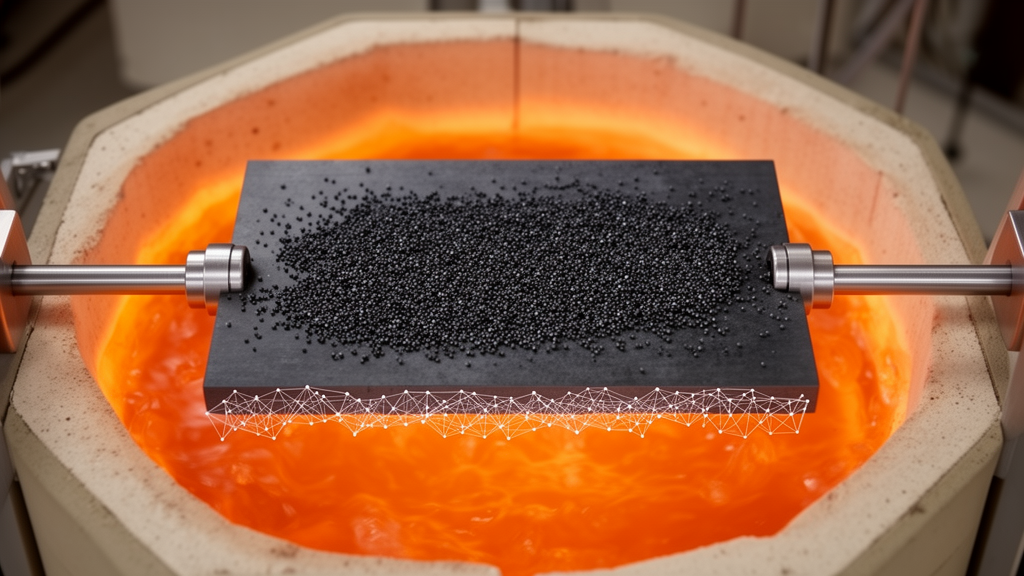
A laboratory study of titanium diboride (TiB2) coatings deposited on graphite has identified a 1.5 wt% particle formulation that produced a dense, crack-free coating 53.15 μm thick. The research combined high-temperature molten-salt electrophoretic deposition, first-principles calculations and laboratory-scale aluminum electrolysis tests to examine coating growth, interfacial adhesion and the performance of an optimized graphite cathode. The results provide evidence for TiB2 deposition within a Na 3 AlF 6 -AlF 3 -CaF 2 -Al 2 O 3 system, but the electrolysis findings were limited to a 72-hour laboratory test rather than an industrial operating period.
The researchers deposited TiB2 onto graphite substrates at particle concentrations of 1–2 wt% and current densities of 60–280 mA/cm 2 , systematically evaluating effects on coating thickness, morphology and uniformity. Across all concentrations tested, thickness varied non-monotonically with current density: it initially increased, reached a maximum and then decreased at higher current densities. Increasing the TiB2 concentration from 1 to 2 wt% raised the maximum coating thickness from 29.55 to 56.82 μm and shifted the current density at which agglomeration began from 120 to 225 mA/cm 2 .
These measured trends show that both particle concentration and electrical current affected the coating process, while the highest tested current densities were associated with agglomeration. The study attributed the concentration effect to the balance between particle surface area and the available surface charge. At a higher TiB2 concentration, the total surface area of the particles increased, reducing the effective surface charge per particle.
A higher current density was therefore needed to sustain stable deposition. The authors selected 1.5 wt% TiB2 as the best overall compromise between coating quality and particle consumption; at this concentration, the coating reached 53.15 μm and was dense and crack-free. First-principles calculations examined bonding between the graphite (0001) and TiB2 (0001) surfaces.
The B-terminated interface had a calculated work of adhesion of 0.378 J/m 2 , substantially higher than the 0.101 J/m 2 calculated for the Ti-terminated interface. The authors associated the difference with stronger B–C electronic interaction at the B-terminated boundary. These model results describe the adhesion of the specified idealized interfaces; they do not directly measure the strength of the complete deposited coating or establish that the observed electrolysis performance was caused solely by this atomic-scale bonding.
Laboratory-scale aluminum electrolysis tests assessed the practical relevance of the optimized coating. After 72 hours of operation, the TiB2-coated cathode retained coating integrity and favorable wettability by molten aluminum, while the cell voltage remained stable. These observations apply specifically to the optimized coated cathode under the laboratory test conditions.
Together, the experiments and calculations show that high-temperature molten-salt electrophoretic deposition can produce a thick, dense and crack-free TiB2 layer on graphite, with adhesion calculations and a short electrolysis test providing complementary evidence about interfacial bonding and behavior in an operating cell.
Subject of Research: Molten-salt deposition and interfacial adhesion of TiB2 coatings on graphite cathodes
Article Title: High-temperature molten salt electrophoretic deposition of TiB2 coatings on graphite: an experimental and first-principles study
Article References: Liu, P., Chen, X., Han, J., & Liang, X. (2026). High-temperature molten salt electrophoretic deposition of TiB2 coatings on graphite: an experimental and first-principles study. Journal of Materials Science, 61(42), 32820-32837. https://doi.org/10.1007/s10853-026-13717-5
Image Credits: AI Generated
DOI: 10.1007/s10853-026-13717-5
Keywords: TiB2 coatings, electrophoretic deposition, molten salts, graphite cathodes, aluminum electrolysis, first-principles calculations, interfacial adhesion, ceramic materials, surface engineering, High-temperature, molten, salt
News Source: Denise Maddox. (October 20, 2026). Research report: High-temperature molten salt electrophoretic deposition of TiB2 coatings on graphite: an experimental and first-principles study. Scienmag.