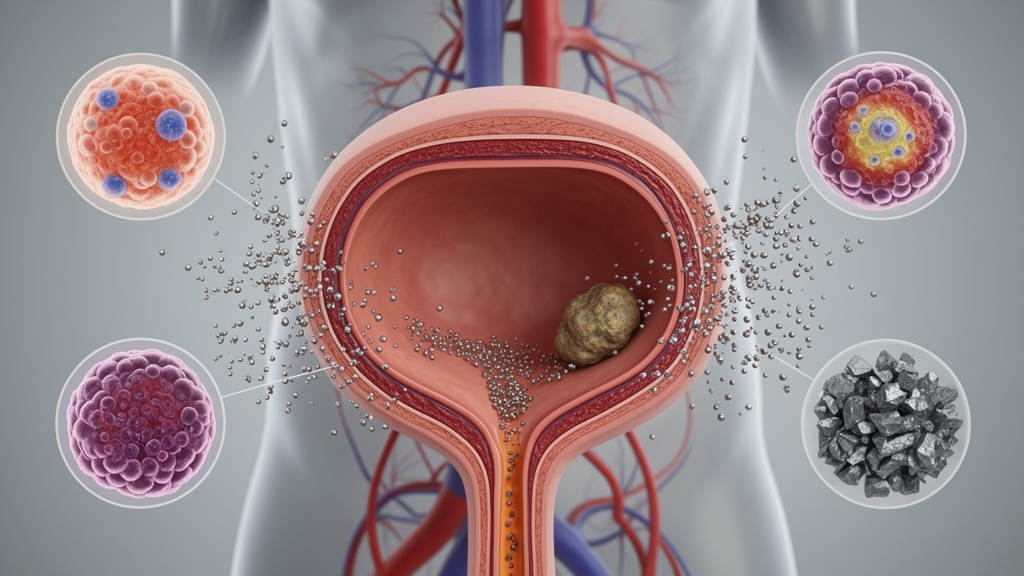
A 2026 systematic review and evidence synthesis concludes that exposure to arsenic, cadmium, chromium and lead is associated with bladder cancer to differing degrees, judging arsenic a causal risk factor, cadmium a likely causal factor, chromium a probable factor and lead a possible factor. The review, published in Frontiers in Cell and Developmental Biology, combines epidemiological and experimental studies to assess cancer risk, molecular mechanisms and possible translational strategies. These classifications are the authors’ Bradford Hill assessments of the available evidence, not results from a new clinical trial, and they do not mean that every exposed person will develop bladder cancer.
Arsenic has the strongest epidemiological support. A systematic review and meta-analysis of 68 studies cited by the article reported a pooled relative risk of 1.60, with a 95% confidence interval of 1.13–2.27, when comparing the highest with the lowest arsenic exposure tertiles. The relationship appeared nonlinear: the association was not significant at or below 10 micrograms per liter in drinking water, but increased steadily across concentrations from 10 to 429 micrograms per liter.
Ecological and case-control investigations in high-exposure regions have also linked drinking-water arsenic with bladder cancer and reported elevated arsenic concentrations in recurrent tumors alongside associations with tumor aggressiveness and early recurrence. By contrast, a prospective nested case-control study within the Alpha-Tocopherol, Beta-Carotene Cancer Prevention cohort, using pre-diagnostic toenail arsenic as a marker of long-term exposure, found no significant association with bladder cancer among Finnish male smokers. Its odds ratio was 1.13, with a 95% confidence interval of 0.70–1.81, for the highest versus lowest quartile.
The review therefore regards arsenic as a causal risk factor while noting that low-dose evidence remains inconclusive. Cadmium shows consistent but less causally secure associations. Case-control studies have repeatedly found higher concentrations in bladder tumor tissue than in adjacent non-cancerous tissue, while some studies have linked blood cadmium with muscle-invasive disease, lymph-node involvement, miRNA-21 expression and other markers associated with aggressive phenotypes.
The same meta-analysis reported a pooled relative risk of 1.38, with a 95% confidence interval of 1.04–1.82. A major limitation is that much of the evidence is cross-sectional, so it cannot establish whether cadmium accumulation preceded malignant transformation or partly resulted from it. Tobacco smoke is also a major cadmium source, making the metal a potential confounder and possible mediator of smoking-related risk.
Formal bladder-cancer-specific dose-response analyses remain limited, and the review classifies cadmium as likely causal while emphasizing the need for prospective studies and causal mediation analyses that separate its independent contribution from smoking. Chromium and lead occupy less secure positions in the review’s evidence hierarchy. Chromium concentrations are elevated in tumor tissue, and experimental work indicates that hexavalent chromium can promote proliferation and migration while inhibiting apoptosis through regulation of filamin A.
However, a prospective European Prospective Investigation into Cancer and Nutrition Florence cohort found no significant relationship between pre-diagnostic serum chromium and bladder cancer among never or long-term former smokers without occupational exposure. The tissue-versus-serum discrepancy may reflect the different exposure windows captured by each matrix, but it also prevents a definitive causal conclusion. Lead has produced broadly supportive yet conditional signals.
Elevated blood or urine concentrations and higher tumor levels have been reported, while body mass index and nutritional status appear to modify the association. These findings remain based largely on cross-sectional evidence and do not establish whether metabolic factors affect lead toxicity directly or merely track shared exposures. The authors consequently rate chromium as a probable risk factor and lead as a possible one.
Why can one study detect an association while another finds none? The review identifies exposure measurement as a central problem. Blood and urine concentrations mainly represent recent exposure, with biological half-lives measured in days or weeks, whereas concentrations in bladder tissue can reflect accumulation over years or decades.
Bladder carcinogenesis may involve a latency of 20–40 years or longer for arsenic, making a single serum sample poorly aligned with the relevant exposure window. Toenails and fingernails can integrate exposure over several months, although they can be affected by external contamination and grow slowly. The matrix used to measure a metal can therefore determine whether a long-term process appears as a strong tissue signal, a modest systemic association or a null result.
Repeated measurements and specimens that integrate longer exposure periods are needed to improve temporal alignment. Smoking introduces another layer of analytical difficulty. It is an established bladder-cancer risk factor and a source of cadmium and lead.
Adjusting for smoking as though it were solely a confounder may remove part of a true metal-mediated effect, whereas inadequate adjustment can inflate the apparent metal association. The review therefore calls for causal mediation analysis, formal interaction tests and stratified analyses rather than simple covariate adjustment. Metals also coexist in real environments and may have additive, synergistic or antagonistic effects that cannot be represented reliably by single-metal models.
Statistical approaches such as Bayesian Kernel Machine Regression and Weighted Quantile Sum regression could examine complex, nonlinear exposure profiles, according to the review, but better modeling must be paired with reliable longitudinal exposure assessment and mixture-focused toxicology. At the molecular level, the proposed mechanism begins with reactive oxygen species and mitochondrial dysfunction. Redox-active metals such as chromium can directly catalyze electron transfer, whereas cadmium and lead can indirectly weaken antioxidant systems including superoxide dismutase and glutathione peroxidase.
In cell and animal models, the resulting oxidative stress is associated with impaired mitochondrial membranes, disturbed electron transport, reduced ATP production and a self-reinforcing cycle of mitochondrial damage. Several observational studies of bladder cancer patients have also found elevated markers such as malondialdehyde, advanced oxidation protein products and total oxidant status, together with reduced antioxidant activity. These observations are consistent with a role for redox injury, but much of the causal mechanistic evidence comes from immortalized cancer-cell lines exposed to acute, high metal concentrations that may not reproduce chronic human exposure.
The review notes that direct validation in physiologically relevant primary urothelial cells, patient-derived organoids and prospective cohorts is still needed. The downstream circuitry includes two reactive-oxygen-species-dependent routes and a route that can operate independently of reactive oxygen species. Oxidative stress can activate p38-MAPK, which feeds into NF-κB-mediated inflammation, and the PI3K/AKT pathway, which supports proliferation and survival.
Epigenetic changes may reinforce these signals: metal-associated increases in DNA methyltransferases have been linked to promoter hypermethylation and reduced expression of PTEN and CDKN2A, while miR-21 and miR-155 can rise and members of the miR-200 family can fall. Antimony provides experimental evidence for a distinct SUMO2/3-dependent, TGF-β/Smad2/3 pathway that promotes epithelial–mesenchymal transition without the same reactive-oxygen-species dependence. NRF2 adds stage-specific complexity: it can protect normal urothelial cells from oxidative injury early in carcinogenesis, but sustained activation in established tumors may support anti-apoptosis, angiogenesis, metabolic reprogramming and chemoresistance.
These pathways are interconnected, and experimental results do not yet establish that blocking one node will prevent cancer in exposed people. The proposed molecular disturbances extend beyond cancer cells. The review describes evidence that metals may reshape the tumor microenvironment through chronic inflammation, altered immune surveillance, activation of cancer-associated fibroblasts and changes in cellular metabolism.
Arsenic has been associated with PD-L1 regulation through STAT3 and NF-κB in experimental bladder-cancer systems, while oxidative injury may impair tumor-infiltrating lymphocytes and natural killer cells. Disruption of mitochondrial oxidative phosphorylation can also shift metabolism toward aerobic glycolysis, producing a lactate-rich environment that may favor tumor cells and suppress immune effectors. These findings remain relatively immature and context dependent: oxygen, nutrient, pH and immune-cell gradients may cause one pathway to dominate in one tumor region and another pathway to dominate elsewhere.
Single-cell sequencing, spatial profiling and post-translational-modification proteomics may help map this heterogeneity, but their use in large population studies presents cost, throughput and data-integration challenges. The review proposes a three-level framework linking environmental control, biomarker-guided surveillance and molecular treatment, but much of its clinical component remains conceptual. Primary prevention would reduce arsenic and cadmium exposure through environmental regulation and counseling in exposed communities.
Secondary prevention would identify individuals using combinations of metal measurements, oxidative-damage markers and susceptibility variants before assessing possible preventive interventions. Tertiary prevention would use molecular profiles to guide treatments such as epigenetic modifiers or SUMOylation inhibitors in established disease. Candidates including lycopene, phytosterols, kaempferol and excavatolide C have shown antioxidant or signal-modifying effects in laboratory models, but poor bioavailability and target-tissue delivery remain substantial barriers, and no clinical evidence cited establishes their benefit for bladder-cancer prevention.
Decitabine and UBC9-directed strategies also require further validation. The central research priority is prospective work that links repeated exposure measurements with molecular pathology, followed by rigorous trials in well-characterized exposed populations, while acknowledging that most mechanistic evidence still comes from cell and animal models rather than demonstrated clinical benefits in humans.
Subject of Research: Epidemiological and molecular evidence linking toxic metal exposure to bladder cancer risk and progression.
Article Title: From epidemiology to molecular pathology: current research status and future prospects on the role of toxic metal exposure in the development and progression of bladder cancer
Article References: Li, D., Sun, X., & Yu, T. (2026). From epidemiology to molecular pathology: current research status and future prospects on the role of toxic metal exposure in the development and progression of bladder cancer. Frontiers in Cell and Developmental Biology, 14, Article 1930640. https://doi.org/10.3389/fcell.2026.1930640
Image Credits: AI Generated
DOI: 10.3389/fcell.2026.1930640
Keywords: bladder cancer, toxic metals, arsenic, cadmium, chromium, lead exposure, systematic review, oxidative stress, molecular pathology, epidemiology, tumor microenvironment, cancer prevention
News Source: Nathaniel Bowman. (October 20, 2026). Research report: From epidemiology to molecular pathology: current research status and future prospects on the role of toxic metal exposure in the development and progression of bladder cancer. Scienmag.