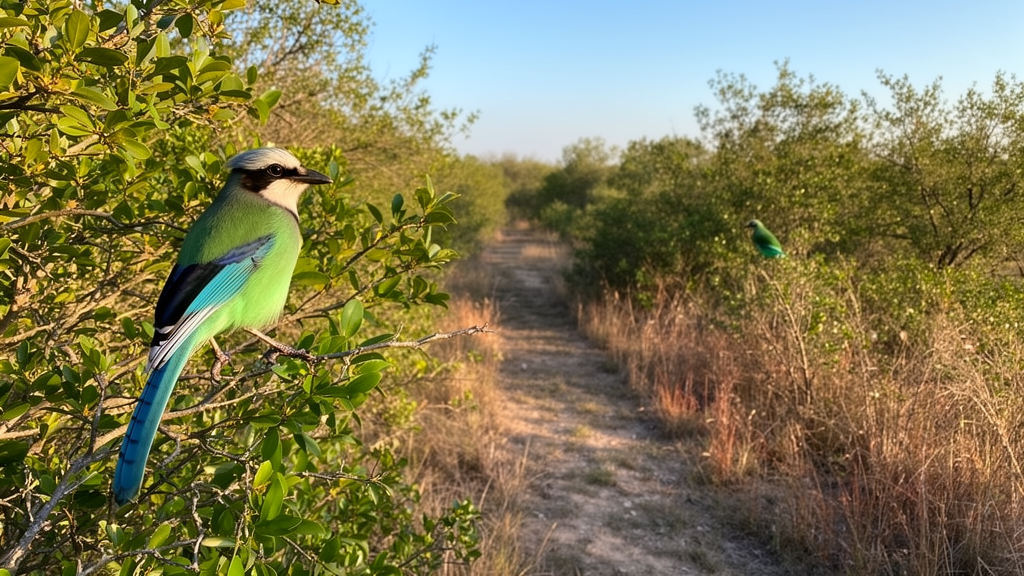
An observational analysis of green jay records, winter climate and supplemental feeding across southern Texas supports a qualified two-phase explanation for the bird’s northward expansion: anthropogenic food resources may have helped begin colonization during a cold period, while later reductions in severe-freeze frequency coincided with more sustained expansion. The study does not directly prove that corn feeding initiated the movement, but its timing and distribution are more consistent with that hypothesis than with warming alone. The researchers combined historical ornithological accounts, eBird observations, temperature records, event-history models and a spatial survey of hunting ranches known to feed deer with corn.
Green jays historically occurred from just north of the Rio Grande south to Honduras, with a separate distribution from Venezuela to Bolivia. In Texas, they favor woodlands and dense brush, avoid open areas with sparse woody cover and travel through vegetated corridors. Their winter diet in the Lower Rio Grande Valley includes Texas ebony and palm fruits, although they also consume lizards, insects and the eggs of other birds.
As native habitat has diminished, citrus orchards, suburban yards and bird feeders have become increasingly important food and nesting resources. Historical accounts indicate that expansion beyond the Lower Rio Grande Valley was underway by the 1960s. Breeding birds were recorded near 27.5° N along both the Rio Grande and the Gulf Coast, although occurrence near the northern margin remained irregular.
Subsequent records documented establishment farther north and inland during the 1980s. A quantitative analysis of 4,983 eBird cell-years, aggregated annually into 0.25° by 0.25° spatial cells, found sustained northward change from approximately 1980 through 2021. The researchers used a quasibinomial generalized additive model to relate green jay detections to total checklist effort while allowing the effect of latitude to change over time and controlling for longitude and checklist protocol composition.
The model’s latitudinal effect was strong, with an estimated degrees of freedom of 5.53, F = 255.41 and p < 0.001. The climate chronology complicates a simple explanation based on warmer winters. Regional winter temperatures showed detectable warming from approximately 1983 to 1991, after northward expansion was already underway.
Moreover, 1973–1982 was the coldest of the 86 possible 10-year windows in the 95-year temperature record used in the study, while four of the ten warmest 10-year periods occurred during the 1930s through the 1950s, before the historical record shows clear expansion. These findings mean that warmer winter conditions alone cannot readily account for when green jays first began moving north, although the study does not exclude climate as a contributing factor. At a finer scale, however, severe cold was associated with a lower probability of successful expansion.
The researchers defined a severe-freeze day as one with a minimum temperature at or below −2.22°C, or 28°F. Using daily minimum temperatures from 1951 through 2026, they modeled regional freeze exposure for the landscape at and north of 27° N. In an event-history analysis, the probability of a first green jay detection declined as the maximum mean frequency of severe freezes during the preceding two winters increased. The estimated coefficient was −0.508 with a standard error of 0.146, z = −3.49 and p < 0.001. The analysis found no evidence that this relationship differed between first and repeated detections, and a penalized-smooth model indicated a linear rather than threshold relationship.
Severe-freeze frequency subsequently showed a detectable decline from approximately 1982 to 1996, overlapping the period of statistically sustained northward change. Supplemental feeding provides a possible explanation for how colonization could have started before winters became consistently milder. Southern Texas ranching and hunting practices have included supplemental corn for white-tailed deer and game birds.
The eradication of the New World screwworm in Texas by 1966 was followed by rapidly increasing deer populations and shifts in wildlife management. Texas permitted doe harvest in 1975, further policy changes in 1979 enabled commercialized hunting, and a 1995 tax measure provided comparable tax benefits for wildlife management on private land. These developments plausibly expanded the use of feeding sites.
Earlier records also described green jays moving north along U.S. Highway 77 after picnic tables and garbage cans were installed beside live-oak mottes in the 1960s, indicating that anthropogenic food was present during the early phase of expansion. The spatial survey found 113 publicly documented white-tailed deer corn-feeding operations across southern Texas, 112 with location information precise enough to map. This represents only a fraction of the region’s feeding activity because many ranches and informal hunting properties are private and do not publicly document supplementation.
A 2006 survey covering 2.3 million acres in South Texas indicated that approximately 46% was managed for hunting and about 80% of that hunting-managed area was managed specifically for deer. Based on reported expenditures, the authors estimated that 133,395 acres within responding ranches received supplemental deer feed. After dividing total spending by the reported per-acre cost and conservatively assigning about half of supplement expenditures to corn, they extrapolated that corn inputs in the Nueces Strip may have reached tens of millions of pounds annually by 2006.
Because annual feeding totals are unavailable, this trajectory was reconstructed from historical policy and management evidence rather than estimated as a formal statistical time series. The mapped distribution nevertheless indicates that feeding occurred across much of the landscape through which the green jay expanded. On intensively managed hunting properties, automatic feeders may be spaced approximately 0.5–1.5 km apart, meaning one feeder can serve roughly 100–240 hectares.
Green jays move in social groups and may be capable of visiting multiple feeders within a home range, so separate feeding sites could function as resource-rich stepping stones through habitat where natural food is patchy. The authors describe this possible network as “corn islands.” Its influence cannot be quantified directly from the public ranch records, and the study does not report an experimental test showing how feeding affected survival or breeding. The proposed mechanism is instead inferred from the overlap between the expansion, the development of feeding practices and the ecological need for winter food in the region.
Land-use change probably had mixed effects. Brush clearing, root plowing and conversion of native vegetation to cattle pasture reduced the woody habitat preferred by green jays across large areas of ranchland. In the Lower Rio Grande Valley, by contrast, repeated freezes damaged citrus orchards and accelerated urban development.
Residential areas with irrigated live oaks, bird feeders and nesting trees may have created favorable habitat within the bird’s former range. At the same time, the fine-scale analysis associates severe freezes with reduced odds of colonization and persistence farther north. These observations are compatible with the possibility that freezes damaged source habitat while also constraining establishment at the new range margin, but the study cannot directly quantify the relative importance of those effects or isolate the effect of feeding at individual sites.
Several limitations prevent a definitive causal conclusion. Historical estimates of supplemental feeding rely on assumptions, including the share of expenditures spent on corn and extrapolation from surveyed ranches to the wider region. The mapped sample omits an unknown amount of private feeding activity, and the event-history analysis uses detection records rather than direct estimates of absolute abundance, although its models account for sampling effort and checklist effort.
Even so, the combined records support the authors’ two-phase hypothesis rather than establish it as a proven mechanism: food subsidies may have created additional opportunities for initial colonization during the 1960s and early 1980s, while declining freeze severity later facilitated continued expansion. Observations of green jays surviving temperatures below −7°C for several days on a western Dimmit County ranch in February 2021 show that established birds can endure extreme cold; they do not by themselves demonstrate that supplemental feeding caused that survival. The central result is thus a qualified interaction: climate appears to have constrained establishment and persistence, whereas the timing of anthropogenic food availability makes it a plausible contributor to the expansion’s beginning.
Subject of Research: Climate, supplemental feeding and the northward range expansion of green jays in Texas
Article Title: Corn or Climate? Climate Change Facilitated, but Did Not Initiate, the Northward Range Expansion of the Green Jay in Texas
Article References: Inman, C. M., & Gilbert, L. E. (2026). Corn or Climate? Climate Change Facilitated, but Did Not Initiate, the Northward Range Expansion of the Green Jay in Texas. Ecology and Evolution, 16(10), Article e74513. https://doi.org/10.1002/ece3.74513
Image Credits: AI Generated
DOI: 10.1002/ece3.74513
Keywords: green jay, range expansion, climate change, supplemental feeding, Texas wildlife, severe freezes, hunting ranches, eBird, bird ecology, anthropogenic food, Corn, Climate
News Source: Sloane Callahan. (October 22, 2026). Research report: Corn or Climate? Climate Change Facilitated, but Did Not Initiate, the Northward Range Expansion of the Green Jay in Texas. Scienmag.