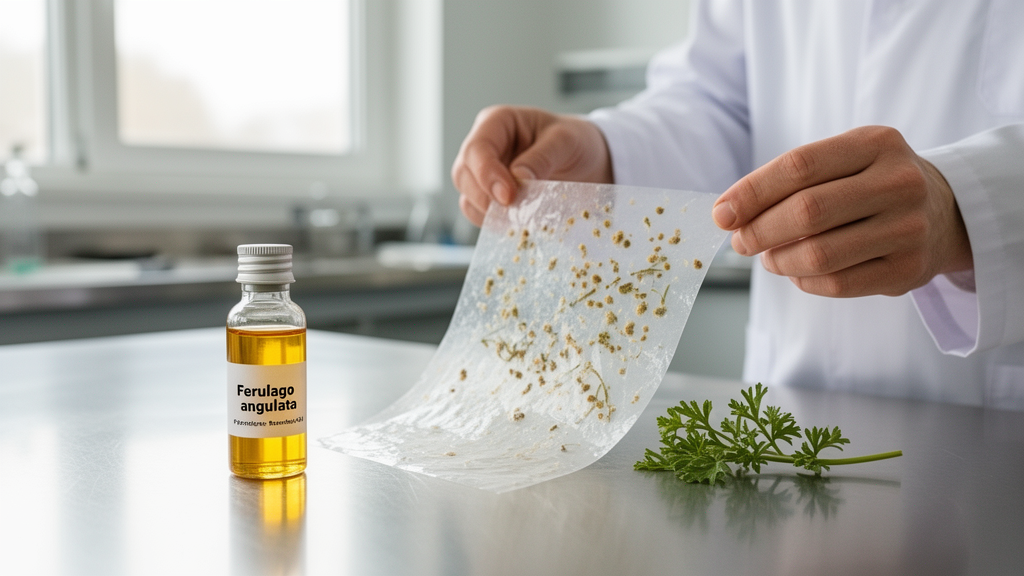
A narrative review finds that essential oil extracted from Ferulago angulata, commonly called chavil, could help extend the shelf life of food in biodegradable active packaging, although its variable composition, volatility, sensory effects and incomplete safety evaluation remain barriers to commercial use. The review examined laboratory demonstrations involving fish, poultry, mushrooms and butter, where Ferulago angulata essential oil, abbreviated FAEO, was incorporated into chitosan, alginate, gelatin, starch, cellulose and zein-based films or nanostructures. Across the compiled food experiments, shelf life was extended by an average of approximately three to eight days, with the strongest results reported for fish and poultry.
These findings concern laboratory and model-food studies rather than a clinical trial or an already approved packaging technology. The review was conducted through searches of PubMed, Scopus, Web of Science and Google Scholar for studies published from January 2000 through 2026. Four researchers screened titles and abstracts and then assessed full texts, while the corresponding authors validated the inclusion and extraction criteria.
Eligible work consisted of peer-reviewed English-language original research examining FAEO chemistry, bioactivity, encapsulation or food-packaging applications. Reviews, systematic reviews, meta-analyses, conference abstracts, editorials, book chapters and studies unrelated to F. angulata or packaging were excluded. Because the work synthesized previously published literature and involved neither human nor animal participants, no new experiment or ethical approval was required.
The available evidence remains uneven: many studies used small food models or short storage trials, and the number of studies directly evaluating FAEO in real food-contact systems was limited. FAEO is chemically distinctive. Gas chromatography–mass spectrometry studies commonly identify monoterpene hydrocarbons including α-pinene, sabinene, (Z)-β-ocimene, limonene and the phellandrenes, but their proportions vary markedly.
An analysis of nine Iranian populations found α-pinene ranging from 20.84% to 49.06%, while other investigations reported stem oil dominated by α-pinene and aerial-part oil containing 32.0% β-phellandrene and 13.8% α-phellandrene. Flower, leaf and fruit oils also had distinct profiles, with essential-oil yields ranging from 0.46% to 2.65%. The review attributes these differences to plant part, geographic origin, altitude, soil, climate and extraction conditions.
That variability matters because the Mongar population with 49.06% α-pinene also showed the strongest antiradical activity among the populations examined, with an EC50 of 42.07 μg/mL. Standardization therefore requires control of more than the botanical name alone. The oil’s antimicrobial activity appears stronger than its antioxidant activity.
Reported minimum inhibitory concentrations included 5 mg/mL for Escherichia coli O157:H7 and 10 mg/mL for Staphylococcus aureus in one food-related study, while FAEO inhibited Bacillus thuringiensis at 8 μL/mL and completely inhibited Fusarium oxysporum at the highest concentration tested. FAEO-loaded chitosan nanoparticles had minimum inhibitory and bactericidal concentrations of 0.45 and 0.90 mg/mL against S. aureus, compared with 2.12 and 4.25 mg/mL against E. coli. The difference is consistent with the extra outer membrane of Gram-negative bacteria acting as a barrier to hydrophobic compounds, although the review stresses that the mechanisms of essential oils remain incompletely resolved.
Proposed effects include insertion of monoterpenes into phospholipid bilayers, increased membrane permeability, leakage of cellular contents, oxidative stress, interference with metabolism and inhibition of spore germination. Antioxidant performance was described as moderate to low relative to phenolic-rich oils such as thyme, oregano and clove. A thymol-rich FAEO chemotype containing 6.9% thymol had an IC50 of 488 μg/mL in one assay, and a chitosan solution with 3% FAEO showed 22% DPPH radical scavenging, compared with 6.15% for chitosan alone.
Encapsulated FAEO in maltodextrin and Arabic gum reached 52.81% ABTS inhibition at 3% loading, with a reported total phenolic content of 66.88 mg/mL. The contrast reflects FAEO’s relatively low concentration of phenolic compounds and its predominance of monoterpene hydrocarbons, which are generally weaker radical scavengers than thymol or carvacrol. Smaller droplets produced by nanoemulsification increased the measured antioxidant effect by improving dispersion and surface area, but the response remained formulation-dependent.
Encapsulation and controlled release emerged as the central engineering strategies for making FAEO usable in packaging. Nanoencapsulated FAEO in methylcellulose films provided sustained release and antioxidant activity. Chitosan nanoparticles made by ionic gelation achieved a maximum encapsulation efficiency of 60.20% and a loading capacity of 24.5%, while zein nanofibers made by electrospinning reached efficiencies of 96.15% to 96.82%.
Electrospinning can also limit exposure to oxygen, light, humidity and pH changes while masking strong aromas, but polymer selection remains important. Release profiles varied sharply: chitosan nanoparticles released about 36% of the oil at pH 3 versus 27% at pH 7.4, zein fibers released 13.23% to 23.45% within 12 hours before a slower phase, and spray-dried chitosan microspheres released roughly half their load during the first five hours. Such burst delivery can provide immediate antimicrobial action but may also waste volatile oil through sensory impact or loss.
A useful film must therefore release the oil at a rate matched to the development of microbial and oxidative spoilage. The polymer matrix can determine whether FAEO strengthens or weakens a film. In carboxymethyl cellulose–Zedo gum films containing 2.5 μL Ferulago extract, tensile strength rose from 6.92 MPa to approximately 10.55–12.50 MPa, while moisture content and water-vapor permeability fell.
By contrast, adding 0.5% to 1.5% FAEO to starch–carboxymethyl cellulose films reduced tensile strength from 7.50 to 3.37 MPa, apparently by disrupting the polymer network, but also lowered water-vapor permeability from 1.81 to 1.14 × 10⁻⁷ g/m·h·Pa, moisture absorption from 14.43% to 10.25% and solubility from 28.72% to 20.88%. Chitosan and methylcellulose formulations also showed formulation-dependent changes in thickness, strength, extensibility and lightness. These apparently opposing effects demonstrate why a successful concentration in one carrier cannot be assumed to work in another.
The extract can act as a reinforcing filler in one network, a plasticizer in another or a source of greater water resistance while simultaneously reducing strength. Food trials provided the most direct evidence for practical preservation. A 3% FAEO nanoemulsion in a chitosan coating reduced growth of the spoilage bacteria Shewanella putrefaciens and Pseudomonas fluorescens in rainbow trout stored for 16 days at 4°C. Total viable counts in controls exceeded 7 log CFU/g by day 8 but remained below that threshold until day 12 in coated samples, while the nanoemulsion reduced microbial growth by about 2.57 log CFU/g by day 16.
Spoilage measured as total volatile basic nitrogen reached its 25 mg N/100 g limit on day 16 rather than day 8, and TBARS remained below 5 mg MDA/kg. Alginate coatings containing FAEO kept chicken total viable counts below 7 log CFU/g until day 9, slowed psychrotrophic growth and reduced lipid oxidation, with TBARS of 0.36 mg MDA/kg after 12 days versus 1.20 mg MDA/kg in controls. These trials indicate shelf-life extension under refrigerated conditions, but they do not establish performance across commercial supply chains or under varied temperature and distribution conditions.
Other applications produced narrower but still measurable benefits. Gelatin–chitosan films with 0.5% FAEO delayed the 7 log CFU/g spoilage threshold in turkey from day 6 to day 12 and improved sensory qualities, while starch–carboxymethyl cellulose films containing FAEO slowed peroxide and acid-number increases in butter for up to six days. In mushrooms, chitosan with 150 ppm FAEO reduced weight loss, loss of firmness and microbial growth.
Sensory effects can be beneficial at low doses: 0.01% FAEO improved taste, aroma and acceptability in probiotic yogurt. At higher concentrations, however, the oil can overpower delicate foods or introduce bitterness. The review therefore treats sensory optimization, rather than maximum bioactivity alone, as a central requirement.
It also notes that the 3-to-8-day average extension was calculated from the compiled studies, most of which reported statistical improvements with p < 0.05, rather than from a pooled meta-analysis of a common endpoint. Commercial adoption remains constrained by safety, consistency and scale. FAEO is volatile and vulnerable to light, heat and oxygen; it is hydrophobic and may separate unevenly in hydrophilic starch, cellulose or chitosan matrices; and its aroma may limit acceptable doses.
Food-contact rules require migration and toxicological assessments, while the evidence summarized here does not establish that FAEO packaging is safe for every food or consumer population. Most experiments focused on spoilage organisms, selected bacteria or fungi, and much less evidence addresses foodborne viral or parasitic hazards. Reported acute-toxicity findings for Ferulago extracts in rats and a cell-based cytotoxicity test are not substitutes for migration testing of the complete oil-loaded packaging system.
Industrial production also requires standardized plant sources, reproducible extraction, uniform loading and scalable processes such as extrusion combined with encapsulation. The review identifies migration studies, long-term stability testing, broader food matrices, hybrid FAEO–bioactive systems, three-dimensional printing and predictive modeling as research priorities. Future work would also need systematic comparisons of electrospun fibers across polymer matrices, optimization for high-moisture and fatty foods, and clear separation of microbial shelf-life extension from biochemical degradation during storage.
The conclusion is therefore promising but conditional: FAEO can function as a moderate antimicrobial and antioxidant additive in active biopolymer packaging, but controlled formulation, standardized composition, tailored release and comprehensive safety evaluation are required before the approach can move reliably from laboratory demonstrations into widespread food-contact use.
Subject of Research: Narrative review of Ferulago angulata essential oil in biopolymer-based active food packaging
Article Title: Bioactive and Functional Properties of Ferulago angulata Essential Oil for Sustainable Food Packaging Systems
Article References: Bahraminejad, M., Mirhesari, D. M., Sadeghi, E., Bahramian, B., Abedi‐Firoozjah, R., & Shokri, S. (2026). Bioactive and Functional Properties of Ferulago angulata Essential Oil for Sustainable Food Packaging Systems. Food Science & Nutrition, 14(10), Article e72470. https://doi.org/10.1002/fsn3.72470
Image Credits: AI Generated
DOI: 10.1002/fsn3.72470
Keywords: Ferulago angulata, essential oil, active packaging, biopolymer films, food preservation, nanoencapsulation, shelf-life extension, antimicrobial activity, antioxidant activity, Bioactive, Functional, Properties
News Source: Alan Morgan. (October 21, 2026). Research report: Bioactive and Functional Properties of Ferulago angulata Essential Oil for Sustainable Food Packaging Systems. Scienmag.