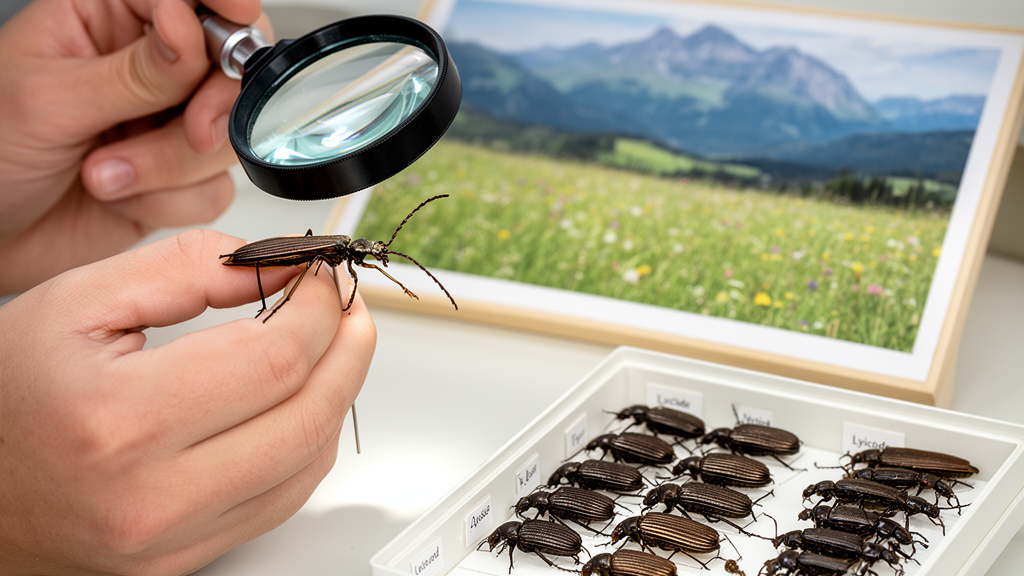
A comprehensive faunistic reassessment recognizes 106 species of soft-bodied beetles in the families Cantharidae and Lycidae as currently occurring, or formerly occurring, in Switzerland. The revised checklist comprises 100 soldier beetles in Cantharidae and six net-winged beetles in Lycidae, adding 12 taxa to the 1979 national list and removing two whose Swiss records could not be substantiated. The study drew on 26,208 occurrence records and separated evidence that could be verified from historical claims that remain taxonomically or geographically uncertain.
Researchers rebuilt the inventory by examining relevant material in 18 museum collections in Switzerland and two major collections abroad: the Natural History Museum in London and the Staatliches Museum für Naturkunde Stuttgart. They also incorporated specimens from the authors’ collections and nine named private collections, together with all available literature relevant to Switzerland and treatments of neighbouring regions in France, Italy, Germany, Austria, Liechtenstein, Alsace and South Tyrol. A record was retained only when its data were considered sufficiently reliable, with unambiguous labels, credible collection history and appropriate diagnostic evidence.
Verified records were then compiled into distribution maps and made available through the CSCF cartographic server and GBIF. The analysis demonstrates that a national checklist is not simply a catalogue of names: it must also track changing taxonomy and the evidential quality of every occurrence. Ancistronycha violacea was renamed A. tigurina under the treatment adopted by Silfverberg, while Malthodes lucernensis, once described as a Swiss species, was synonymised with M. maurus after examination of abundant material.
Malthodes icaricus was elevated from subspecies of M. penninus to a separate species, M. transeuropaeus was synonymised with M. europaeus, and Malthodes trifurcatus atramentarius was subsumed under M. trifurcatus. The checklist also restored Silis ruficollis as the valid name for Crudosilis ruficollis and transferred Silis nitidula to the genus Autosilis. The newly accepted Swiss taxa are Cantharis fibulata, C. liburnica and C. paradoxa; Malthinus rubricollis and M. sordidus; Malthodes facetus, M. holdhausi, M. kahleni, M. stolzi, M. umbrosus and M. vincens; and Rhagonycha pedemontana.
More intensive surveying produced many of these additions, while others followed taxonomic splits that separated species previously treated as one, including the revalidation of Cantharis fibulata. Conversely, Malthodes montanus was removed after examination showed that the cited Swiss specimens were misidentified M. spathifer, M. cyphonurus or M. hexacanthus. M. boicus, which had been added after the 1979 checklist, was also deleted after its Swiss voucher specimens were found to be M. umbrosus.
Male terminalia proved decisive in many of the revisions. Reliable identification of numerous Malthodes, Malthinus and Rhagonycha species depends on anatomical features that cannot be assessed confidently from external appearance, so the authors counted only dissected males as verified records where females were not reliably identifiable. Systematic examination of the Cantharis quadripunctata and C. montana complex showed that the Swiss males previously assigned to the former belonged to C. montana, leaving a single anatomically confirmed Swiss specimen of C. quadripunctata, collected in far eastern Grisons in 2017.
Dissection also confirmed the presence of both C. pagana and C. fibulata in Switzerland, while numerous specimens recorded as Rhagonycha femoralis were reassigned to R. fuscitibia. Several exclusions arose from weak labels, problematic collection histories or geographical confusion. The Charles Maerky collection at Geneva contains insects from several sources, often without their original labels, and has long been treated as problematic.
A claimed Cantharis liburnica specimen from Mendrisio came from that collection and was not retained, although a second, undated specimen supported a new country record. The supposed Swiss locality for Autosilis nitidula was Macugnaga, which is in Italy near the border, while two other specimens bore only the imprecise label “Schweiz.” Malthodes bifurcatus was removed because its cited specimen could not be found and the remaining specimens from the same locality were identified as M. spretus. A vague 1856 literature citation was the only evidence for M. dimidiaticollis, so that species was also excluded.
Some confirmed records represent conspicuous extensions of known ranges. Malthodes stolzi had been considered a rare endemic of the Bergamasque Prealps in northern Italy, but a voucher collected at Bruzella in southern Ticino in 1980 extends its documented Swiss and Italian range by about 50 kilometres. M. kahleni, described from Tyrol and regarded as a possible relict species with a broad but sparse European distribution, is represented in Switzerland by one specimen from Hasle im Entlebuch in Lucerne, found in riparian woodland.
M. crassicornis is provisionally retained on the strength of a single specimen from Tannino near Chiasso, collected in 1930 and subsequently dissected to confirm its identity. The authors stress that further sampling is needed before the extent and status of these occurrences can be regarded as secure. Even with 26,208 occurrences compiled, the distribution picture remains uneven.
The authors regard the general foundation as solid by comparison with available knowledge for many other countries, but targeted collecting and anatomical examination remain necessary for difficult Malthodes, Malthinus and Rhagonycha species. Species known from adjacent regions may also be present but undiscovered in Switzerland, particularly in Ticino. Research cited by the checklist reported distinct mitochondrial lineages within species then treated as single taxa, including Cantharis terminata, C. tristis and Malthodes mysticus, indicating that additional cryptic diversity may remain concealed within named species.
The updated maps therefore provide a baseline for testing future records rather than a claim that every distributional gap represents true absence. The checklist also exposes major gaps in ecological knowledge. Adults of Cantharidae can be encountered by sweeping herbaceous vegetation, beating trees and shrubs or searching flowers, but Swiss larval ecology remains fragmentary for most species.
Malthinus and some Malthodes larvae are predators in rotting wood, whereas larvae of other cantharid genera are reported as predators in soil and leaf litter; the source does not establish species-specific larval ecology for most Swiss taxa. Several included beetles are rare at European scale or have restricted ranges, among them Malthodes kahleni, M. bertolinii, M. vincens and M. stolzi. Yet apparent scarcity may reflect short adult periods, small body size and difficult identification rather than genuine rarity, while conversely an undetected decline could occur because little is known about habitat requirements.
The final list consequently identifies both the present evidence for Swiss occurrence and the sampling, taxonomic and ecological work still required.
Subject of Research: Taxonomy, occurrence and distribution of Swiss Cantharidae and Lycidae
Article Title: An updated checklist of the Cantharidae and Lycidae of Switzerland ( Coleoptera , Elateroidea )
Article References: Chittaro, Y., Sanchez, A., & Geiser, M. (2021). An updated checklist of the Cantharidae and Lycidae of Switzerland (Coleoptera, Elateroidea). Alpine Entomology, 5, 77-94. https://doi.org/10.3897/alpento.5.67808
Image Credits: AI Generated
Keywords: Cantharidae, Lycidae, Swiss fauna, beetle checklist, taxonomic revision, museum collections, species distribution, male genitalia, biodiversity monitoring, coleopterology, updated, checklist
News Source: Drew Townsend. (October 20, 2026). Research report: An updated checklist of the Cantharidae and Lycidae of Switzerland ( Coleoptera , Elateroidea ). Scienmag.