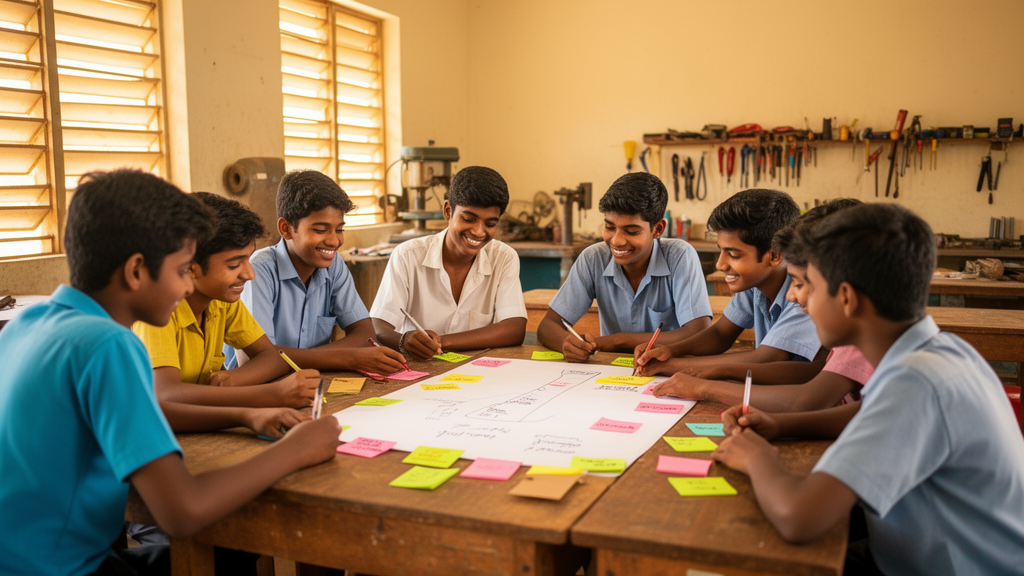
Youth violence in schools, universities and vocational colleges is widely recognised as a public health problem, but the people best placed to change it — the students themselves — are rarely put in charge. A new study from Sri Lanka took the opposite approach. Researchers at a technical college in the country’s Central Province handed a twelve-month violence prevention effort over to the students, guiding them through participatory action research (PAR) and health promotion principles rather than imposing a fixed programme from above. According to the qualitative findings, published in Discover Public Health, students reported a broadened understanding of what counts as violence, greater awareness of its harms, weaker peer encouragement of violent behaviour, less glamour attached to fighting, and reductions in physical, verbal and emotional violence after the intervention.
The study population consisted of all 74 students enrolled in two-year-long courses at the college — 48 women and 26 men, aged 20 to 27 years. Because the intervention required sustained interaction, eligibility was limited to these two-year students, who belonged to two consecutive academic batches separated by only one semester. Using a census sampling approach, the team invited every eligible student, and all 74 consented to participate. COVID-19-related disturbances extended the courses, so both batches remained enrolled and took part in all phases, from baseline data collection through intervention design and implementation to the post-intervention interviews.
The scale of the problem the students confronted is well documented in the region. An estimated 246 million school-going adolescents worldwide experience some form of bullying each year. In Sri Lanka, 48 percent of surveyed school students aged 13 to 15 reported being physically attacked at least once in the previous year, and a cross-sectional survey of 2,641 students aged 12 to 14 in Kegalle District found bullying victimisation of 59 percent, with verbal bullying at 45.2 percent. In tertiary education, ragging — a hazing-like practice — is a serious concern: among undergraduates from eight state universities, 51.1 percent reported at least one instance of verbal harassment during ragging, 34.3 percent a negative psychological experience, 23.8 percent physical harassment and 16.8 percent sexual harassment. Vocational training institutions, where large numbers of young people gather and interact closely over long periods, had rarely been studied.
The intervention ran from March 2022 to March 2023 and was informed by a community-centred model of health promotion developed by Samarasinghe and colleagues in 2011. Rather than prescribing activities, the process moved through structured steps. In facilitated discussions, students first agreed that a violence-free college was essential to a supportive learning environment and adopted that as their shared goal. They then identified determinants of youth violence from their own experience, analysed them across individual, family, school and societal levels, and prioritised three using explicit criteria: modifiability, impact on violence, available time and resources, and their own interest. The chosen targets were poor awareness of harm, peer influence, and the glamourisation of violence.
Over fifteen further hour-long interactive discussions, students co-designed and implemented eight actions addressing those three determinants. The principal investigator facilitated, probing for clarification and encouraging consensus, but the specific actions were generated and led by the students themselves. Fidelity was monitored using implementation outcomes — participants’ responsiveness and quality of delivery — with students rating each session and the team adjusting subsequent sessions, for example by adding more small-group and interactive activities, when scores flagged low engagement. The principal investigator also kept a reflective diary recording every session, its outcomes and reflections, which fed modifications into the ongoing work.
Changes were assessed through qualitative data collected before and after the intervention: six focus group discussions with students and seven key informant interviews with staff members in each phase, conducted in Sinhala and lasting roughly 60 to 90 minutes. The topic guides were initially drafted by the research team and then refined with students in two dedicated discussions. Data collection ran from January to February 2022 at baseline and from April to May 2023 afterwards, continuing until saturation. Transcripts were analysed separately for each phase using a six-step framework thematic analysis, then compared integratively. In keeping with the PAR ethos, students also reviewed anonymised preliminary findings, checked them for accuracy and helped interpret them.
Five themes described the changes participants reported. First, the meaning of violence broadened: before the intervention, some students saw violence as a way of releasing stress or solving problems, and name-calling was normalised as joking; afterwards, most rejected violence as a means of obtaining social justice or enforcing rights, and recognised threatening, insulting and stigmatising acts as violence even without bodily harm. Perceptions linking toughness and aggression to masculinity also weakened, with some male students explicitly rejecting the idea that violence belongs to manhood. Second, awareness of harm expanded from physical injury and disrupted education to psychological stress, fear experienced by perpetrators, damage to families’ standing, and even consequences for national development and productivity.
The third and fourth themes concerned the social fabric around violence. Peer responses that once encouraged fighting shifted toward criticism and de-escalation, which students attributed to classroom-based actions in which they monitored and changed their own reactions to conflict. Students described refusing friends’ requests to join fights, and female students who had previously supported male peers’ violence reported stopping fights before they started. Staff members observed that the peer group itself was now discouraging trouble, noting that students of this age listen more to their friends than to teachers. The glamour attached to violence also faded: the image of the fighter as a hero gave way to violence being framed as foolish, cowardly and shameful, a shift students and staff linked to the posters and social media messages the students produced.
The fifth theme covered reported behavioural change. Staff said they no longer witnessed physical violence between courses at collective college events such as volleyball matches, which had previously often ended in fights, and no parents of new students complained of physical harassment during enrolment — a break from past patterns. Students reported using non-violent strategies, such as informing teachers and discussing conflicts. Screaming and scolding of juniors by seniors declined, relationships between batches improved, and name-calling, public embarrassment and hurtful social media posts were reported as less frequent. Some behaviours persisted, however: staff noted that seniors still marginalised some freshers, and certain seniors continued shouting at juniors.
The authors are careful about what these findings can and cannot show. As a qualitative, single-institution study, it demonstrates perceived changes reported by participants rather than measured reductions in violence incidents, and the design does not allow definitive attribution of the changes solely to the intervention. Focus groups on sensitive topics such as violence may introduce social desirability bias, all interviewed staff were men, the intervention targeted only three prioritised determinants, and academic staff were not directly addressed, which may affect sustainability. The sample’s family characteristics also cannot be generalised to the wider Sri Lankan population. Within those limits, the study fills a gap in low- and middle-income country evidence on PAR-based violence prevention, where comprehensive approaches — such as peer-led and teacher-focused interventions in Indonesia that reduced bullying by roughly 30 percent, or Uganda’s Good School Toolkit, which cut physical violence by 42 percent — have shown what coordinated strategies can achieve. The team recommends assessing the sustainability of the outcomes over time and extending the approach to other vocational institutions and universities in Sri Lanka and the region, while future research addresses family and societal determinants and other forms of violence, such as dating violence, that this study did not target.
Subject of Research: A student-centred participatory action research intervention addressing youth violence in a Sri Lankan vocational training institution
Article Title: A student-centred intervention guided by participatory action research to address youth violence in a vocational training institution in Sri Lanka
Article References: Rathnayake, N., Abhayasinghe, K., De Silva, J., & Guruge, G. N. D. (2026). A student-centred intervention guided by participatory action research to address youth violence in a vocational training institution in Sri Lanka. Discover Public Health, 23(1), Article 1733. https://doi.org/10.1186/s12982-026-03202-4
Image Credits: AI Generated
DOI: 10.1186/s12982-026-03202-4
Keywords: youth violence, participatory action research, health promotion, Sri Lanka, vocational training, violence prevention, peer influence, ragging, qualitative research, student empowerment, bullying, technical college
News Source: Ophelia Keating. (October 30, 2026). Research report: A student-centred intervention guided by participatory action research to address youth violence in a vocational training institution in Sri Lanka. Scienmag.