• HOME
  • NEWS
  • EXPLORE
    • CAREER
      • Companies
      • Jobs
    • EVENTS
    • iGEM
      • News
      • Team
    • PHOTOS
    • VIDEO
    • WIKI
  • BLOG
  • COMMUNITY
    • FACEBOOK
    • INSTAGRAM
    • TWITTER
Sunday, May 17, 2026
BIOENGINEER.ORG
No Result
View All Result
  • Login
  • HOME
  • NEWS
  • EXPLORE
    • CAREER
      • Companies
      • Jobs
        • Lecturer
        • PhD Studentship
        • Postdoc
        • Research Assistant
    • EVENTS
    • iGEM
      • News
      • Team
    • PHOTOS
    • VIDEO
    • WIKI
  • BLOG
  • COMMUNITY
    • FACEBOOK
    • INSTAGRAM
    • TWITTER
  • HOME
  • NEWS
  • EXPLORE
    • CAREER
      • Companies
      • Jobs
        • Lecturer
        • PhD Studentship
        • Postdoc
        • Research Assistant
    • EVENTS
    • iGEM
      • News
      • Team
    • PHOTOS
    • VIDEO
    • WIKI
  • BLOG
  • COMMUNITY
    • FACEBOOK
    • INSTAGRAM
    • TWITTER
No Result
View All Result
Bioengineer.org
No Result
View All Result
Home NEWS Science News Health

Research could lead to more precise diagnosis and treatment of ovarian cancer

Bioengineer by Bioengineer
May 8, 2019
in Health
Reading Time: 2 mins read
0
IMAGE
Share on FacebookShare on TwitterShare on LinkedinShare on RedditShare on Telegram

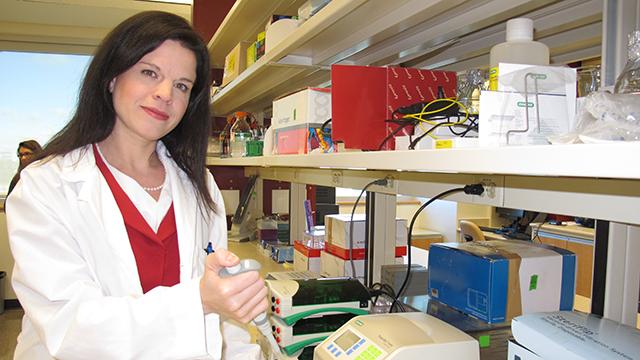
Newly found biomarkers 99% accurate at differentiating between two types of ovarian cancer, according to University of Alberta researcher
IMAGE

Credit: University of Alberta

Oncologists may soon have an accurate and inexpensive way of differentiating between types of ovarian cancer that will improve how patients are treated, thanks to findings from a national research study co-led out of the University of Alberta.

“One of the issues with ovarian cancer is that we cannot fully decipher between subtypes,” said Lynne Postovit, U of A oncology researcher and co-director of the Cancer Research Institute of Northern Alberta. “This is an important problem because the different subtypes should be treated differently.”

She explained that women with endometrioid-type ovarian carcinoma usually have a better prognosis for beating the disease and need a less aggressive treatment than women suffering from high-grade serous carcinomas, which is the most common and deadly form of ovarian cancer.

Unfortunately, the diagnosis of which form of ovarian cancer a woman has is wrong 10 per cent of the time.

“That doesn’t sound like a big deal, but the difference in the ways that women with endometrioid versus high-grade serous are treated is significant,” said Postovit, who received funding from the Lois Hole Hospital for Women through the Women and Children’s Health Research Institute.

“Not knowing with complete certainty which form of cancer the patient has means that oncologists have to go with the harshest treatment regardless.”

Growing weary of the cautionary and often overly aggressive one-size-fits-all treatment, Postovit, together with colleagues at the University of Calgary and Western University, looked at the proteins present in the different types of cancers.

The team found eight protein biomarkers that enable pathologists to differentiate between a endometrioid or high-grade serous carcinoma with 99.2 per cent accuracy.

“The relevance is if you know what you’re looking at, you take a precision medicine approach to better tailor the treatment to the patient, so they have potentially less side-effects,” she said. “This is what personalized medicine is all about–starting to look at each patient’s cancer differently.”

And because the study was tailored to be more practical, Postovit said the team can immediately start to test how broadly this might work.

“In fact, because it is a rather inexpensive test and involves technology we already have, there is no need to build a new paradigm. It can be taken up without costing all that much.”

Postovit said the next steps are to validate the results on a larger patient cohort and then to suggest implementation, which could be within a few years.

“This is all because of philanthropic and chair funding that allows us to ask questions that normally we wouldn’t,” she said.

###

Media Contact
Ross Neitz
[email protected]

Original Source

https://www.folio.ca/research-could-lead-to-more-precise-diagnosis-and-treatment-of-ovarian-cancer/

Related Journal Article

http://dx.doi.org/10.1158/1078-0432.CCR-18-3818

Tags: cancerDiagnosticsMedicine/Health
Share13Tweet8Share2ShareShareShare2

Related Posts

Phocaeicola dorei Eases Liver Fibrosis via Efferocytosis

May 17, 2026

Boosting Aging Positivity and Activity in Older Couples

May 17, 2026

Short-Term Home Cognitive & Physical Training Tested in Seniors

May 16, 2026

New Kineococcus Species Discovered on Anabasis Seeds

May 16, 2026
Please login to join discussion

POPULAR NEWS

  • Research Indicates Potential Connection Between Prenatal Medication Exposure and Elevated Autism Risk

    844 shares
    Share 338 Tweet 211
  • New Study Reveals Plants Can Detect the Sound of Rain

    730 shares
    Share 291 Tweet 182
  • Salmonella Haem Blocks Macrophages, Boosts Infection

    62 shares
    Share 25 Tweet 16
  • Breastmilk Balances E. coli and Beneficial Bacteria in Infant Gut Microbiomes

    58 shares
    Share 23 Tweet 15

About

We bring you the latest biotechnology news from best research centers and universities around the world. Check our website.

Follow us

Recent News

Phocaeicola dorei Eases Liver Fibrosis via Efferocytosis

Boosting Aging Positivity and Activity in Older Couples

Explainable Multi-Agent Learning Disrupts Terrorist Networks

Subscribe to Blog via Email

Enter your email address to subscribe to this blog and receive notifications of new posts by email.

Join 82 other subscribers
  • Contact Us

Bioengineer.org © Copyright 2023 All Rights Reserved.

Welcome Back!

Login to your account below

Forgotten Password?

Retrieve your password

Please enter your username or email address to reset your password.

Log In
No Result
View All Result
  • Homepages
    • Home Page 1
    • Home Page 2
  • News
  • National
  • Business
  • Health
  • Lifestyle
  • Science

Bioengineer.org © Copyright 2023 All Rights Reserved.