• HOME
  • NEWS
  • EXPLORE
    • CAREER
      • Companies
      • Jobs
    • EVENTS
    • iGEM
      • News
      • Team
    • PHOTOS
    • VIDEO
    • WIKI
  • BLOG
  • COMMUNITY
    • FACEBOOK
    • INSTAGRAM
    • TWITTER
Thursday, June 25, 2026
BIOENGINEER.ORG
No Result
View All Result
  • Login
  • HOME
  • NEWS
  • EXPLORE
    • CAREER
      • Companies
      • Jobs
        • Lecturer
        • PhD Studentship
        • Postdoc
        • Research Assistant
    • EVENTS
    • iGEM
      • News
      • Team
    • PHOTOS
    • VIDEO
    • WIKI
  • BLOG
  • COMMUNITY
    • FACEBOOK
    • INSTAGRAM
    • TWITTER
  • HOME
  • NEWS
  • EXPLORE
    • CAREER
      • Companies
      • Jobs
        • Lecturer
        • PhD Studentship
        • Postdoc
        • Research Assistant
    • EVENTS
    • iGEM
      • News
      • Team
    • PHOTOS
    • VIDEO
    • WIKI
  • BLOG
  • COMMUNITY
    • FACEBOOK
    • INSTAGRAM
    • TWITTER
No Result
View All Result
Bioengineer.org
No Result
View All Result
Home NEWS Science News Biology

Remarkable cellular architecture and phylogenetic position of the mysterious arm-swinging protist meteora sporadica

Bioengineer by Bioengineer
February 6, 2024
in Biology
Reading Time: 2 mins read
0
Image Photo
Share on FacebookShare on TwitterShare on LinkedinShare on RedditShare on Telegram

Tsukuba, Japan—Meteora sporadica is a small, unicellular eukaryote (protist) that was discovered in deep Mediterranean sea sediments in 2002. It differs from known protists by the presence of two lateral arms that swing back and forth. However, the ultrastructure and phylogenetic position of M. sporadica remain unknown.
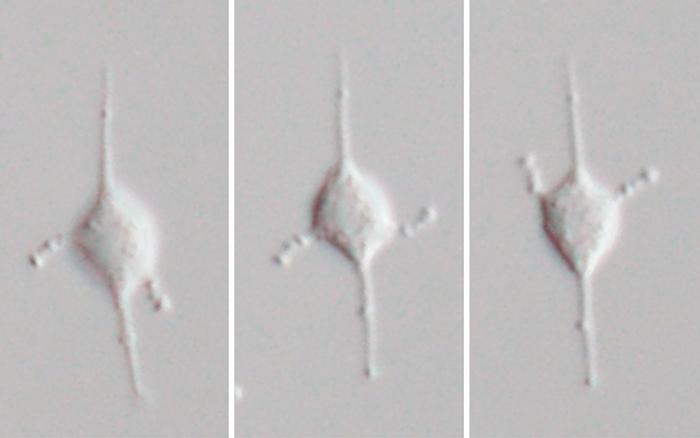
Image Photo

Credit: University of Tsukuba

Tsukuba, Japan—Meteora sporadica is a small, unicellular eukaryote (protist) that was discovered in deep Mediterranean sea sediments in 2002. It differs from known protists by the presence of two lateral arms that swing back and forth. However, the ultrastructure and phylogenetic position of M. sporadica remain unknown.

In this study, researchers successfully cultured and analyzed two strains of M. sporadica from marine sediments in detail. Ultratructural observations revealed that M. sporadica has a complex cytoskeleton, with lateral arms that are supported by microtubules extending from multiple microtubule-organizing centers (MTOCs) located in the center of the cell. A large-scale molecular phylogenetic analysis using amino acid sequences of 254 genes revealed that M. sporadica is not associated with any of the major eukaryotic lineages (supergroups) identified to date, but is closely related to Hemimastigophora, a group of protists considered to be one of the most deep-branching eukaryotes.

Interestingly, Hemimastigophora is composed of large protists with numerous flagella and no arms or MTOCs. This study demonstrates that Meteora and Hemimastigophora represent a morphological diversity that is comparable to other supergroups. Identifying and analyzing poorly-studied protists, such as M. sporadica, is essential for elucidating the phylogeny and diversity of eukaryotes.

###
This study was supported by the Japan Society for the Promotion of Science (JSPS) KAKENHI Grant Numbers: 13J00587, 18J02091, by NSERC discovery grant 298366-2019 (to AGBS), and NSERC Discovery grant RGPIN-2022-05430 (to AJR).


Original Paper

Title of original paper:
Meteora sporadica, a protist with incredible cell architecture, is related to Hemimastigophora

Journal:
Current Biology

DOI:
10.1016/j.cub.2023.12.032

Correspondence

Assistant Professor SHIRATORI, Takashi
Institute of Life and Environmental Sciences, University of Tsukuba

Related Link

Institute of Life and Environmental Sciences


Journal

Current Biology

DOI

10.1016/j.cub.2023.12.032

Article Title

Meteora sporadica, a protist with incredible cell architecture, is related to Hemimastigophora

Article Publication Date

22-Jan-2024

Share12Tweet8Share2ShareShareShare2

Related Posts

Natural Hallucinogens: Evolution’s Ecological Tools, Not Mere Chemical Byproducts

June 25, 2026

This Famous Butterfly Revealed: Three Distinct Species Hidden in One

June 25, 2026

Scientists Attack Soybean Cyst Nematode by Starving Its Food Source

June 25, 2026

Decoding the Secret Code of a Crucial Immune Sensor

June 24, 2026

POPULAR NEWS

  • Saying Goodbye to PGY-6: Pediatric Fellowship Realities

    103 shares
    Share 41 Tweet 26
  • Multi-Hospital Study Reveals Long Covid Burden Is Twice as High as Current Estimates

    92 shares
    Share 36 Tweet 23
  • Detection of EDCs in Breast Milk and Infant Urine Up to Six Months Highlights Early Exposure Risks

    77 shares
    Share 31 Tweet 19
  • New Drug Candidate Developed at McMaster Shows Potential for Treating Brain Cancer

    58 shares
    Share 23 Tweet 15

About

We bring you the latest biotechnology news from best research centers and universities around the world. Check our website.

Follow us

Recent News

Tracking Lanthanide-Labeled Microplastics in Plants

POSTECH Researchers Slash Cost of Reconstituted Cell-Free Systems by 95%

AI and Physics Collaborate to Design Advanced Hydrogen Storage Materials

Subscribe to Blog via Email

Success! An email was just sent to confirm your subscription. Please find the email now and click 'Confirm' to start subscribing.

Join 82 other subscribers
  • Contact Us

Bioengineer.org © Copyright 2023 All Rights Reserved.

Welcome Back!

Login to your account below

Forgotten Password?

Retrieve your password

Please enter your username or email address to reset your password.

Log In
No Result
View All Result
  • Homepages
    • Home Page 1
    • Home Page 2
  • News
  • National
  • Business
  • Health
  • Lifestyle
  • Science

Bioengineer.org © Copyright 2023 All Rights Reserved.