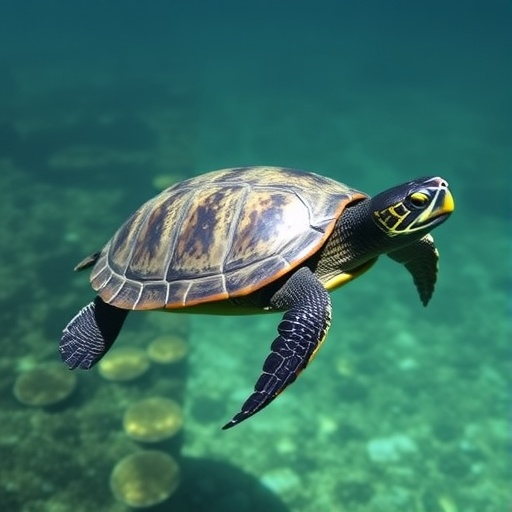
In 2015, a virus swept through a single Australian river and erased ninety percent of the turtles living in it. The Bellinger River turtle (Myuchelys georgesi), confined to a 60-kilometre stretch of freshwater on the mid-north coast of New South Wales, crashed from roughly 4,000 individuals to around 200 as the pathogen moved through its only home. A new study, published in the journal Immunogenetics, has now re-sequenced the complete genomes of 31 pure-bred animals and delivered a sobering diagnosis: the species entered that epidemic already carrying one of the lowest levels of genome-wide genetic diversity ever recorded in a reptile, with ninety percent of its genome locked inside long stretches of identical DNA. Yet hidden within that depleted genome, researchers found something unexpected — a compact cluster of immune genes that has clung to a surprising share of its variation, offering both a puzzle and a sliver of hope for one of the world’s most endangered turtles.
The culprit behind the collapse was a nidovirus, since named Bellinger River virus — a positive-sense RNA virus whose relatives infect mammals, fish and other reptiles. What made the event so catastrophic was geography. The Bellinger catchment is wedged between the Pacific Ocean to the east and the Great Dividing Range to the west, barriers that isolated the region’s waterways for millions of years and drove the evolution of species found nowhere else on Earth. That isolation proved to be a trap: with no neighbouring populations to supply new immigrants, the turtle had no genetic rescue option when disease arrived. Since 2015, two further, less documented viral outbreaks have struck the river, in January 2022 and May 2024, and the species remains at high risk of extinction — a situation that pushed scientists to ask what underlying genetic weaknesses might explain such extreme susceptibility to infection.
To find answers, a team led by Holly Nelson of the University of Sydney, working with colleagues at the University of Canberra and the New South Wales Department of Climate Change, Energy, the Environment and Water, mapped the genomes of 19 turtles collected before the outbreak in 2007 and 12 collected afterwards in 2019 against a high-quality reference genome the group had previously assembled — a two-billion-base-pair sequence spanning 128 scaffolds with an N50 of 123.4 megabases, meaning half of the assembled genome sits in contiguous blocks longer than that. The team also sequenced four backcross animals, offspring of hybrids between the Bellinger River turtle and the widespread Murray River turtle (Emydura macquarii) that had been mated back to pure M. georgesi. The Murray River turtle is a crucial character in this story, because despite being one of the Bellinger turtle’s closest relatives — the two lineages split an estimated 6.1 million years ago during a period of aridification — it appears to tolerate the very viruses that devastate its endangered cousin.
The researchers’ first task was to chart the major histocompatibility complex, or MHC, a family of genes that anchors the adaptive immune system. MHC molecules capture fragments of proteins from inside pathogens and display them on cell surfaces, allowing T cells to recognise infection and mount a targeted response. The more MHC variants an individual carries, the broader the repertoire of pathogen fragments it can present, which is why MHC diversity is often the single best predictor of a population’s capacity to withstand novel disease. Using a homology-based approach, the team searched the turtle’s genome and transcriptome with MHC sequences from other reptiles, including the tuatara, green sea turtle, marine iguana and caiman, then manually verified every exon boundary against RNA-sequencing data from brain, liver and spleen tissue. The effort produced the first comprehensive map of the MHC in any freshwater turtle: fifteen genes packed into a remarkably compact 272,213-base-pair region on scaffold 10, comprising five class I genes, named Myge-UA through Myge-UE, and ten class II genes arranged as five tightly linked pairs of alpha and beta chains.
The architecture turned out to be strikingly orderly. Unlike the tuatara, an ancient New Zealand reptile whose MHC genes are scattered across two different chromosomes, the Bellinger turtle’s class I and class II genes sit together in a single core region, with no evidence of extensive duplication of functional MHC genes anywhere else in the genome — an arrangement resembling that of the Chinese alligator and komodo dragon, and broadly conserved across four-legged vertebrates. Most of the genes were structurally conventional, with two exceptions: Myge-DAB5 has apparently lost its fifth exon and shows no trace of transcription in any tissue examined, while Myge-UA carries unusually large first and second introns plus one additional exon. Phylogenetic trees built from the complete coding sequences placed the turtle’s immune genes neatly among those of other turtles and crocodilians, with turtles and crocodiles forming a combined group separate from lizards, birds and the tuatara — a topology that mirrors the accepted reptile family tree and suggests the region has remained evolutionarily stable for hundreds of millions of years.
The genome-wide picture was far grimmer. Scanning the mapped genomes with ROHan, a program that combines Bayesian and hidden Markov models to estimate heterozygosity and detect runs of homozygosity, the team calculated that pure Bellinger River turtles carry an average autosomal heterozygosity of just 1.18 × 10⁻⁴ — roughly fifty-eight times lower than the 6.8 × 10⁻³ measured in the backcross animals. Ninety percent of the pure turtles’ genomes were covered by runs of homozygosity, uninterrupted stretches in which both chromosomes carry identical DNA because the same sequences were inherited from a shared ancestor. The longest single run spanned thirty-six percent of an entire chromosome. Long runs typically signal recent mating between close relatives, while short ones record generations of inbreeding among distant cousins; the Bellinger turtles carried both, indicating that inbreeding has haunted the population across multiple timescales. The backcross animals, by contrast, were almost entirely free of long runs and carried about fifteen million raw genetic variants apiece, compared with roughly 650,000 in the pure turtles.
Reconstructing the species’ demographic history explained how it sank to these depths. A pairwise sequentially Markovian coalescent analysis, which infers past population sizes from the density of heterozygous sites along individual genomes, showed the effective population size peaking before the last interglacial period, around 110,000 years ago, and declining more or less continuously ever since. By roughly 10,000 years ago the effective size had fallen below 500 individuals, and a complementary method based on linkage disequilibrium traced an even steeper recent slide — from an estimated 700 individuals fifty generations ago to about 100 today, assuming the species’ 14-year generation time. Glacial cycles probably shrank and fragmented the river’s habitat, cutting the population off from relatives elsewhere. The authors conclude that the turtle may have been trapped in an extinction vortex — a self-reinforcing spiral in which small numbers drive inbreeding, inbreeding erodes fitness, and declining fitness shrinks the population further — long before humans ever disturbed its catchment.
Perhaps the most striking finding, however, is what the 2015 catastrophe did not leave behind. Comparing the nineteen pre-outbreak genomes with the twelve post-outbreak genomes, the team detected no statistically significant change in either genome-wide heterozygosity — 1.17 × 10⁻⁴ before versus 1.21 × 10⁻⁴ after — or in diversity across the immune genes. The earlier cohort carried 257 SNPs across the annotated MHC exons, the later cohort 232; allele counts dipped slightly, from fifteen to thirteen in class I and from thirty-five to twenty-seven in class II, but the differences fell short of significance. Roughly two-thirds of the pre-outbreak variants altered the amino acid sequence of the resulting proteins, a sign of functionally meaningful flexibility in the immune repertoire. With a 14-year generation time, the genetic scar of a bottleneck that killed ninety percent of the population may simply not have surfaced yet in whole-genome data, the researchers caution — although the reduction in variants seen at six of the fifteen MHC genes could represent the earliest detectable signs of allele loss, or possibly the survival of animals carrying protective immune variants.
Even more intriguing is where the surviving variation resides. Scaffold 10, the chromosome carrying the MHC, showed the lowest density of runs of homozygosity of any macrochromosome, and the core immune region itself was conspicuously free of them — a pattern hinting that balancing selection may be actively preserving immune-gene diversity even as the rest of the genome decays. Heterozygosity patterns at the MHC also inverted those seen at neutral markers, reinforcing a growing argument in conservation biology that small panels of neutral genetic markers can badly misrepresent a species’ true adaptive potential. The hybrid animals supply a provocative clue as well: pure Murray River turtles and Bellinger–Murray hybrids have tested positive for the virus yet show no symptoms, and the near-absence of long runs of homozygosity in backcross genomes suggests that the Murray turtle’s genetic contribution — the two species differ by only about 7.8 percent at the genomic level — may buffer hybrid animals against the disease that devastates their pure relatives.
For wildlife managers, the findings sharpen an already difficult set of choices. The conservation breeding program, built from founding groups of just 16 and 19 wild individuals, now has a genetic baseline to plan around, and the annotated MHC provides functional markers for tracking immune diversity in future generations. But the standard remedy for inbreeding — introducing animals from other populations — simply does not exist for a species confined to a single river. The authors suggest that options normally reserved for last resorts, including managed introgression of Murray River turtle genes, back-breeding to recover lost variation, or even genome editing, may need to be weighed. With fresh outbreaks recorded in 2022 and 2024 and no sign that the long decline in effective population size has reversed, the window for intervention is narrowing. What the study makes unmistakably clear is that the Bellinger River turtle’s fight is not only against a virus, but against more than 100,000 years of accumulated genetic erosion — and the new genomic toolkit gives conservationists their sharpest view yet of just how steep that battle has become.
Subject of Research: Genome-wide and immune-gene (MHC) diversity in the critically endangered Bellinger River turtle (Myuchelys georgesi), including reconstruction of the species’ demographic history and assessment of genetic change following the 2015 nidovirus outbreak.
Subject of Research: Biology
Article Title: Genome-wide diversity and MHC characterisation in a critically endangered freshwater turtle susceptible to disease
Article References: Nelson, H. V., Silver, L., Kovacs, T. G. L., McLennan, E. A., Georges, A., DeGabriel, J. L., Hogg, C. J., & Belov, K. (2025). Genome-wide diversity and MHC characterisation in a critically endangered freshwater turtle susceptible to disease. Immunogenetics, 77(1), Article 21. https://doi.org/10.1007/s00251-025-01378-8
Image Credits: AI Generated
DOI: 10.1007/s00251-025-01378-8
Keywords: Bellinger River turtle, conservation genomics, major histocompatibility complex, immune genes, whole-genome re-sequencing, runs of homozygosity, genetic diversity, critically endangered species, nidovirus, effective population size, adaptive potential, Myuchelys georgesi
Cite Scienmag News
APA MLA Chicago
Juliet Wilcox. (August 30, 2026). Immune gene diversity mapped in critically endangered disease-prone freshwater turtle. Scienmag. https://scienmag.com/immune-gene-diversity-mapped-in-critically-endangered-disease-prone-freshwater-turtle/
Juliet Wilcox. “Immune gene diversity mapped in critically endangered disease-prone freshwater turtle.” Scienmag, 30 August 2026, https://scienmag.com/immune-gene-diversity-mapped-in-critically-endangered-disease-prone-freshwater-turtle/. Accessed 30 August 2026.
Juliet Wilcox. “Immune gene diversity mapped in critically endangered disease-prone freshwater turtle.” Scienmag. August 30, 2026. https://scienmag.com/immune-gene-diversity-mapped-in-critically-endangered-disease-prone-freshwater-turtle/
Copy citation Download RIS
Tags: Bellinger River turtle population declineconservation genetics of Bellinger River turtleconservation genetics of freshwater turtlesdisease susceptibility in critically endangered reptileseffects of habitat confinement on genetic variationEndangered freshwater turtleEndangered freshwater turtle conservationgenetic diversity loss in reptilesgenetic resilience in disease-prone wildlifegenetic resilience in low-diversity speciesgenome sequencing in reptilesgenome sequencing of Bellinger River turtlegenomic insights into endangered species recoveryimmune gene clusters in endangered speciesimmune gene diversityimmune gene diversity in critically endangered reptilesimpact of climate and geography on disease spread in reptilesimpact of nidoviruses on freshwater turtlesimpact of pathogen outbreaks on turtle populationslow genetic diversity in reptile speciesrole of nidoviruses in turtle die-offsvirus-induced species extinction