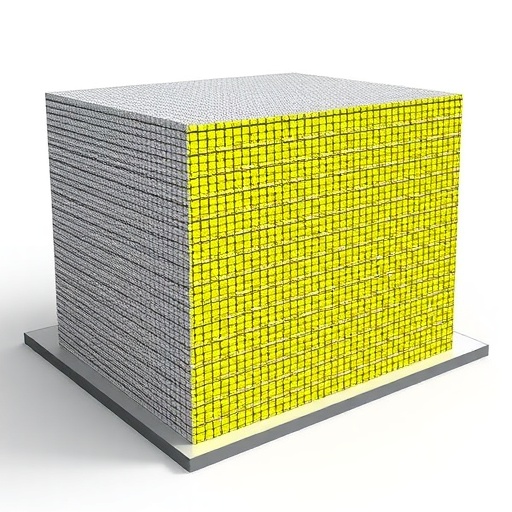
Every radar pulse, 5G transmission and power-electronics switching event floods the air with microwaves that can scramble sensors, corrupt communications and, in military settings, betray an object’s position. The usual defense is to shield: wrap sensitive equipment in metal and bounce the radiation away. But reflection merely relocates the problem, sending the energy back into the environment or straight back toward an adversary’s receiver. A team of materials scientists in China and Germany now reports a flexible, cloth-like membrane engineered to do the opposite — to invite microwaves in and then destroy them. In a study published in the Journal of Materials Science, researchers at Guangdong Polytechnic Normal University, working with colleagues at Friedrich-Alexander-Universität Erlangen-Nürnberg and partner institutions, show that dispersing a rare-earth compound, gadolinium oxide, into a polyurea coating on nickel-coated fabric provides a single, adjustable dial for controlling exactly where, and how forgivingly, the material absorbs electromagnetic radiation.
The physics of microwave absorption is a tightrope walk. For an incoming wave to be absorbed rather than reflected, it must first cross the boundary between air and material without complaint, a condition governed by what engineers call impedance matching. Free space possesses a characteristic electromagnetic impedance — roughly 377 ohms — and if a material’s input impedance strays too far from that value, the wave bounces off the surface just as light bounces off a window, no matter how lossy the material’s interior may be. Conductive additives such as carbon nanotubes, carbonyl iron or metal coatings make a composite better at dissipating electromagnetic energy, but they simultaneously drag its impedance downward and deepen the mismatch at the surface. An ideal absorber therefore has to reconcile two opposing demands: an exterior that welcomes waves in and an interior that never lets them escape. In flexible, fabric-based systems this balancing act is especially delicate, because the metallized textiles that give such materials their conductivity are often so rich in metal that reflection wins outright. Controlling that surface reflection is what separates a mere shield from a true absorber, and it is exactly where the new study aims its tools.
The new membrane attacks that trade-off with a sandwich architecture. Its core is nickel-coated fabric, an ordinary textile converted into a conductive scaffold by depositing metallic nickel onto its fibers. On both faces, the researchers cast layers of polyurea, an elastomer produced when isocyanates react with amine-bearing compounds; its polymer chains are stitched together by dense hydrogen bonding between urea groups, which is what gives polyurea coatings their celebrated resilience in blast-mitigation, impact-resistance and anti-corrosion applications. Into this polyurea matrix the team dispersed gadolinium oxide, Gd₂O₃, a ceramic powder whose lanthanide electronic structure endows it with a distinctive dielectric personality. The result is a three-layer composite in which a continuous, lossy dielectric skin drapes over a conductive textile backbone. That geometry multiplies internal interfaces — between particle and polymer, and between polymer and metal — where charges accumulate and oscillate under the influence of a passing microwave, draining energy from the wave at every cycle.
Before any microwave measurements, the group verified that the chemistry had cooperated. Structural characterization confirmed that the gadolinium oxide was genuinely incorporated into the polyurea rather than sitting as an alien phase, that the polymer layers remained continuous across both faces of the fabric, and that the interfaces between layers stayed intact — the kind of structural cleanliness on which predictable electromagnetic behavior depends. Interfaces are not cosmetic details: in lossy composites, the boundaries between phases are precisely where charge accumulates, so a debonded or discontinuous layer would silence the very mechanisms the design relies on. Just as important for a material intended to be worn, draped or folded, the membranes retained tensile strengths above 70 megapascals, a figure comparable to some rigid engineering plastics. An absorber that cracks the first time it is bent is of little use in a garment, an aircraft skin or the enclosure of a flexible electronic device. These membranes held together at a level of mechanical integrity the authors describe as acceptable for flexible electromagnetic applications, uniting two property sets that rarely coexist comfortably.
The electromagnetic analysis delivered the study’s central insight: gadolinium oxide behaves as a dielectric regulator, not a magnetic one. In microwave engineering, a material’s response is captured by two complex quantities — the permittivity, which describes how it polarizes in an oscillating electric field, and the permeability, which describes how it responds to magnetic fields. As the Gd₂O₃ content rose, the membranes’ dielectric parameters shifted measurably, while their magnetic response barely moved. The mechanism is rooted in polarization. At every boundary between an oxide particle and the surrounding polyurea, electric charges pile up unevenly, producing interfacial — or Maxwell–Wagner — polarization that lags behind the field of a passing microwave and dissipates energy as heat. Dipoles within the gadolinium oxide lattice and in the urea groups of the polymer add their own contributions, and a modest touch of conduction loss completes the picture. In short, the additive rewrites how the material stores and squanders electrical energy while leaving its magnetic character essentially untouched.
That dielectric tuning showed up precisely where absorber designers want it: in the impedance matching window. For any microwave absorber there exists a region of the frequency–thickness map where the material’s input impedance approaches that of free space, allowing waves to enter with minimal reflection; its size and position determine which frequencies a given thickness of material can realistically absorb. The researchers found that this window evolved systematically with composition. Changing the gadolinium oxide loading did not simply strengthen absorption — it relocated and reshaped the portion of the frequency–thickness landscape over which waves could gain entry at all. The mathematics is familiar from transmission-line theory. Because the nickel-coated fabric backing reflects whatever energy survives the polyurea, waves that do enter travel to the metal layer and back, and when the membrane thickness approximates a quarter of the wavelength inside the material, the returning wave cancels destructively against freshly reflected portions of itself. By tuning the dielectric constant of the skin, the team effectively repositioned where that quarter-wavelength interference and surface matching conspire to swallow the most power.
Intriguingly, the story was not one of simple dose and response. The attenuation constant — a measure of how rapidly a wave decays as it propagates through the material — did not climb monotonically as more Gd₂O₃ was added. That is a familiar cautionary tale in composite design: excessive filler can cluster into agglomerates, dilute the polymer’s own loss channels, or aggravate surface mismatch, so the relationship between loading and loss is rarely a straight line. It is also a reminder that in these membranes, dissipation is entangled with the dielectric architecture the oxide builds, rather than being a simple function of filler content. Yet the higher loadings delivered something arguably more valuable. Reflection-loss maps — contour plots charting how much of an incident wave survives across combinations of frequency and thickness — revealed that gadolinium-rich membranes produced deeper, more continuous absorption valleys whose behavior shifted in an orderly, predictable way as thickness changed. That thickness robustness matters in practice, because real-world absorbers are almost never deployed at the exact thickness a simulation assumes; a valley that survives small thickness errors is a valley an engineer can actually build.
The standout formulation was the most heavily loaded membrane in the series, designated Gd75-PU@NiF. It showed the clearest improvement in impedance matching response and the broadest negative reflection-loss region of any composition tested — meaning that across the widest span of the frequency–thickness landscape, more electromagnetic energy flowed into the membrane than bounced off its surface. By the standard convention of the absorption community, reflection losses below −10 decibels correspond to at least ninety percent of incident power being absorbed, the threshold that separates a laboratory curiosity from a practical absorber. The significance here is less a record number than a demonstration of control: a single variable — the oxide loading — reproducibly steers where the absorption profile concentrates, how continuous the absorption valley becomes, and how forgiving the material is to manufacturing tolerances.
The work sits at the junction of two research streams that have rarely been asked to collaborate. Rare-earth oxides such as ceria have attracted growing attention for sculpting the dielectric response of microwave absorbers, and gadolinium oxide has already shown promise in flexible optoelectronic composites. Polyurea, meanwhile, has been prized for impact resistance, blast mitigation and self-healing behavior, but seldom recruited for electromagnetic duty. Merging the two on a metallized textile yields something neither stream offered alone: a mechanically robust, drapable absorber that can be cut, sewn and conformed to curved surfaces. The presence of a waterproofing-materials company among the co-author affiliations points to an established industrial home for polyurea coatings, should microwave-absorbing variants follow. Plausible applications stretch from electromagnetic-interference suppression in wearable electronics, electric vehicles and dense server racks to radar-absorbing treatments for aircraft, anechoic chamber linings and protective fabrics for personnel working near high-power transmitters. Because absorption — unlike shielding — removes energy from the environment rather than ricocheting it elsewhere, materials of this kind address the growing problem of electromagnetic pollution at its source.
The authors frame the outcome as a formulation–structure strategy: instead of redesigning an entire multilayer architecture for every new frequency band, a designer can adjust the gadolinium oxide content to retune the absorption profile of a fixed, flexible platform. In a world whose electromagnetic spectrum grows more congested by the year — dense with radar, satellite links, wireless power transfer and ever-faster cellular standards — the ability to specify, on demand, where a fabric-like material absorbs radiation is a quiet but consequential advance. The membrane described here remains a laboratory specimen, and translating it into products will require work on scale, durability, environmental resistance and cost. But its message is crisp. With the right rare-earth seasoning, the textile materials of the future may not merely shield us from microwaves; they may eat them, quietly, tunably and without ever cracking a seam.
Subject of Research: Flexible nickel-coated fabric/polyurea composite membranes in which gadolinium oxide (Gd₂O₃) regulates dielectric response and impedance matching, reshaping the frequency- and thickness-dependent microwave absorption profile for tunable, mechanically robust electromagnetic wave absorption.
Subject of Research: Technology and Engineering
Article Title: Gd₂O₃-regulated impedance matching and absorption-profile evolution in flexible nickel-coated fabric/polyurea composite membranes
Article References: Cai, J., Bai, X., Liu, J., Fang, R., Xu, C., Schubert, D. W., Mu, C., Wang, X., & Qu, M. (2026). Gd2O3-regulated impedance matching and absorption-profile evolution in flexible nickel-coated fabric/polyurea composite membranes. Journal of Materials Science. https://doi.org/10.1007/s10853-026-13567-1
Image Credits: AI Generated
DOI: 10.1007/s10853-026-13567-1
Keywords: electromagnetic wave absorption, impedance matching, gadolinium oxide, polyurea, nickel-coated fabric, dielectric loss, reflection loss, microwave absorption, flexible composites, rare-earth oxide, composite membranes, attenuation constant
Cite Scienmag News
APA MLA Chicago
Denise Maddox. (August 30, 2026). Gd2O3 tunes impedance matching in flexible nickel-coated fabric polyurea absorbers. Scienmag. https://scienmag.com/gd2o3-tunes-impedance-matching-in-flexible-nickel-coated-fabric-polyurea-absorbers/
Denise Maddox. “Gd2O3 tunes impedance matching in flexible nickel-coated fabric polyurea absorbers.” Scienmag, 30 August 2026, https://scienmag.com/gd2o3-tunes-impedance-matching-in-flexible-nickel-coated-fabric-polyurea-absorbers/. Accessed 30 August 2026.
Denise Maddox. “Gd2O3 tunes impedance matching in flexible nickel-coated fabric polyurea absorbers.” Scienmag. August 30, 2026. https://scienmag.com/gd2o3-tunes-impedance-matching-in-flexible-nickel-coated-fabric-polyurea-absorbers/
Copy citation Download RIS
Tags: 5G and radar signal shielding solutionsadvanced materials for 5G and radar protectionadvanced textile-based electromagnetic protectionelectromagnetic interference control in military and communication deviceselectromagnetic wave control in military applicationselectromagnetic wave destruction techniquesenvironmental electromagnetic radiation mitigationflexible cloth-like microwave absorbing membranesflexible conductive fabrics for radar stealthflexible electromagnetic interference shieldsflexible electromagnetic shieldinggadolinium oxide in electromagnetic interference mitigationgadolinium oxide in polyurea coatingsimpedance matching in electromagnetic shieldingimpedance matching in radar absorbing materialsmicrowave absorption materialsnickel-coated fabric for electromagnetic interference mitigationnickel-coated fabric for electromagnetic shieldingpolyurea coatings for microwave absorptionrare-earth compound in electromagnetic materialsrare-earth compounds in electromagnetic devicestunable electromagnetic absorberstunable microwave absorbers