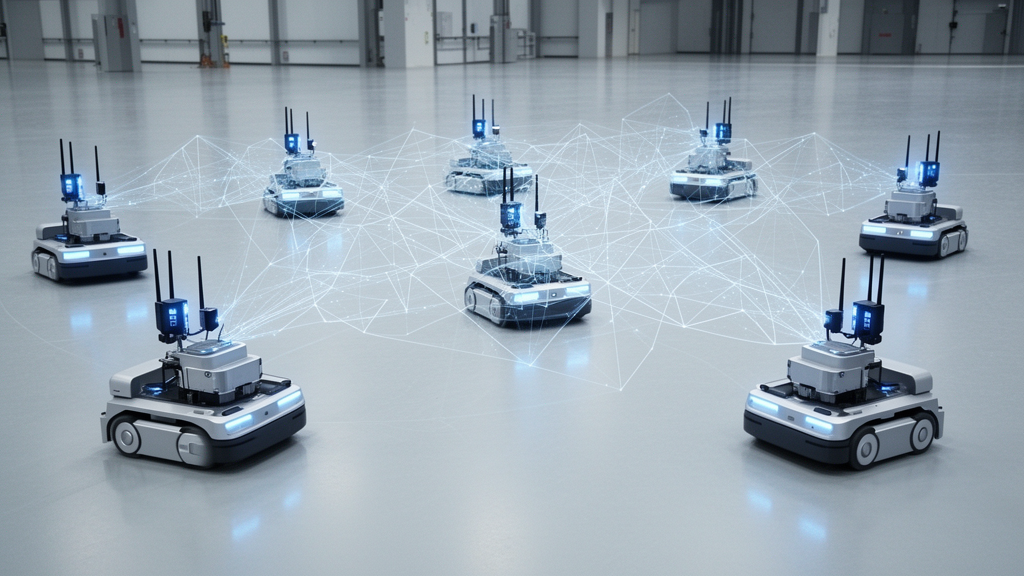
A distributed motion control framework developed by researcher Toru Murayama enables mobile multi-robot networks equipped with redundant communication transceivers to preserve global connectivity when individual wireless communication modules fail. Autonomous multi-robot systems have attracted widespread attention for demanding applications ranging from search-and-rescue missions and disaster response to industrial automation and environmental monitoring. These collaborative teams offer distinct operational advantages over single-agent systems, particularly regarding efficiency, flexibility, and task robustness. However, maintaining reliable inter-robot communication remains a fundamental challenge in dynamic and hazardous operational environments where physical obstacles, electromagnetic interference, and hardware breakdowns can abruptly sever critical communication links. While conventional network control strategies often depend on centralized routing or enforce strict biconnectivity to withstand node losses, Murayama proposed a decentralized motion control strategy that dynamically adjusts physical network topology. Published in Artificial Life and Robotics, the research combines algebraic graph theory with distributed artificial potential functions to guarantee continuous network integrity across multi-agent systems without over-constraining spatial mobility.
The central mechanism of the proposed architecture equips each mobile robot with two distinct wireless communication systems: a radio frequency transceiver and an image-sensor-based optical communication module. Radio-frequency communication modules are commonly used across robotic networks to coordinate cooperative behaviors, but they remain susceptible to packet loss and signal interference in congested spectrum environments. To address these limitations, Murayama introduced optical channels, including visible light communication, as a complementary transmission modality. Optical communication transceivers provide an important functional capability: they can receive signals simultaneously from multiple transmitters through spatial separation on the image sensor. This spatial separation improves scalability when the number of interacting robots increases, while substantially mitigating radio-frequency interference risks. In the study’s model, the maximum transmission range for radio communication was set to six units, whereas optical communication was limited to three units. This geometric configuration reflects real-world physical constraints, where radio waves achieve greater transmission distances while optical communication provides superior multi-signal reception and local spatial reuse.
Murayama formulated the robotic network across a two-dimensional plane containing N autonomous mobile robots alongside M static obstacles that impede physical mobility and wireless transmission. The spatial position of each robot and obstacle is represented by planar coordinate vectors, with global communication topology modeled through a graph adjacency matrix. Continuous quality functions represent the performance of radio and optical links between robot pairs. These communication quality metrics incorporate Euclidean distance and line-of-sight clearance around obstacles, decaying smoothly to zero when agents move beyond maximum communication ranges or when obstacles occlude transmission paths. Binary status variables track hardware conditions for each robot’s communication devices, indicating whether the radio or optical transceiver is active or faulty. Under the study’s system model, the effective communication quality between two robots is defined by the maximum value between their radio and optical links. Consequently, active communication persists between neighbor robots as long as either communication device on each agent remains functional, providing structural redundancy against isolated component failures.
To maintain connectivity before hardware malfunctions cause severe network disconnections, the author developed an analytical framework utilizing perturbed adjacency and Laplacian matrices that model the network topology following hypothetical module failures. The study evaluates topological robustness using algebraic connectivity, defined as the second smallest eigenvalue of the graph Laplacian matrix. In distributed control systems, a positive algebraic connectivity confirms that the entire graph is connected, with larger values reflecting greater robustness against structural failure. Murayama defined a normalized connectivity parameter by dividing the second smallest eigenvalue of the perturbed Laplacian by a small positive constant. By comparing this normalized connectivity value against theoretical bounds established in graph connectivity literature, the algorithm determines whether the network remains connected if an active communication transceiver fails or if an entire robot node is removed. This mathematical formulation allows mobile agents to assess network vulnerability and execute proactive physical movements that reinforce critical links before communication breaks occur.
The motion control framework implements dual inequality conditions that establish safety thresholds based on the operational health of each robot’s communication modules. When both the radio and optical devices of an agent are fully operational, the system enforces a connectivity threshold proportional to the agent’s degree of connection across the network. Meeting this condition ensures that global network connectivity will be maintained even if either transceiver fails unexpectedly. Conversely, when one of the communication modules has already failed, the threshold transitions to an alternate condition designed to keep the remaining network fully connected if that compromised robot fails completely. Murayama incorporated an empirical margin of zero point zero one into the threshold formulas to guarantee numerical stability. While theoretically any small positive value satisfies the inequality, choosing this specific margin prevents numerical instability and computational degradation arising from limited arithmetic precision, striking an effective balance between theoretical rigor and numerical stability in simulation and practical implementation.
To satisfy these connectivity inequality conditions through autonomous physical navigation, the control strategy utilizes an exponential artificial potential function. The potential function penalizes network configurations where the normalized algebraic connectivity approaches or drops below the designated threshold, with an adjustable gain governing the steepness of the exponential curve. Each autonomous robot computes its motion velocity input along the negative gradient of the summed artificial potential functions with respect to its own planar position. This distributed gradient descent control drives physical movement, prompting robots to reposition themselves autonomously to reinforce weakening communication paths without requiring centralized oversight. All necessary calculations are locally computable by each robot using relative positions obtained from neighboring communicable agents and decentralized eigenvalue estimation methods. By directly exploiting the physical mobility of the mobile robots to preserve network connectivity under hardware degradation, this distributed approach provides a decentralized alternative to conventional network control methods that assume fixed communication infrastructures.
Murayama validated the control strategy through numerical simulations of a seven-robot network operating among obstacles on a two-dimensional plane. In the initial configuration, the communication network was vulnerable to disconnection if any single radio communication module experienced a fault. Driven by the distributed artificial potential function, the robots autonomously adjusted their planar positions, establishing a resilient network structure by time two hundred forty that remained connected despite potential module failures. To demonstrate fault tolerance during hardware breakdown, a failure was introduced at time one hundred fifty, disabling the radio communication transceiver of robot six. Following this fault, the perturbed algebraic connectivity of robot six temporarily decreased but rapidly recovered above the required threshold as neighboring robots repositioned themselves to maintain global connectivity. Meanwhile, the perturbed algebraic connectivities of all other robots remained consistently above their respective thresholds throughout the simulation, confirming that the network topology remained robust and prevented partition.
To evaluate whether the control algorithm scales effectively to larger swarms, Murayama conducted an expanded numerical simulation featuring one hundred autonomous mobile robots. The experimental setup placed forty-nine robots in one cluster and fifty robots in a second cluster, connected exclusively by a single bridge robot. At time two point five seconds, the radio communication module of the bridge robot failed, while its optical communication module remained functional. The sudden failure caused an immediate drop in the perturbed algebraic connectivity across the bridge, threatening to divide the network into two disconnected components. However, the proposed distributed motion control law enabled the surrounding robots to reposition dynamically, restoring the algebraic connectivity above the safety threshold. The simulation confirmed that the control algorithm maintained global network connectivity and numerical stability even within a large-scale network of one hundred robots, demonstrating that physical mobility can effectively compensate for critical communication module failures in dense multi-robot teams.
The author also examined the theoretical boundaries and trade-offs of the proposed methodology under adverse operating conditions. The study’s core mathematical model assumes that redundant communication modules on the same robot do not fail simultaneously, but rather that a second failure occurs only after sufficient time has elapsed. To investigate the consequences of violating this assumption, a supplementary simulation evaluated network behavior when both communication modules of robot six failed concurrently at time one hundred fifty. In this scenario, the network was unable to adapt and became disconnected. Murayama noted that preventing network disconnection under simultaneous dual-module failure requires enforcing strict biconnectivity, which ensures the graph remains connected even if any single node is entirely removed. However, enforcing biconnectivity limits the allowable configuration space of the robots, which can restrict mobility and reduce operational flexibility during collaborative tasks such as coverage maintenance, exploration, and disaster response missions.
Although the control framework operates without centralized coordination, Murayama highlighted practical computational constraints that affect real-time execution in large teams. The main computational requirement involves calculating perturbed algebraic connectivity values for all robots across the network, which scales quadratically with team size in a straightforward implementation. While decentralized eigenvalue estimation techniques allow moderate teams of several tens of robots to execute these calculations within typical control cycles of tens of Hertz, extending the algorithm to very large swarms remains an open challenge. Future research directions proposed by the author include developing adaptive switching strategies that transition between different levels of network redundancy based on environmental hazards and estimated failure risks.
Subject of Research: Fault-tolerant distributed motion control for multi-robot communication networks
Article Title: Fault-tolerant control for multi-robot networks with redundant communication modules
Article References: Murayama, T. (2026). Fault-tolerant control for multi-robot networks with redundant communication modules. Artificial Life and Robotics, 31(1), 168-176. https://doi.org/10.1007/s10015-025-01094-2
Image Credits: AI Generated
DOI: 10.1007/s10015-025-01094-2
Keywords: multi-robot systems, fault-tolerant control, algebraic connectivity, Laplacian matrix, redundant communication, optical wireless communication, visible light communication, artificial potential function, distributed control, network topology, mobile robotics, decentralized systems, graph theory, obstacle avoidance, Fiedler eigenvalue, biconnectivity, spatial separation
News Source: Denise Maddox. (November 26, 2026). Redundant Wireless Modules and Distributed Motion Control Prevent Multi-Robot Network Disconnections. Scienmag.