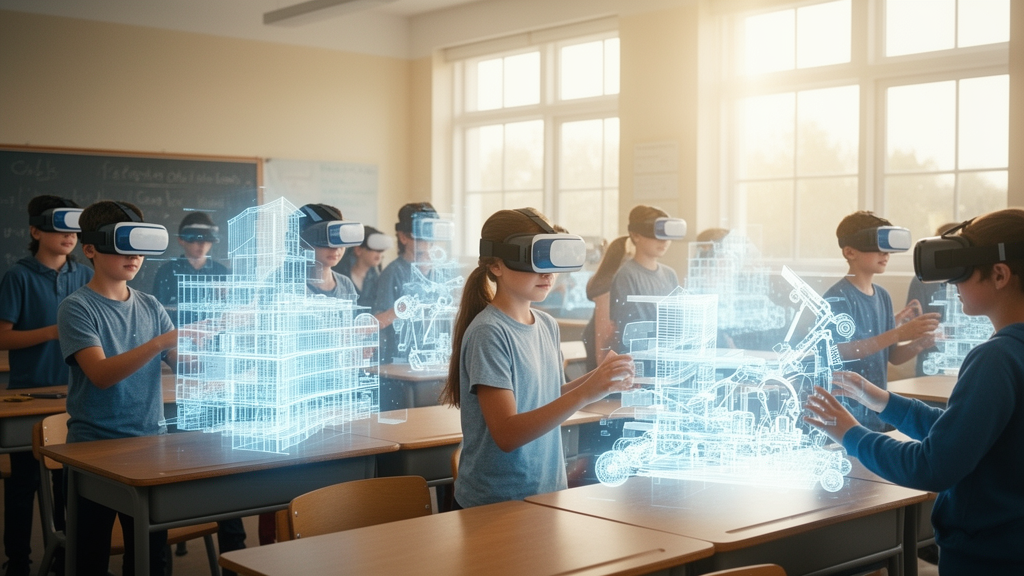
Integrating immersive virtual reality into middle school career and technical education curricula significantly bolsters adolescent student engagement and occupational awareness compared to conventional instruction, but the temporal placement of simulation sessions fundamentally alters how students conceptualize potential careers. In a six-week quasi-experimental investigation conducted across public middle school classrooms in Colorado, researchers observed that deploying virtual reality simulations prior to classroom instruction stimulated rich procedural inquiry and problem-solving hypotheses, whereas introducing identical simulations following conceptual lessons fostered schema consolidation and self-efficacy gains. Although educational technology literature has increasingly documented broad motivational advantages associated with head-mounted immersive environments, practical guidance regarding instructional sequencing has remained scarce. The findings establish that pedagogical timing is not a neutral logistical consideration, demonstrating instead that the cognitive entry point at which middle school learners encounter simulated vocational environments governs whether they approach occupational exploration as an open-ended practical encounter or as applied conceptual verification.
Adolescence represents a sensitive developmental phase wherein young learners formulate provisional career self-concepts by identifying emerging interests, personal values, and perceived occupational opportunities. Traditional career education in middle schools typically relies heavily on didactic lectures, text-based descriptions, and teacher-led conversations, which frequently fail to provide the embodied, authentic representations necessary for adolescents to conduct meaningful comparative self-evaluations. Immersive virtual reality bridges this experiential deficit by situating students inside realistic vocational contexts without the real-world liabilities associated with hazardous workplaces. To determine whether virtual reality sustains attitudinal engagement over multi-week curricula and how the scheduling of immersive activities modifies student exploration, investigators implemented a mixed-methods design in a Colorado school district serving a predominantly Hispanic and economically disadvantaged student population. A total of 75 students provided signed parental consent and student assent, with 72 pupils across grades six through eight participating throughout the full six-week curriculum.
The experimental framework examined three distinct instructional conditions across six rotating technical career topics: Car Mechanics, Refrigeration and Cooling, Construction Safety, Production Line Operations, Plumbing, and Logistics. Each weekly unit centered on a specific vocational domain using head-mounted displays to deliver authentic 15-minute interactive simulations. In Group A, designated as the introduction condition, students completed the virtual reality simulation prior to participating in formal conceptual lectures and teacher-facilitated discussions. In Group B, designated as the review condition, students received structured conceptual instruction and classroom dialogue before entering the identical virtual reality environment. Group C operated as an active control group, receiving standard classroom presentations, printed materials, and guided group discussions covering identical career content without any virtual reality exposure. Scheduling conflicts at one school site prevented the delivery of the Refrigeration module to the control cohort, leading researchers to exclude data from that session from cross-condition comparisons to maintain statistical parity.
To evaluate cumulative and session-level developmental changes, researchers gathered both quantitative metrics and qualitative records across the six-week intervention. The quantitative strand incorporated a comprehensive 25-item baseline and endline attitudinal survey completed by 42 matched students who attended both administrative sessions, assessing Self-Efficacy and Confidence, Motivation and Engagement, Teacher Influence and Learning Environment, Understanding Self, Exploring Careers, and Career Decision-Making. In parallel, students completed ten-item weekly survey forms following each session to measure real-time Engagement and Motivation, Career Awareness, and Self-Efficacy, alongside two open-ended qualitative prompts asking students to describe compelling occupational aspects and remaining questions. The qualitative corpus was supplemented by verbatim audio transcripts of all weekly classroom discussions and a semi-structured interview conducted with the primary implementing teacher upon curriculum completion. A dedicated qualitative codebook containing twenty descriptive codes organized into five thematic categories guided the systematic analysis of student discourse and reflection responses.
Across the entire matched sample of 42 students, pre-to-post survey comparisons revealed that only one of the six measured attitudinal constructs demonstrated a statistically significant change over the six-week program. Understanding Self exhibited a significant decrease from an initial baseline mean of 4.01 down to 3.73 at endline, yielding a paired t-statistic of 2.345 and a negative effect size of negative 0.362. The other five constructs displayed non-significant downward trends over time, including Motivation and Engagement, which moved from 3.29 to 3.11, Exploring Careers, which shifted from 3.35 to 3.21, Teacher Influence, declining from 3.63 to 3.51, Career Decision-Making, decreasing from 3.66 to 3.55, and Self-Efficacy, dropping marginally from 3.69 to 3.64. One-way analyses of variance examining between-group differences in change scores indicated that Teacher Influence was the sole metric showing a statistically significant divergence among instructional groups. Students in Group A reported a positive shift in perceived teacher influence of positive 0.25, while control students in Group C exhibited a substantial decline of negative 0.46, producing a significant pairwise contrast.
Analysis of the 200 topic-level weekly survey responses via generalized estimating equations underscored pronounced advantages for both virtual reality conditions over conventional classroom instruction. Significant omnibus group effects emerged for Engagement and Motivation, Career Awareness, and Self-Efficacy. For Engagement and Motivation, both Group A and Group B attained significantly higher scores than the control condition, with Group A averaging 3.52 and Group B averaging 3.51 compared to Group C at 2.45. Pairwise generalized estimating equation contrasts confirmed that Group A and Group B each significantly surpassed Group C, while differing negligibly from one another. A parallel pattern characterized Career Awareness, where Group A recorded an average of 3.53 and Group B recorded 3.46, both significantly outpacing Group C at 2.67. On the single-item measure of Self-Efficacy, however, only Group B achieved a statistically significant advantage over the control group, demonstrating a regression coefficient of 0.747, whereas Group A did not differ significantly from Group C.
Exploratory item-level evaluations revealed subtle process divergences between the two virtual reality timing structures that aligned closely with qualitative observations. When assessing session-specific engagement directly through the statement regarding whether students felt engaged during the day’s lesson, Group A achieved a higher average of 4.16 relative to Group B at 3.78, yielding an uncorrected pairwise difference that favored the introduction sequence. Conversely, for the career interest statement regarding personal curiosity toward entering the profession, only Group B achieved a statistically significant elevation above the control group. Furthermore, topic-level evaluations indicated that the magnitude of instructional impact varied across domains, reaching peak divergence during the Construction Safety module. In that session, both immersive groups recorded marked gains over the control cohort across Engagement, Career Awareness, and Self-Efficacy, representing the only weekly topic where all three quantitative indicators reached simultaneous statistical significance.
Qualitative analysis of student reflection responses and classroom dialogue transcripts illustrated that instructional sequencing generated fundamentally divergent cognitive orientations toward vocational practice. Students in Group A, having engaged the simulation prior to formal instruction, entered subsequent classroom discussions speaking from an embodied, firsthand perspective. In construction safety and plumbing modules, Group A participants articulated nuanced physical observations regarding spatial confinement, dangerous equipment operations, and mechanical balance. Furthermore, Group A students generated unprompted hypotheses concerning the cognitive demands of safety inspections and contributed 12 percent of their post-session inquiries toward explicit educational and credentialing requirements. In contrast, Group B students, who received conceptual instruction prior to entering virtual reality, utilized the simulation to verify previously introduced principles, such as framing warehouse logistics in terms of Newtonian mechanics or identifying automated production lines with computer coding. Group B participants also exhibited a distinct sense of epistemic closure, with six percent indicating they had mastered all necessary topic content.
The qualitative transcripts also illuminated a steady decline in student engagement within the non-virtual control condition over the course of the six-week program. Control group participants predominantly described vocational occupations using generic, categorical phrases such as building structures or repairing objects, and frequently focused on financial compensation rather than operational tasks. In their written reflections, 26 percent of Group C entries expressed active disinterest or dismissal, using phrases such as wanting to learn nothing further. The participating educator noted in post-intervention interviews that maintaining enthusiasm in the control classroom became increasingly challenging across successive weeks, necessitating greater direct advocacy by the teacher to sustain conversational participation. Additionally, exploratory disaggregation by educator revealed that while student engagement remained stable across different teachers in the two virtual reality cohorts, outcomes in the control group fluctuated drastically depending upon the instructor, suggesting that immersive technology can provide a consistent experiential foundation that buffers against variations in teaching style.
The study’s participating teacher identified student topic familiarity as a potential boundary condition governing optimal simulation timing. Her observations indicated that when students possessed little to no preexisting conceptual knowledge regarding an occupation, such as logistics and supply chain operations, deploying virtual reality as an initial introduction yielded far richer subsequent classroom discussions by supplying an experiential frame of reference that direct explanation could not establish. Conversely, when introducing occupations with which middle school students maintained intuitive familiarity or personal exposure, such as residential plumbing, providing conceptual instruction first enabled students to integrate technical vocabulary and professional certifications into their upcoming simulation trial. Although derived from practitioner reflection and illustrative transcripts rather than controlled factorial manipulation, this observation indicates that educators need not view simulation timing as a rigid dichotomy, but rather as an adaptable design variable calibrated to curricular familiarity.
The program-wide decline observed in career self-understanding represents a compelling paradox when contrasted with the elevated engagement and awareness documented in the virtual reality classrooms. Rather than signaling pedagogical failure, researchers contextualized this reduction within Super’s career development framework and the concept of constructive disequilibrium. Authentic exposure to realistic occupational complexities routinely destabilizes adolescents’ superficial or idealized assumptions regarding vocational fields, temporarily lowering their subjective clarity as they recognize the depth of skills and preparation demanded by technical trades. This interpretation was reinforced by weekly survey metrics: reported worry about understanding technical topics correlated positively with engagement, career awareness, and self-efficacy. In the immersive cohorts, cognitive dissonance prompted focused inquiries regarding career entry pathways, whereas in the control group, declining self-concept scores accompanied motivational fatigue and disengagement.
The authors outlined several methodological and contextual boundaries that qualify the generalizability of their conclusions. The quasi-experimental assignment of intact class sections rather than individual student randomization leaves open the possibility of unmeasured cohort differences, even though multi-week repeated measures and qualitative cross-validation provided analytical safeguards. Furthermore, the modest sample size of 42 matched students in the pre-post survey restricted statistical power to detecting large effects within individual conditions, meaning non-significant numerical changes cannot be interpreted as confirmed null results. Finally, because the investigation took place within a single Colorado school district serving predominantly Hispanic, low-income students across six specific trade vocations, additional investigations across broader geographic regions, grade levels, and technical disciplines are necessary to determine whether these instructional sequencing dynamics operate consistently across diverse educational settings.
Subject of Research: Instructional sequencing of immersive virtual reality in middle school career and technical education
Article Title: Sequencing matters: How the timing of immersive virtual reality supports career and technical education in middle school
Article References: Wang, Y., Vishwanath, A., & Lui, M. (2026). Sequencing matters: How the timing of immersive virtual reality supports career and technical education in middle school. Computers & Education: X Reality, 9, Article 100186. https://doi.org/10.1016/j.cexr.2026.100186
Image Credits: AI Generated
DOI: 10.1016/j.cexr.2026.100186
Keywords: immersive virtual reality, career and technical education, instructional sequencing, middle school education, experiential learning, career exploration, vocational training, self-concept clarity, career self-efficacy, pedagogical timing, educational technology, quasi-experimental research, constructive disequilibrium, curriculum design, stem learning, student engagement, classroom discourse
News Source: Denise Maddox. (November 26, 2026). Virtual Reality Timing Shapes Career Learning Dynamics in Middle School Classrooms. Scienmag.