• HOME
  • NEWS
  • EXPLORE
    • CAREER
      • Companies
      • Jobs
    • EVENTS
    • iGEM
      • News
      • Team
    • PHOTOS
    • VIDEO
    • WIKI
  • BLOG
  • COMMUNITY
    • FACEBOOK
    • INSTAGRAM
    • TWITTER
Tuesday, May 19, 2026
BIOENGINEER.ORG
No Result
View All Result
  • Login
  • HOME
  • NEWS
  • EXPLORE
    • CAREER
      • Companies
      • Jobs
        • Lecturer
        • PhD Studentship
        • Postdoc
        • Research Assistant
    • EVENTS
    • iGEM
      • News
      • Team
    • PHOTOS
    • VIDEO
    • WIKI
  • BLOG
  • COMMUNITY
    • FACEBOOK
    • INSTAGRAM
    • TWITTER
  • HOME
  • NEWS
  • EXPLORE
    • CAREER
      • Companies
      • Jobs
        • Lecturer
        • PhD Studentship
        • Postdoc
        • Research Assistant
    • EVENTS
    • iGEM
      • News
      • Team
    • PHOTOS
    • VIDEO
    • WIKI
  • BLOG
  • COMMUNITY
    • FACEBOOK
    • INSTAGRAM
    • TWITTER
No Result
View All Result
Bioengineer.org
No Result
View All Result
Home NEWS Science News Biology

Re-trafficking proteins to fight Salmonella infections

Bioengineer by Bioengineer
June 9, 2020
in Biology
Reading Time: 2 mins read
0
IMAGE
Share on FacebookShare on TwitterShare on LinkedinShare on RedditShare on Telegram

IMAGE

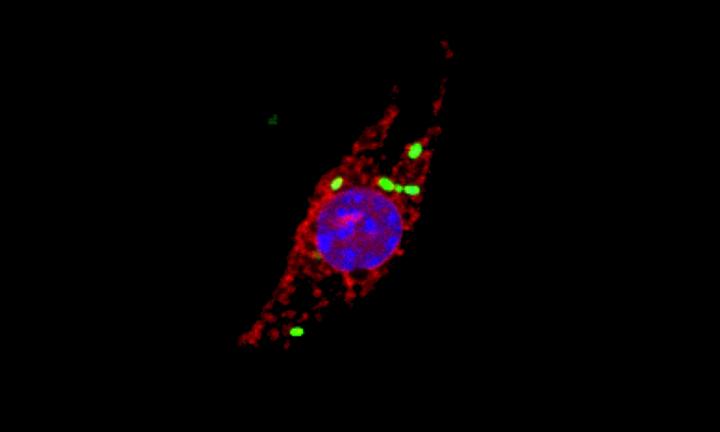
Credit: Joel Selkrig/EMBL

When humans get infected by pathogenic bacteria, the body’s immune system tries to eliminate the intruders. One way of doing this is by launching an inflammatory response – a cascade of events that includes the expression of protective proteins, the activation of immune cells, and a process of controlled cell death when infected cells can’t be saved.

Scientists including members of EMBL’s Typas group, members of the group of EMBL alumnus Jeroen Krijgsveld at the German Cancer Research Center (DKFZ) in Heidelberg, and other collaborators have investigated how immune cells called macrophages respond to infection by the intracellular pathogen Salmonella enterica. The scientists applied a method recently developed in their labs to enrich, identify, and quantify all newly produced proteins from Salmonella-infected macrophages. They marked newly produced proteins with a specific chemical label and identified them using a technique called mass spectrometry, which allowed them to analyse the entire set of cellular proteins. Importantly, the scientists measured protein levels in macrophages at different infection stages and across different cell compartments. Their study, which is published in Nature Microbiology, shows that monitoring the dynamic changes in protein production and targeting can reveal new insights into the mechanisms by which cells respond to pathogens.

One of the unexpected findings of the study was that a well-known family of proteins called cathepsins move to a new location when cells get infected by Salmonella. Cathepsins are proteases – proteins that break down other proteins. They’re normally kept inside small subcellular structures known as lysosomes and have previously been implicated in promoting cell death, although the mechanism or any link between the process and bacterial infection were unknown. The scientists have now discovered that Salmonella causes newly produced cathepsins to accumulate in the nuclei of infected cells. The protein-degrading activity of cathepsins in the nucleus is then required to initiate an inflammatory form of programmed cell death.

The new study shows the benefit of systematically following protein dynamics during infection, which can unravel new pathways and mechanisms the host uses to defend itself against pathogens.

###

Media Contact
Mathias Jäger
[email protected]

Original Source

https://www.embl.org/news/science/re-trafficking-proteins-to-fight-salmonella-infections/

Related Journal Article

http://dx.doi.org/10.1038/s41564-020-0736-7

Tags: BiologyInfectious/Emerging DiseasesMedicine/HealthMolecular Biology
Share12Tweet8Share2ShareShareShare2

Related Posts

Decoding Darkness: Photoreceptor Functions With and Without Light — Biology

Decoding Darkness: Photoreceptor Functions With and Without Light

May 19, 2026
Advanced Models Pave the Way for Improved Therapies Targeting Primary Sclerosing Cholangitis — Biology

Advanced Models Pave the Way for Improved Therapies Targeting Primary Sclerosing Cholangitis

May 19, 2026

How Bats Filter Out Background Noise to Sharpen Prey Detection

May 19, 2026

Newly Discovered “Happy-Face” Spider Species Found in the Indian Himalayas

May 19, 2026
Please login to join discussion

POPULAR NEWS

  • Research Indicates Potential Connection Between Prenatal Medication Exposure and Elevated Autism Risk

    845 shares
    Share 338 Tweet 211
  • New Study Reveals Plants Can Detect the Sound of Rain

    731 shares
    Share 292 Tweet 182
  • Salmonella Haem Blocks Macrophages, Boosts Infection

    62 shares
    Share 25 Tweet 16
  • Breastmilk Balances E. coli and Beneficial Bacteria in Infant Gut Microbiomes

    58 shares
    Share 23 Tweet 15

About

We bring you the latest biotechnology news from best research centers and universities around the world. Check our website.

Follow us

Recent News

New Alliance Launches Trial to Explore Targeted Radiation Therapy Following Lung Cancer Surgery

Hierarchical Tissue-Specific Modeling of Pathology Images Predicts Treatment Response in HER2-Positive Breast Cancer

NIR-Driven Biomimetic Nanomotors Enable Synergistic Photothermal, Chemodynamic, and NO-Based Tumor Therapy

Subscribe to Blog via Email

Enter your email address to subscribe to this blog and receive notifications of new posts by email.

Join 82 other subscribers
  • Contact Us

Bioengineer.org © Copyright 2023 All Rights Reserved.

Welcome Back!

Login to your account below

Forgotten Password?

Retrieve your password

Please enter your username or email address to reset your password.

Log In
No Result
View All Result
  • Homepages
    • Home Page 1
    • Home Page 2
  • News
  • National
  • Business
  • Health
  • Lifestyle
  • Science

Bioengineer.org © Copyright 2023 All Rights Reserved.