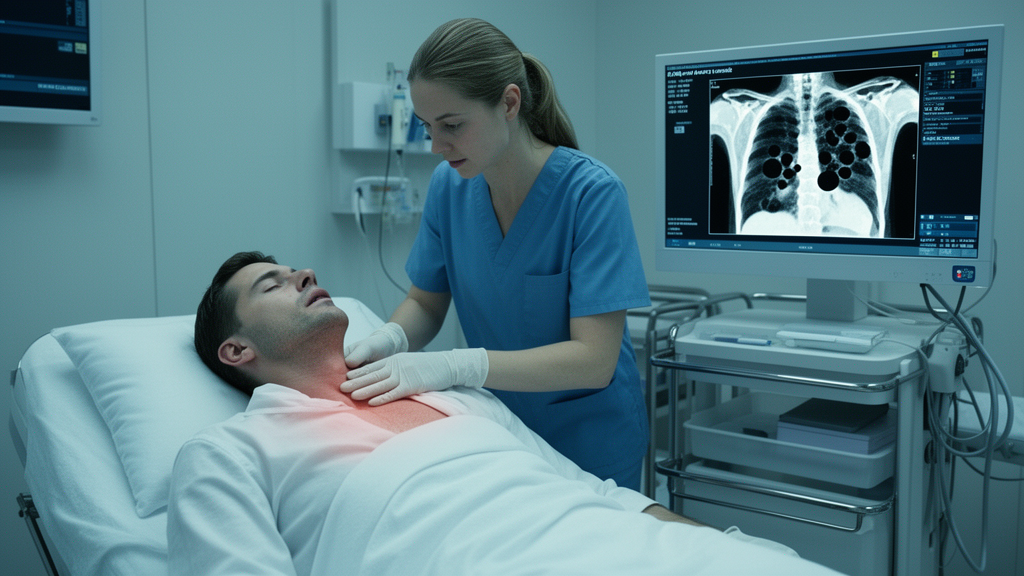
A 37-year-old man who had undergone a routine minimally invasive hemorrhoid procedure developed a life-threatening soft-tissue infection within two days, with gas from the infection tracking upward through his pelvis, retroperitoneum, and posterior mediastinum all the way into his neck. Surgeons found a half-centimeter defect in the surgical staple line, confirmed necrotizing fasciitis across multiple deep compartments, and treated him with emergency colostomy, radical debridement, and broad-spectrum antibiotics. He recovered fully, with no recurrence at one-year follow-up. The case, published in Frontiers in Medicine, documents an unusually complete anatomic chain from a tiny staple-line defect to gas ascending above the diaphragm.
Necrotizing fasciitis is an acute, life-threatening infection of the fascia and subcutaneous tissue characterized by rapidly progressive necrosis. It typically begins suddenly and advances aggressively, making diagnosis difficult and carrying high morbidity and mortality. Reported incidence ranges from 3 to 50 cases per million population annually, with mortality rates of 17 to 35 percent. The condition most often follows trauma, surgical intervention, or an immunocompromised state, and it arises when bacteria invade the skin and subcutaneous tissue and then spread swiftly along superficial and deep fascial planes and through potential soft-tissue spaces. Common sites include the perianal region, the perineum, and the extremities. If not recognized and treated promptly, it can progress to septicemia, multi-organ failure, and death. Radical surgical debridement remains an essential component of effective treatment.
Stapled hemorrhoidopexy, also known as the Procedure for Prolapse and Hemorrhoids or PPH, is a minimally invasive operation for mixed hemorrhoids that gained wide acceptance because it reduces postoperative pain and shortens recovery. As the number of treated cases grew, however, complications such as anastomotic stenosis, rectal narrowing, and postoperative bleeding were reported, contributing to a gradual decline in its clinical use. In extremely rare circumstances, disruption or ischemia at the staple line can allow leakage of intestinal bacteria, producing deep-tissue infection and secondary necrotizing fasciitis. Cephalad gas tracking along fascial spaces with mediastinal emphysema has previously been reported as a benign extraperitoneal air leak through the staple line, but its coexistence with surgically confirmed necrotizing fasciitis extending from the perineum and retroperitoneum had been less well characterized.
The patient in this report was previously healthy and had undergone PPH for mixed hemorrhoids at an outside institution, where the surgery itself was uneventful. Two days after the operation he developed acute anal pain and a high fever of 39.3 degrees Celsius. Antipyretics provided only transient relief, and the pain worsened significantly, radiating upward to the lower abdomen and accompanied by shortness of breath. On the third postoperative day his temperature rose again to 38.4 degrees Celsius, and he was transferred to the authors’ hospital. Physical examination revealed extensive swelling and erythema of the perianal and gluteal regions with palpable crepitus, the crackling sensation produced by gas under the skin. Digital rectal examination found deep tenderness at the posterior rectal wall with a depression at the staple line, and the pain was far greater than typically expected after routine PPH.
Laboratory tests showed a white blood cell count of 17.98 × 10⁹ per liter, a neutrophil percentage of 89.5 percent, C-reactive protein of 102.1 mg/L, and serum amyloid A above 200.00 mg/L. Hemoglobin, platelet count, creatinine, and most electrolytes were within normal limits, although potassium was low at 3.3 mmol/L. Urgent contrast-enhanced CT of the pelvis, abdomen, and chest revealed widespread gas tracking from the perianal region and ischiorectal fossae through the pelvic and retroperitoneal fascial layers along the psoas and iliac muscles, extending superiorly through the diaphragmatic hiatus into the posterior mediastinum and even the cervical fascial spaces. No mediastinal fluid collection or abscess was observed. The imaging, together with operative findings, confirmed necrotizing fasciitis involving the perianal, perineal, ischiorectal, pelvic, and retroperitoneal compartments, accompanied by radiologically demonstrated ascending mediastinal emphysema. The authors stress that the mediastinal and cervical gas represented emphysematous tracking rather than surgically or microbiologically confirmed necrotizing mediastinitis.
The approximately 0.5-centimeter posterior staple-line defect was directly visualized on CT as a small posterior defect roughly 3 centimeters above the dentate line, localized preoperatively by digital rectal examination, and subsequently confirmed and roughly measured by gentle probing during surgical exploration. Urgent surgical exploration took place within 12 hours of diagnosis. The stapled rectal anastomosis showed a full-thickness 0.5-centimeter defect on the posterior rectal wall with active leakage of purulent fluid, confirming anastomotic leakage through a staple-line perforation. No significant loosening, shedding, cutting into the intestinal wall, or exposure of the anastomotic staples was observed at the defect site. Severe edema and abundant necrotic purulent tissue precluded complete visualization of the entire staple line, but the focal defect itself had been localized before surgery and could be directly visualized, probed, and measured before debridement.
Intraoperative exploration confirmed necrotizing fasciitis involving the perianal subcutaneous tissue, the superficial and deep perineal fascia, the bilateral ischiorectal fossae, and the retroperitoneal space, accompanied by extensive fascial necrosis and foul-smelling pus. The surgical strategy followed damage-control principles that prioritize source control and defer definitive reconstruction in the setting of severe contamination and physiological instability. First, a transverse double-barrel colostomy was constructed to achieve complete fecal diversion and eliminate ongoing enteric bacterial contamination. Because of the acute infection phase, severe tissue edema, and an extremely high risk of repair failure, neither primary repair of the defect nor staple removal was attempted at this stage. Radical layered fascial debridement then proceeded through a curved incision 5 centimeters lateral to the anal verge at the 6 o’clock position, with all necrotic fascia and non-viable tissue in the perianal region, perineum, pelvic cavity, and retroperitoneal space completely excised and all involved infected cavities irrigated with hydrogen peroxide and povidone-iodine solution. Double-lumen drainage catheters were placed transanally across the anastomotic defect and in the bilateral ischiorectal fossae and retrorectal space for continuous postoperative irrigation, and rubber seton loops were placed between the left inguinal and left scrotal incisions for dependent counter-drainage.
Postoperatively the patient was admitted to intensive care. Initial antibiotic therapy combined imipenem-cilastatin with metronidazole to cover both aerobic and anaerobic pathogens, consistent with IDSA recommendations for broad empiric therapy in necrotizing soft-tissue infection. Supportive treatment included fluid resuscitation, correction of metabolic acidosis, maintenance of adequate diuresis, and supplementation with albumin and electrolytes. By postoperative day 5, the white blood cell count had fallen to 8.06 × 10⁹ per liter, within the normal reference range, and C-reactive protein had dropped to 24.2 mg/L, a reduction of more than 70 percent from baseline. The patient had remained afebrile and hemodynamically stable for more than 72 consecutive hours. Cultures of pus specimens collected intraoperatively returned negative for bacterial or fungal growth at 5 days of incubation, but the authors caution that these results must be interpreted cautiously because specimens were obtained after broad-spectrum antibiotics had begun and fastidious anaerobes may fail to grow despite appropriate transport. Negative cultures therefore do not prove sterility, and no causative organism was isolated.
On that basis the regimen was de-escalated to latamoxef monotherapy, an oxacephem with documented in-vitro activity against Enterobacterales and many anaerobes including Bacteroides fragilis, as an individualized step-down strategy intended to narrow the antimicrobial spectrum, reduce selective pressure for resistance, and limit adverse events such as Clostridioides difficile infection linked to prolonged carbapenem use. Because no organism was isolated, microbiological confirmation of the regimen’s adequacy was impossible, and the team monitored the patient closely with a low threshold for re-escalation. Repeat CT on postoperative day 8 showed complete absorption of mediastinal gas and no further spread of infection. The patient was discharged on postoperative day 19 with satisfactory wound healing and stable colostomy function. Follow-up surgeries included high fistula repair with seton drainage and removal of exposed staples at three months, V-Y flap reconstruction of the perianal defect at six months, and colostomy reversal at nine months. At one-year follow-up, anal function and perineal appearance were normal, with no recurrence or stenosis.
The authors frame their principal observation as a documented anatomic chain: a small posterior staple-line defect visualized on CT, localized by digital rectal examination, and directly measured at surgery; surgically confirmed perineal, ischiorectal, and retroperitoneal necrotizing fasciitis; and radiographically continuous cephalad gas tracking into the posterior mediastinum and cervical spaces without mediastinal collection. A plausible mechanism is staple tension combined with relatively insufficient local blood supply in the anastomotic area, but no direct evidence of excessive staple tension or local ischemia was documented, and the precise mechanism of the defect remains unconfirmed. CT images showed the infection originating in the perianal region and ischiorectal fossae, spreading upward to the mediastinum and cervical spaces via the pelvic and retroperitoneal fasciae while also extending downward and outward to multiple intermuscular spaces including those of the psoas major, pectineus, sartorius, and gracilis muscles. Gas and infectious agents can enter the retroperitoneal space via the extraperitoneal pelvic space, ascend through weak areas or natural foramina of the diaphragm, and reach the deep cervical spaces through channels such as the visceral and retropharyngeal spaces, a low-resistance anatomic pathway that can produce life-threatening extensive fascial necrosis and sepsis within a short time.
The report carries explicit limitations. It is a single-patient observation and cannot establish incidence, causality, or the superiority of any individual treatment component. The independent contributions of fecal diversion, non-repair of the staple-line defect, the drainage strategy, antimicrobial selection, and staged reconstruction cannot be separated in this case. The favorable outcome was temporally associated with prompt source control, extensive debridement, diversion, drainage, antimicrobial therapy, and multidisciplinary supportive care, consistent with established principles for managing necrotizing soft-tissue infection, but the contribution of any single intervention cannot be definitively concluded. The authors also note that patients who underwent surgery within 24 hours of admission had significantly higher survival in the literature, and early surgery within 6 hours can further improve survival, yet the contribution of timing to survival cannot be isolated in a single uncontrolled observation. From this case they generate two testable hypotheses requiring larger, preferably multi-institutional series: that in active necrotizing fasciitis with severely edematous tissues, primary repair of a staple-line defect carries a high failure rate and fecal diversion with wide drainage followed by staged management is a reproducible strategy; and that CT demonstration of mediastinal or cervical gas tracking without mediastinal collection should not automatically trigger thoracic exploration, with thoracic management reserved for evidence of true mediastinitis. For clinicians, the practical message is that disproportionate pain, persistent fever, or subcutaneous crepitus after anorectal surgery should prompt urgent CT and surgical consultation rather than reliance on the rarity of the complication.
Subject of Research: A case report of necrotizing fasciitis and ascending mediastinal emphysema caused by anastomotic perforation after stapled hemorrhoidopexy
Article Title: Case report: necrotizing fasciitis with ascending mediastinal emphysema secondary to anastomotic perforation after stapled hemorrhoidopexy
Article References: Wang, Z., Deng, Z., Wang, J., Li, H., Chen, S., & Jian, L. (2026). Case report: necrotizing fasciitis with ascending mediastinal emphysema secondary to anastomotic perforation after stapled hemorrhoidopexy. Frontiers in Medicine, 13, 1914139. https://doi.org/10.3389/fmed.2026.1914139
Image Credits: AI Generated
DOI: 10.3389/fmed.2026.1914139
Keywords: necrotizing fasciitis, stapled hemorrhoidopexy, anastomotic leakage, mediastinal emphysema, case report, surgical complications, CT imaging, retroperitoneal infection, colostomy, debridement, damage-control surgery, antibiotic de-escalation
News Source: Ophelia Keating. (October 27, 2026). Rare Flesh-Eating Infection With Gas Rising to the Chest After Hemorrhoid Surgery. Scienmag.