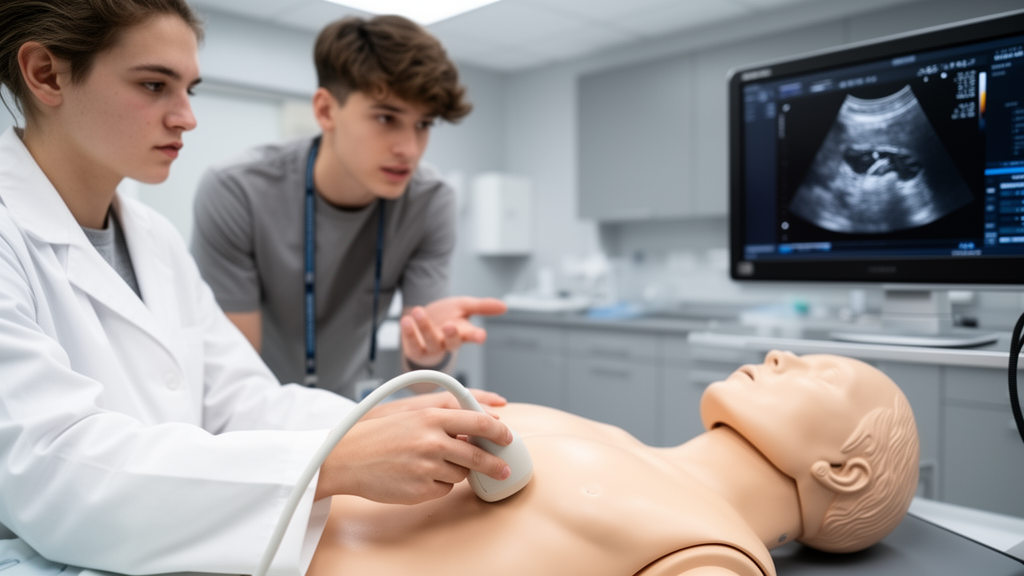
A mandatory ultrasound simulation training integrated into a fifth-year medical curriculum significantly improved students’ ultrasound knowledge and self-confidence, according to a prospective cohort study published in BMC Medical Education.
Ultrasound is an essential diagnostic modality in modern medicine due to its wide availability, safety, and versatility. However, the diagnostic accuracy of ultrasound is highly dependent on operator proficiency, and despite growing recommendations from professional societies for early and structured ultrasound education, training often begins late and predominantly in clinical practice.
Simulation-based ultrasound training offers a safe and standardized learning environment, particularly for intimate examinations in gynecology and obstetrics. The study aimed to evaluate the educational effectiveness of a mandatory ultrasound simulation training integrated into an undergraduate medical curriculum.
In the prospective cohort study, 143 fifth-year medical students enrolled in a mandatory obstetrics and gynecology module were allocated via a quasi-randomized approach to an intervention group or a waitlist-control group. The intervention consisted of three 20-minute ultrasound simulation sessions using high-fidelity models for transvaginal sonography, fetometry, and breast ultrasound.
Knowledge acquisition and self-efficacy were assessed using study-specific, pilot-tested pre- and post-intervention questionnaires, and group-level statistical analyses were performed to evaluate learning outcomes.
A total of 126 students completed the post-test, with 55 in the waitlist-control group and 71 in the intervention group. Baseline characteristics and pre-test knowledge scores did not differ significantly between the groups, strengthening the comparison of learning outcomes.
After the intervention, the intervention group demonstrated a significantly greater increase in ultrasound knowledge compared to the waitlist-control group, with a p-value of .005. Participants reported high satisfaction with the training and increased self-confidence in ultrasound application. Notably, the majority of participants, 87 percent, expressed a desire for extended training duration.
The authors concluded that mandatory ultrasound simulation training significantly improves undergraduate medical students’ ultrasound knowledge and self-confidence, even after short training interventions. They described these real-life evaluation data as supporting simulation-based ultrasound education as an effective and feasible component of competency-based medical curricula.
Subject of Research: Simulation-based ultrasound training in undergraduate gynecology and obstetrics education
Article Title: A prospective cohort study on ultrasound simulation training in gynecology and obstetrics using pelvic, fetometry, and breast models
Article References: Tüscher, L., Weyers, S., Arslan, M., Fehm, T., Borgmeier, F., Jäger, B., Helbig, M., Banys-Paluchowski, M., Cieslik, J., Wadenpohl, J., Neubacher, M., & Krawczyk, N. (2026). A prospective cohort study on ultrasound simulation training in gynecology and obstetrics using pelvic, fetometry, and breast models. BMC Medical Education. https://doi.org/10.1186/s12909-026-10682-0
Image Credits: AI Generated
DOI: 10.1186/s12909-026-10682-0
Keywords: ultrasound, simulation training, medical education, gynecology, obstetrics, transvaginal sonography, fetometry, breast ultrasound, medical students, self-efficacy, curriculum, prospective
News Source: Ophelia Keating. (October 27, 2026). Short Simulation Sessions Boost Medical Students’ Ultrasound Knowledge and Confidence. Scienmag.