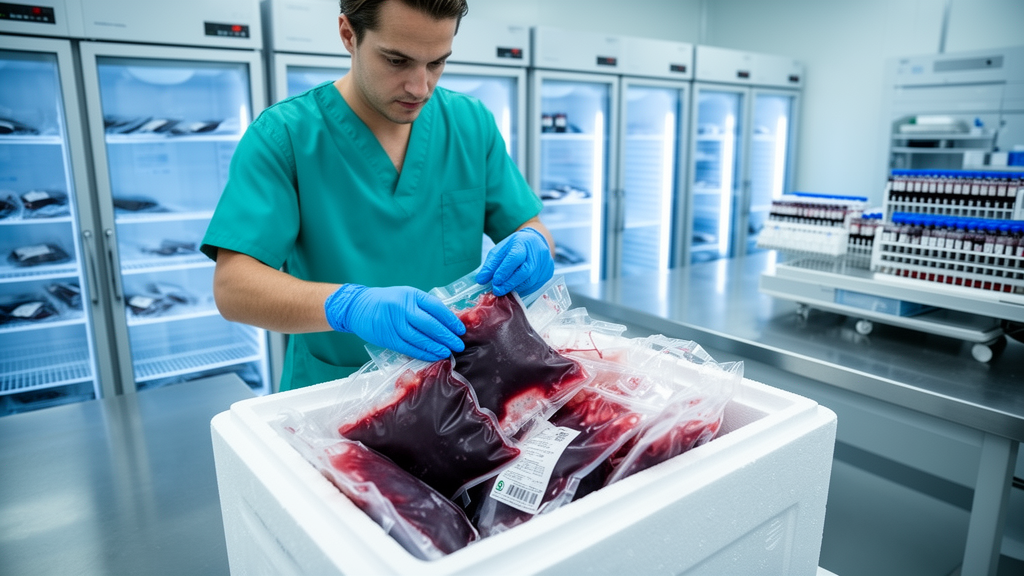
A mathematical modeling framework that couples open queuing networks with iterative decomposition can systematically evaluate facility location and inventory transshipment across complex blood supply chains, according to an investigation by operations researchers in Brazil. Blood supply systems represent uniquely challenging logistics networks because blood cannot be manufactured synthetically and relies entirely on voluntary human donations that exhibit high stochastic variability. At the same time, clinical demand from hospitals fluctuates continuously, while transfusions enforce strict compatibility requirements and tight perishability constraints across separated biological fractions. The investigators addressed an enduring gap in healthcare logistics literature, which has traditionally focused on isolated supply stages or demand-side hospital inventories rather than chain-wide operational dynamics. By linking collection, component manufacturing, laboratory testing, and regional storage into a unified queue-theoretic structure, the researchers demonstrated how strategic consolidation decisions directly alter transit delays, network processing times, and regional product availability across both current operations and multi-decade demographic projections.
To capture the fundamental physics of workflow congestion across distributed facilities, the study formulated blood movement through a generalized open queuing network evaluated via an approximate decomposition method. Unlike classical Jackson networks that enforce restrictive Poisson arrival assumptions and exponential service distributions, generalized queuing networks accommodate non-exponential arrival intervals and arbitrary service variability, which are essential for reflecting actual clinical and laboratory environments. The decomposition procedure separated the intractable multi-station network into single-station subsystems analyzed through three sequential operational phases: calculating arrival superposition and departure splitting across transfer arcs, evaluating localized waiting times and server utilizations, and synthesizing system-wide performance into aggregate lead-time metrics. Traffic variability equations established a solvable linear system determining the interarrival variability across stations, from which expected queuing delays were computed using Whitt approximations. The resulting optimization framework evaluated candidate configurations spanning full network decentralization down to single-site centralization, utilizing network lead time as the objective benchmark.
The research team calibrated and empirically evaluated the integrated architecture using comprehensive operational data from the Center for Hematology and Hemotherapy of Santa Catarina, known as HEMOSC, which coordinates approximately 99 percent of hemotherapy coverage across the southern Brazilian state. The base empirical dataset comprised records gathered between August 2023 and August 2024 across a network consisting of one central coordinating blood center, six regional blood centers, and two dedicated collection units. In the baseline operational analysis, the researchers focused specifically on red blood cell concentrates, which maintain a direct one-to-one yield ratio with whole blood donations. Input parameters were derived from historical network throughput, establishing monthly external arrival rates across collection nodes, localized hospital demand rates, and a target inventory threshold defined as a seven-day rolling clinical demand. Baseline production and testing losses were fixed at 1.25 percent, while storage expiration waste was calculated at 6.48 percent, with external interarrival variability established at 0.4354.
A primary structural finding of the study reveals the explicit operational trade-off between administrative centralization and logistical transit duration across the geographic network. Exhaustive combinatorial evaluation across production configurations demonstrated that the expected lead time from donor collection to inventory entry increases monotonically as component manufacturing concentrates into fewer facilities. In a completely decentralized layout where all seven regional blood centers operate active fractionation facilities, the expected lead time was calculated at 0.33 hours because collected blood is processed immediately on-site without inter-facility road transfers. As the model systematically consolidated production down to five centers, lead time grew to 0.96 hours; reducing capacity to three centers increased processing and transfer delay to 2.68 hours. Under full centralization within a single facility located at regional node P2, the expected lead time rose to 6.66 hours, driven entirely by cross-state transit times from outlying collection units.
To validate the analytical accuracy of the decomposition-based queuing network, the authors constructed an independent discrete-event simulation model mirroring the spatial and operational topology of the Santa Catarina blood system. The simulation mimicked bag flows from initial donor intake through intermediate processing to cold-chain storage across one hundred monthly replications, incorporating realistic non-empty starting inventory baselines. Across all seven structural configurations, the expected lead-time estimates generated by the queuing decomposition method closely tracked the outputs of the computationally intensive discrete-event simulation, with observed percentage deviations ranging between 0.84 percent and 7.76 percent. This close agreement demonstrated that the approximate analytical equations accurately captured network congestion, queue formation, and transportation latency without requiring prolonged numerical simulation runs. Computational benchmark experiments revealed that while a five-unit problem required only 0.01 minutes of processing time across 30 candidate configurations, a twenty-unit network generated over one million configurations and required 3024.35 minutes, underscoring practical scaling limits for exhaustive search procedures.
Beyond physical facility siting, the researchers integrated tactical lateral transshipment mechanisms to resolve geographical inventory disparities and suppress product spoilage before expiration. Under baseline allocations prior to lateral product exchange, regional inventories exhibited severe localized imbalances despite achieving an overall network stock equivalent to 6.37 days of demand, or roughly 91 percent of the seven-day target. Individual storage centers experienced inventory holdings ranging from a critical low of 11.76 percent of target coverage up to an excessive 192.72 percent surplus, with the most acute deficits concentrated at nodes E2 and E4 in high-density population areas. The authors evaluated two competing tactical transshipment policies: a nearest-neighbor heuristic that prioritized shipping volume from high-surplus centers to the closest deficit sites, and a mixed-integer linear programming model designed to achieve proportional inventory fairness across all network nodes while minimizing total transit distance.
The comparative evaluation of transshipment models demonstrated that simple distance-minimizing heuristics fail to safeguard vulnerable regional hubs within asymmetric supply chains. While the heuristic succeeded in raising six of the seven regional centers to 100 percent of their target inventory, storage unit E4 remained critically undersupplied at only 59.15 percent of its required stock, reflecting its logistical isolation relative to primary surplus nodes. In contrast, the mixed-integer mathematical formulation enforced equity constraints that restricted relative stock deviations to within 10 percent of target levels across all facilities, successfully bringing every center above 90 percent inventory satisfaction. However, achieving geographic equity demanded substantial additional transportation effort: the optimization model increased the gross quantity of transferred blood products by 26.7 percent and raised the total distance-weighted freight volume by 44.42 percent compared to the heuristic approach, illustrating a clear logistical cost for regional inventory protection.
The study subsequently tested the optimization framework against long-term demographic transformations projected to reshape Brazilian healthcare demand between 2030 and 2070. Forecasting models applied to the regional network estimated that while donor availability will grow by only 6.06 percent by 2030 and peak at 30.28 percent by 2050, clinical blood demand will expand by 26.11 percent in 2030, surging to 119.89 percent in 2050 and reaching 179.23 percent by 2070.
When these shifting demographic projections were evaluated through the queuing model, all baseline future scenarios proved mathematically infeasible without substantial operational interventions, because projected hospital demand consistently exceeded incoming donations. The mathematical configurations that minimized lead times remained structurally identical to those in the 2024 baseline, with facility P2 functioning as the central consolidator and nodes E2 and E4 persistently facing the most severe local shortfalls. To determine the operational adjustments required to prevent systemic collapse, the authors modeled incremental donation expansions. Maintaining Santa Catarina’s historical stock level of 6.37 days of demand would require securing an additional 20 percent in donor collections by 2030, a 40 percent increase by 2040, a 170 percent expansion by 2050, and a 230 percent expansion by 2070 over projected natural trends, demanding massive investments in mobile collection infrastructure and municipal recruitment campaigns.
The authors emphasized that while centralized processing yields undeniable economies of scale, standardized testing oversight, and lower capital facility footprints, health planners cannot execute consolidation abruptly without accounting for network lead times and facility continuity. In Santa Catarina, HEMOSC migrated from a six-center production structure prior to 2022 into a five-center configuration consisting of centers P1, P2, P3, P4, and P7, strategically preserving center P2 during transition phases to avoid costly decommissioning and subsequent reactivation. The researchers noted that their current framework was evaluated on single-component red blood cell flows and identified critical pathways for future development, including multi-commodity optimization across platelets and plasma with differing shelf lives, explicit facility processing capacities, and multi-objective algorithms balancing transportation expenditure, equity of access, and spoilage prevention.
Subject of Research: Decomposition-based queuing network optimization for integrated blood supply chain logistics
Article Title: A decomposition-based location and allocation framework for integrated blood supply chain planning using queuing networks
Article References: Gualberto, C. R., Rodrigues, L. F., de Freitas Almeida, J. F., de Arruda, E. F., & Mazziero, M. (2026). A decomposition-based location and allocation framework for integrated blood supply chain planning using queuing networks. Healthcare Analytics, 10, Article 100511. https://doi.org/10.1016/j.health.2026.100511
Image Credits: AI Generated
DOI: 10.1016/j.health.2026.100511
Keywords: blood supply chain, queuing networks, operations research, facility location, inventory management, blood product transshipment, open queuing networks, approximate decomposition, HEMOSC, Santa Catarina, red blood cells, health logistics, donor demographics, perishable inventory, mathematical modeling, supply chain centralization, discrete-event simulation
News Source: Ophelia Keating. (November 26, 2026). Queuing Network Framework Optimizes Blood Supply Chains Amid Shifting Demographic Pressures. Scienmag.