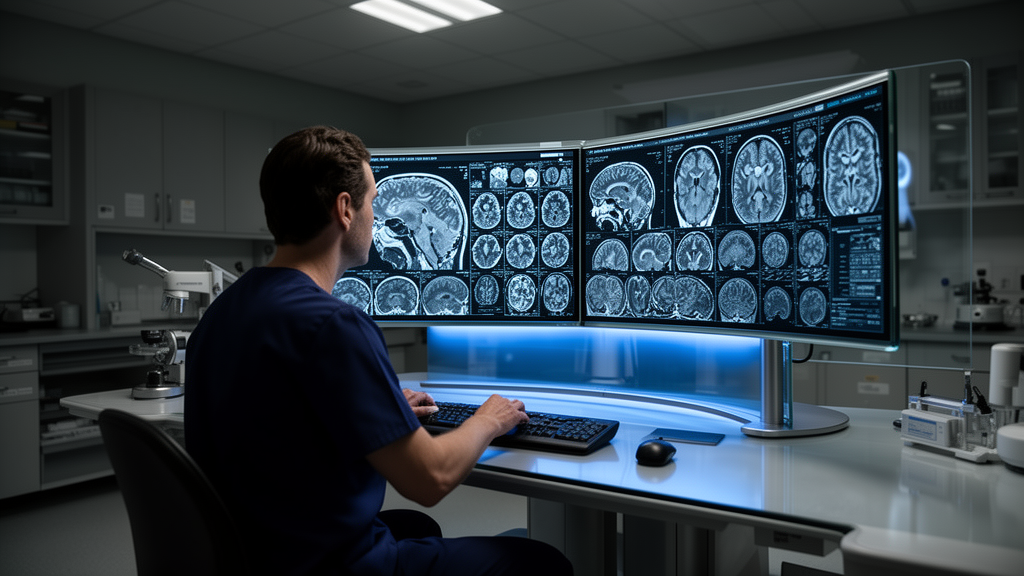
A unified artificial intelligence framework combining convolutional neural networks with precision-constrained heuristic decision rules achieved one hundred percent subject-level classification accuracy on internal held-out magnetic resonance imaging test sets across Alzheimer’s disease, pediatric epilepsy, and intracranial aneurysms. Developed by researchers Rani Ghassan Al Rahbani and Anastasia Ioannou, the computational approach resolves a longstanding bottleneck in neuroimaging diagnostics by replacing the resource-intensive analysis of entire three-dimensional scan volumes with the targeted evaluation of individual two-dimensional slices. By restricting the primary diagnostic classification to decision rules that yielded zero false positives on the training data, the methodology achieved complete diagnostic consensus across diverse test cohorts while simultaneously reducing the total volume of processed neuroimaging slices by as much as eighty-nine percent compared to exhaustive whole-volume scans.
Diagnosing neurological conditions at an early stage remains one of modern medicine’s most difficult clinical objectives because distinct neurodegenerative and structural pathologies often exhibit subtle or overlapping imaging presentations. In patients with Alzheimer’s disease, initial biomarker alterations and early structural changes can easily be confounded with normal aging or non-Alzheimer’s dementias. For individuals with epilepsy, delays in identifying focal cortical dysplasia frequently prevent timely surgical intervention and contribute to medically refractory seizures, while intracranial cerebral aneurysms are rarely discovered prior to life-threatening vascular rupture. Although automated deep learning algorithms have shown substantial promise in radiological interpretation, the vast majority of existing computational models are designed strictly for a single disease and demand immense computational processing to evaluate redundant volumetric three-dimensional neuroimaging series without incorporating clinically grounded hierarchical reasoning.
To overcome these clinical and computational barriers, the investigative team established an overarching diagnostic architecture that maintains a standardized methodological design across distinct neurological disorders while instantiating specialized pipelines tailored to individual imaging modalities, resolution profiles, and class structures. The investigation utilized publicly available, de-identified neuroimaging repositories encompassing structural T1-weighted MPRAGE scans from the OASIS1, OASIS2, ADNI-256, and ADNI-192 cohorts for Alzheimer’s disease evaluation, pre-surgical T1-weighted and FLAIR imaging from an OpenNeuro repository of pediatric patients aged three to thirteen years with focal cortical dysplasia type II alongside matched controls, and OpenNeuro three-dimensional Time-of-Flight magnetic resonance angiography series encompassing verified aneurysm cases and healthy vascular controls.
Across all datasets, the researchers extracted two-dimensional image frames from volumetric neuroimaging series and implemented scan-specific intensity normalization protocols, including whole-brain normalization for the OASIS cohorts, gray matter-masked skull stripping via FSL BET for the ADNI series, cortical region-of-interest normalization for the pediatric epilepsy dataset, and vessel-specific intensity standardization for time-of-flight angiography volumes. To prevent data leakage and overly optimistic performance estimates, the experimental methodology enforced a patient-level stratified splitting protocol in which ten percent of subjects from each cohort were entirely sequestered as an uncompromised held-out test partition. The remaining ninety percent of subjects supplied slice pools that were split into training, validation, and preliminary internal testing subsets, guaranteeing that every final performance calculation was evaluated on patients whose scans were never seen during feature representation learning or decision rule construction.
The foundational neural network pipeline utilized transfer learning on two distinct pre-trained convolutional backbones, EfficientNetB0 and ResNet50V2, which were selected over vision transformer architectures because convolutional networks demonstrate superior feature extraction on constrained medical imaging cohorts with substantially lower computational expenditure. Training was conducted within a standardized Google Colab environment utilizing a single Tesla T4 graphics processing unit with sixteen gigabytes of memory, optimizing network weights via the Adam algorithm across batch sizes of sixteen. Across training trajectories converging between thirteen and sixty-nine epochs, checkpoint weights were preserved whenever validation loss improved, producing sixty-eight saved checkpoints for EfficientNetB0 and one hundred and one checkpoints for ResNet50V2 across all evaluated imaging datasets.
Validation experiments revealed substantial performance differences between the two underlying convolutional models, with EfficientNetB0 outperforming ResNet50V2 by an average margin of 7.34 percentage points across all six evaluated imaging cohorts. EfficientNetB0 demonstrated pronounced resilience to reductions in image resolution, maintaining a validation accuracy of 97.23 percent on the 192 by 192 pixel ADNI-192 dataset where ResNet50V2 dropped sharply to 85.38 percent, despite both models achieving over 96 percent accuracy on the 256 by 256 pixel ADNI-256 series. In the pediatric epilepsy cohort, EfficientNetB0 achieved 99.77 percent validation accuracy by epoch thirteen, compared to 98.51 percent for ResNet50V2 at epoch twenty-nine, while on the intracranial aneurysm series, EfficientNetB0 reached 97.15 percent validation accuracy against 95.39 percent for the residual network.
When individual, diagnostically optimal two-dimensional slices were tested in isolation against the strictly held-out patient test partitions, baseline convolutional accuracy varied widely from 40.62 percent in ADNI-192, 50.00 percent in ADNI-256, 70.59 percent in OASIS2, and 72.73 percent in OASIS1, up to 89.29 percent in intracranial aneurysm detection and 95.00 percent in pediatric focal cortical dysplasia. Standard aggregation techniques failed to resolve this single-slice variability, as unweighted majority voting across all volume slices caused performance to drop to 37.50 percent in ADNI-192, 40.48 percent in ADNI-256, 64.71 percent in OASIS2, 85.00 percent in epilepsy, and 60.71 percent in aneurysm detection. Furthermore, sweeping confidence thresholds between 0.50 and 0.99 prior to majority voting yielded identical test accuracy to naive voting, because high uncertainty across non-discriminative anatomical slices caused extensive frame discards and amplified background noise.
To bridge the considerable divide between single-slice classification and patient-level clinical certainty, the investigators deployed a precision-constrained heuristic post-processing framework operating through sequential covering. Primary decision rules were derived strictly from the training partition by identifying specific model checkpoints and frame indices that achieved perfect precision, defined as zero false positives, for an unassigned diagnostic class. In this sequential architecture, the single primary rule exhibiting the highest recall among perfect-precision candidates is applied first, correctly resolved subjects are removed from the analysis pool, and the selection process iterates across remaining unassigned diagnostic categories until either all categories are covered or no remaining candidates satisfy the zero false positive criterion, at which point an optimal F1-score fallback predictor resolves remaining ambiguous cases.
This structured consensus logic completely eliminated diagnostic errors across all six independent held-out patient test cohorts, elevating final subject-level classification accuracy to one hundred percent across every evaluated condition. The precision-first framework improved diagnostic accuracy over the best single-frame baselines by 50.00 percentage points in ADNI-256, 59.38 percentage points in ADNI-192, 29.41 percentage points in OASIS2, 27.27 percentage points in OASIS1, 10.71 percentage points in intracranial aneurysms, and 5.00 percentage points in pediatric epilepsy, with McNemar statistical testing confirming that these improvements over single-slice predictions and majority voting were statistically significant at p values below 0.001 even after rigorous Bonferroni correction.
Crucially, the heuristic selection rules automated the identification of neuroanatomically meaningful imaging planes, concentrating decision logic within mid-volume slices spanning twenty to eighty percent of total scan depth and bypassing anatomically uninformative peripheral frames. In the Alzheimer’s cohorts, the primary rules prioritized slices cutting directly through the medial temporal lobe, entorhinal cortex, and hippocampal formations where early structural atrophy is clinically documented. In the epilepsy dataset, rule derivation converged on frame 195 along the cortical ribbon where focal cortical dysplasia lesions manifest, and in the vascular angiography series, frame 253 intersecting the Circle of Willis was isolated as the primary locus for detecting arterial aneurysm morphology.
The structural efficiency of the heuristic framework directly mirrored pathological complexity, requiring only three primary decision rules to classify 97.6 percent of pediatric epilepsy test subjects under perfect precision, seven rules to achieve 91.2 percent coverage in intracranial aneurysms, and nine to eleven rules to achieve 89.5 to 94.1 percent coverage across three-class and four-class Alzheimer’s staging problems. Because primary rules resolved the vast majority of patient scans with zero false positives, secondary fallback predictors were required for only 2.4 percent of epilepsy cases, 8.8 percent of aneurysm cases, and between 5.9 and 12.7 percent of dementia subjects, with the total computational processing burden averaging approximately thirty-two percent of standard exhaustive whole-volume evaluation.
To assess whether the discovered heuristic rules were sensitive to data sampling variations without retraining all 169 neural network checkpoints, the authors executed a patient-level bootstrap analysis encompassing one thousand random ninety-ten data resamples on pre-computed prediction matrices. Across one thousand resamples, the binary epilepsy pipeline maintained a mean subject-level accuracy of 1.0000 with zero variance, while the aneurysm pipeline achieved a mean accuracy of 0.9985 with 95.8 percent of resamples reaching complete diagnostic perfection. The four-class ADNI-256 and ADNI-192 datasets maintained mean bootstrap accuracies of 0.9865 and 0.9862 respectively, while the three-class OASIS2 and OASIS1 cohorts achieved mean accuracies of 0.9701 and 0.9223, reflecting increased diagnostic ambiguity among transitional dementia stages such as mild cognitive impairment converters who exhibited zero percent recall in isolated single-frame tests.
Despite the remarkable achievement of one hundred percent subject-level classification across all experimental test partitions, the authors emphasized critical limitations regarding current clinical translation. Because all imaging data originated from Siemens 1.5-Tesla and 3.0-Tesla scanners and evaluated cohorts presented notable demographic constraints, such as an eighty-seven percent Caucasian representation within ADNI and an exclusively pediatric scope in epilepsy, the derived rule sets remain partially dataset-specific. The researchers underscored that these findings represent an experimental proof of concept rather than a completed clinical tool, emphasizing that prospective multi-center trials across diverse scanner vendors, nested cross-validation with full model retraining, and formal neuroradiological validation incorporating Grad-CAM saliency mapping remain necessary prerequisites prior to real-world medical deployment.
Subject of Research: Unified deep learning and heuristic framework for MRI classification of neurological disorders
Article Title: A unified deep-learning-heuristic framework for MRI-based classification of Alzheimer’s, epilepsy, and aneurysms
Article References: Al Rahbani, R. G., & Ioannou, A. (2026). A unified deep-learning-heuristic framework for MRI-based classification of Alzheimer’s, epilepsy, and aneurysms. Computer Methods and Programs in Biomedicine Update, 10, Article 100268. https://doi.org/10.1016/j.cmpbup.2026.100268
Image Credits: AI Generated
DOI: 10.1016/j.cmpbup.2026.100268
Keywords: Magnetic Resonance Imaging, Deep Learning, Heuristic Framework, Alzheimer's Disease, Epilepsy, Intracranial Aneurysms, EfficientNetB0, ResNet50V2, Neuroimaging, Computer-Aided Diagnosis, Focal Cortical Dysplasia, Transfer Learning, Slice Selection, Precision-Constrained Rules, ADNI Dataset, OASIS Dataset, Medical Image Analysis
News Source: Ophelia Keating. (November 26, 2026). Dual-Network Framework Uses Targeted MRI Slices to Classify Complex Neurological Conditions. Scienmag.