• HOME
  • NEWS
  • EXPLORE
    • CAREER
      • Companies
      • Jobs
    • EVENTS
    • iGEM
      • News
      • Team
    • PHOTOS
    • VIDEO
    • WIKI
  • BLOG
  • COMMUNITY
    • FACEBOOK
    • INSTAGRAM
    • TWITTER
Sunday, May 17, 2026
BIOENGINEER.ORG
No Result
View All Result
  • Login
  • HOME
  • NEWS
  • EXPLORE
    • CAREER
      • Companies
      • Jobs
        • Lecturer
        • PhD Studentship
        • Postdoc
        • Research Assistant
    • EVENTS
    • iGEM
      • News
      • Team
    • PHOTOS
    • VIDEO
    • WIKI
  • BLOG
  • COMMUNITY
    • FACEBOOK
    • INSTAGRAM
    • TWITTER
  • HOME
  • NEWS
  • EXPLORE
    • CAREER
      • Companies
      • Jobs
        • Lecturer
        • PhD Studentship
        • Postdoc
        • Research Assistant
    • EVENTS
    • iGEM
      • News
      • Team
    • PHOTOS
    • VIDEO
    • WIKI
  • BLOG
  • COMMUNITY
    • FACEBOOK
    • INSTAGRAM
    • TWITTER
No Result
View All Result
Bioengineer.org
No Result
View All Result
Home NEWS Science News Biology

Queen’s University Belfast researcher turning dirty tinfoil into…

Bioengineer by Bioengineer
February 8, 2018
in Biology
Reading Time: 2 mins read
0
Share on FacebookShare on TwitterShare on LinkedinShare on RedditShare on Telegram
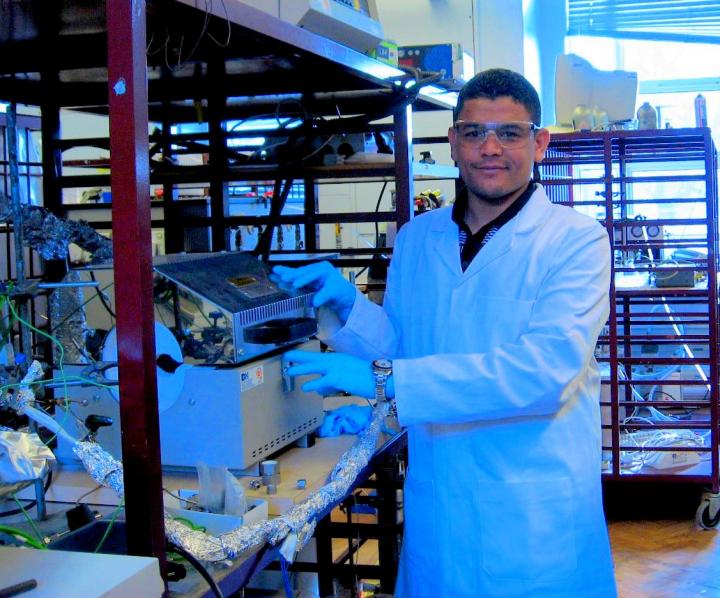
IMAGE

Credit: Queen's University Belfast

A researcher at Queen's University Belfast has discovered a way to convert dirty aluminium foil into a biofuel catalyst, which could help to solve global waste and energy problems.

In the UK, around 20,000 tonnes of aluminium foil packaging is wasted each year – enough to stretch to the moon and back. Most of this is landfilled or incinerated as it's usually contaminated by grease and oils, which can damage recycling equipment.

However, Ahmed Osman, an Early Career Researcher from Queen's University's School of Chemistry and Chemical Engineering, has worked with engineers at the university to create an innovative crystallisation method, which obtains 100% pure single crystals of aluminium salts from the contaminated foil. This is the starting material for the preparation of alumina catalyst.

Usually, to produce this type of alumina it would have to come from bauxite ore, which is mined in countries such as West Africa, the West Indies and Australia, causing huge environmental damage.

Osman, who took on the project under the University's Sustainable Energy, Pioneering Research Programme, has created a solution which is much more environmentally-friendly, effective and cheaper than the commercial catalyst which is currently available on the market for the production of dimethyl ether – a biofuel which is regarded as the most promising of the 21st century. Osman says making the catalyst from aluminium foil cost about £120/kg while the commercial alumina catalyst comes in at around £305/kg.

Its unique thermal, chemical and mechanical stability means it can also be used as an absorbent, in electronic device fabrication, as a cutting tool material or as an alternative for surgical material for implants.

The ground-breaking research has been published in Scientific Reports.

Osman commented: "I have always been inspired by Chemistry and I believe that catalysis especially can make the world a better place. One day I took a walk through our laboratories at Queen's and found lots of Aluminium foil waste so I did a little digging and after speaking to my colleagues, I ran my experiment and was astonished by the ultrapure single crystals – I didn't expect it to be 100% pure.

"At Queen's, our scientists and engineers often work hand in hand on common challenging problems for the society. By using our joint expertise, we have been able to tackle the issue of sustainable development and come up with a research solution which lies in an area between chemistry and chemical engineering.

"This breakthrough is significant as not only is the alumina more pure than its commercial counterpart, it could also reduce the amount of aluminium foil going to landfill while also sidestepping the environmental damage associated with mining bauxite."

Osman is hoping to continue his research into how these catalysts can be further improved and explore the opportunities for commercialisation of biofuel production or use the modified alumina catalyst in the catalytic converters in natural gas vehicles.

###

Media Contact

Emma Gallagher
[email protected]
289-097-5384
@QueensUBelfast

http://www.qub.ac.uk

Original Source

http://www.qub.ac.uk/Connect/News/Allnews/Queensresearcherturningdirtytinfoilintobiofuelcatalyst.html


Share12Tweet7Share2ShareShareShare1

Related Posts

Uncovering C. elegans Immunity via Genetic Screens — Biology

Uncovering C. elegans Immunity via Genetic Screens

May 16, 2026
Single mother must adapt swiftly — the survival of her colony depends on it — Biology

Single mother must adapt swiftly — the survival of her colony depends on it

May 15, 2026

Why Are Nearly Everyone Right-Handed? It Might Be Linked to How We Learned to Walk

May 15, 2026

Excessive Neuronal Activity Initiates Severe Autoimmune Brain Disorder

May 15, 2026
Please login to join discussion

POPULAR NEWS

  • Research Indicates Potential Connection Between Prenatal Medication Exposure and Elevated Autism Risk

    844 shares
    Share 338 Tweet 211
  • New Study Reveals Plants Can Detect the Sound of Rain

    730 shares
    Share 291 Tweet 182
  • Salmonella Haem Blocks Macrophages, Boosts Infection

    62 shares
    Share 25 Tweet 16
  • Breastmilk Balances E. coli and Beneficial Bacteria in Infant Gut Microbiomes

    58 shares
    Share 23 Tweet 15

About

We bring you the latest biotechnology news from best research centers and universities around the world. Check our website.

Follow us

Recent News

Intrinsic Capacity, Resilience, Frailty in Stroke Recovery

Seed Traits Key to Rare vs. Common Astragalus

Noncanonical Sulfur Metabolism, Immunity Altered in Down Syndrome

Subscribe to Blog via Email

Success! An email was just sent to confirm your subscription. Please find the email now and click 'Confirm' to start subscribing.

Join 82 other subscribers
  • Contact Us

Bioengineer.org © Copyright 2023 All Rights Reserved.

Welcome Back!

Login to your account below

Forgotten Password?

Retrieve your password

Please enter your username or email address to reset your password.

Log In
No Result
View All Result
  • Homepages
    • Home Page 1
    • Home Page 2
  • News
  • National
  • Business
  • Health
  • Lifestyle
  • Science

Bioengineer.org © Copyright 2023 All Rights Reserved.