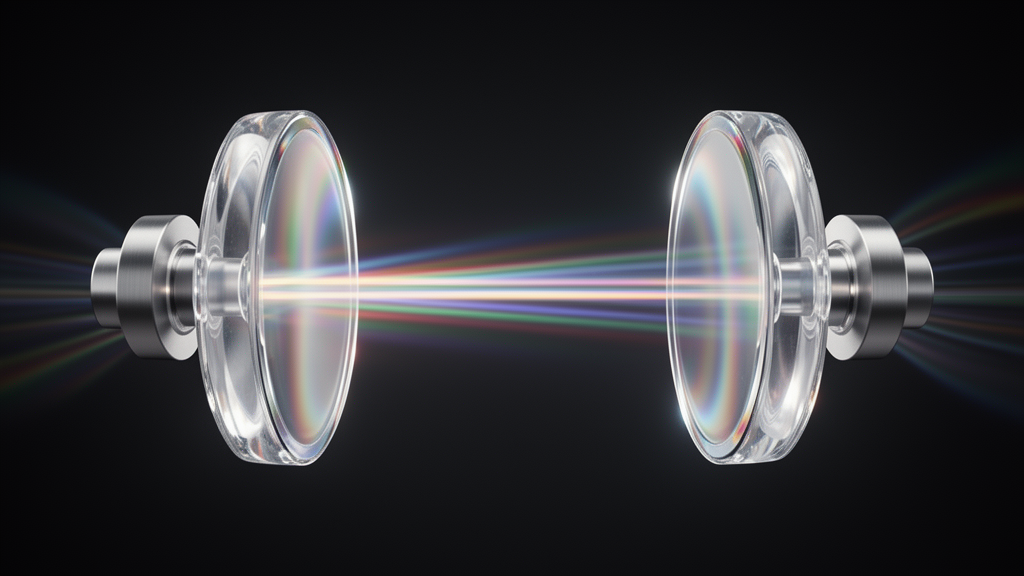
Researchers from Stanford University, Technische Universität Berlin, and Queen’s University have developed a theoretical framework to accurately model quantum dissipation in strongly coupled optical cavity systems. Optical cavities, which confine light to facilitate strong interactions with matter such as atoms and molecules, are foundational components for proposed quantum technologies, including quantum computing and enhanced sensing. However, as modern engineering allows light to be confined into increasingly minute volumes, the interaction bandwidth expands significantly, causing conventional theoretical models of cavity leakage to break down. The international team addressed this limitation by advancing the quantum theory of cavity photon dissipation, introducing an approach designed for emerging regimes of cavity quantum electrodynamics.
Standard quantum descriptions of light escaping an open cavity often become insufficient when interaction bandwidths grow exceptionally wide. To resolve these discrepancies, the researchers constructed their mathematical approach on the foundation of quasinormal modes, which represent the fundamental physical resonances of open cavities. By applying quantum mechanical treatments to these open modes, the team derived a dissipative quantum model tailored for broadband light-matter interactions within a single-mode platform. This theoretical advance allows researchers to calculate and predict key behavioral characteristics of the coupled system, including frequency-dependent dissipation rates, without abandoning the analytical utility and relative simplicity found in earlier single-mode frameworks.
A primary outcome of the investigation, published in Light: Science & Applications, is the formal identification of what the authors designate as the broadband dissipative regime of cavity quantum electrodynamics. Within this regime, the spectral width of the light-matter interaction is large enough that standard approximations fail, requiring the theoretical corrections derived in this work to describe the physical behavior accurately. The researchers established that this newly classified domain encompasses the ultrastrong coupling regime, a focus of substantial theoretical and experimental study over the past two decades. Furthermore, their calculations revealed that broadband dissipative effects can manifest at coupling strengths considerably weaker than those traditionally required to enter the ultrastrong coupling threshold.
Under broadband dissipative conditions, the dynamic evolution of the system ceases to depend solely on the numerical strength of the coupling between light and the emitter. Instead, the dynamics also depend directly on the spatial phase of the cavity field mode at the exact physical location of the emitter, a structural property typically neglected in conventional single-mode models. Because this spatial phase can be evaluated directly from Maxwell’s equations for any specified open cavity structure, the model enables a first-principles, ab initio calculation of the system dynamics. The authors noted that this formulation significantly generalizes previous single-mode models in the ultrastrong coupling regime for open systems, granting direct access to coupling constants and cavity-environment spectral densities without relying on empirical or phenomenological fitting parameters.
The theoretical framework also establishes a rigorous method for evaluating the fundamental limits of single-mode approximations commonly used across quantum science. Numerous elementary designs for quantum information processing components presume that light-matter coupling operates purely within a single mode. By identifying the boundary conditions where broadband corrections become essential, the newly developed model provides an objective benchmark to test when those single-mode assumptions remain valid and when multimode or broadband dissipative corrections must be incorporated into system designs.
To assess practical relevance, the researchers examined realistic open cavity architectures characterized by dominant quasinormal modes, analyzing both experimentally motivated plasmonic structures and dielectric resonators. Based on these configurations, the authors concluded that the broadband dissipative phenomena predicted by their model are directly relevant to ongoing laboratory efforts and should in principle be observable with current or near-future experimental technologies. This framework marks a notable step toward a comprehensive first-principles description of photon leakage in realistic cavities, offering deeper insight into light dissipation from engineered quantum structures.
The practical necessity for this theoretical advance arises directly from the physical mechanisms governing open optical cavities. When cavities confine electromagnetic fields to small volumes, light interacts intensely with emitters such as atoms or molecules, establishing behaviors vital for quantum technologies like computation and enhanced sensing. However, as confinement grows tighter, the interaction bandwidth expands across a wide frequency range where standard leakage descriptions break down. By treating open cavity resonances quantum mechanically, the team demonstrated how photon dissipation rates can be derived directly from the fundamental scattering geometry of the structure rather than relying on empirical adjustments.
A critical technical distinction in this formulation is that system evolution depends not just on overall coupling strength, but explicitly on the spatial phase of the cavity field mode at the emitter’s exact physical position. In conventional single-mode models, this phase variable is typically omitted. Because researchers can calculate the phase directly from Maxwell’s equations for a specified resonator geometry, the framework delivers an ab initio pathway to determine coupling constants and cavity-environment spectral densities. This capability provides a benchmark to verify whether simple single-mode assumptions remain valid in emerging quantum hardware designs.
Ultimately, establishing a first-principles model for photon leakage addresses a longstanding obstacle in describing realistic engineered quantum platforms. Because open cavities inherently leak light into their surrounding environments, accurate dissipative descriptions are necessary to understand and manipulate optical states. The authors demonstrated that broadband dissipation appears across both plasmonic and dielectric cavity systems, offering a concrete theoretical tool to guide forthcoming laboratory experiments exploring strong and ultrastrong light-matter coupling regimes.
Subject of Research: Broadband dissipation modeling in cavity quantum electrodynamics
Article Title: Theory of broadband dissipation in cavity quantum electrodynamics
Article References: Theory of broadband dissipation in cavity quantum electrodynamics. Original publication (Bibliographic details unavailable.)
Image Credits: AI Generated
DOI: Not provided
Keywords: cavity quantum electrodynamics, quasinormal modes, broadband dissipation, ultrastrong coupling, optical cavities, light-matter interactions, quantum dissipation, single-mode cavity, open cavity systems, Maxwell's equations, cavity photon dissipation, plasmonic cavities, dielectric cavities, quantum technology, spatial phase, spectral density, quantum modeling
News Source: Katie Riggs. (November 13, 2026). Quantum Model Predicts Broadband Dissipation in Open Cavity Electrodynamics. Scienmag.