A research team led by Rawan Elsersawy and Mohammad Abu Hasan Khondoker has engineered a customized coaxial tri-extrusion additive manufacturing system designed to fabricate stretchable conductive wires by simultaneously depositing low-melting-point metallic cores inside protective ultraviolet-curable elastomeric sheaths. Flexible and stretchable electronic components represent a critical technological foundation for modern wearable devices, soft robotic actuators, and medical diagnostic biosensors, yet conventional subtractive manufacturing techniques struggle to process delicate, deformable substrates and generate complex three-dimensional geometries. Existing additive methods that attempt to encapsulate liquid metals within thermoplastic shells frequently encounter major manufacturing hurdles, notably the high melt viscosity of thermoplastics that necessitates secondary thermal drawing steps as well as slow cooling rates during which fluid metallic cores can distort outer protective channels. To overcome these engineering constraints, the investigators integrated a positive-displacement dispensing mechanism with rapid ultraviolet photopolymerization to deposit and solidify functional conductive pathways in a single continuous printing operation.
The multi-material dispensing system relies on a heavily modified fused filament fabrication architecture paired with a custom-engineered extruder printhead developed in computer-aided design software and fabricated on an LCD printer using high-temperature resistant resin capable of withstanding operational thermal loads up to 220 degrees Celsius. The fluidic routing within the printhead comprises three discrete input conduits: a dedicated vertical channel allocated to Field’s metal, an intersecting conduit inclined at an angle of 45 degrees dedicated to eutectic gallium-indium liquid metal, and a horizontal feeding assembly dedicated to acrylated aliphatic urethane elastomer resin. Because Field’s metal remains in a solid phase at ambient room temperature, the vertical feedline incorporates an integrated heating chamber designed to maintain an operational temperature window between 60 and 70 degrees Celsius, which safely exceeds its eutectic melting threshold of approximately 62 degrees Celsius. The 45-degree angle of the liquid metal inlet was specifically configured to shorten channel path lengths and harness gravitational forces to overcome the fluid alloy’s substantial cohesive surface tension.
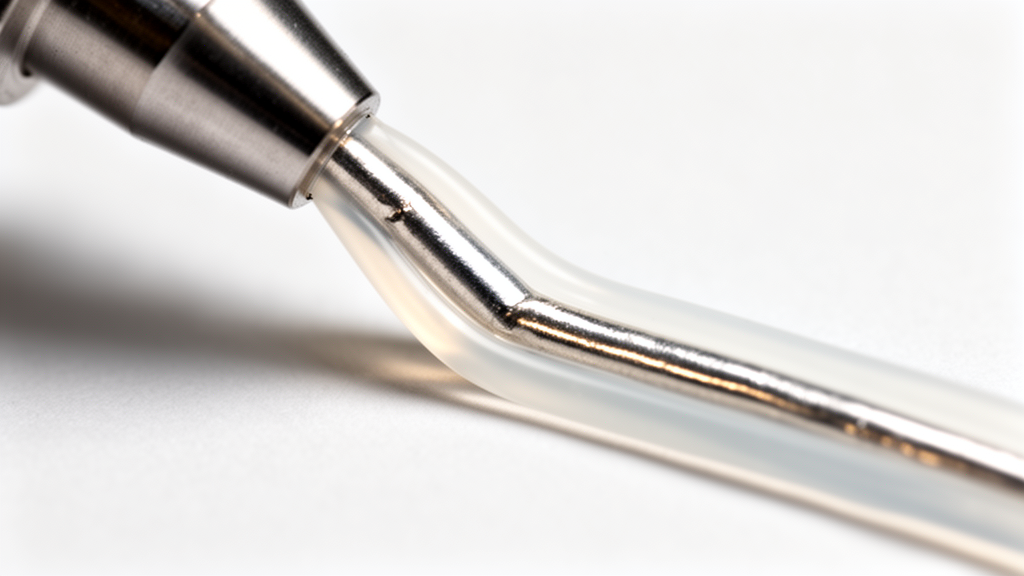
To guarantee uniform resin encapsulation around the inner conductive metal stream, the single delivery pathway for the stretchable photocurable polymer was split into three converging channels that feed into an internal cylindrical mixing chamber from multiple distinct angles. The mechanical envelope of this converging chamber was dimensioned with a structural wall thickness of 1000 micrometers and an overall outer nozzle diameter of 3800 micrometers, which effectively avoided clogging the internal metal delivery needle while accommodating the comparatively large droplet characteristics of viscous resin. The central delivery needle allocated to the metallic core materials features an internal diameter of 800 micrometers and a needle wall thickness of 500 micrometers, coupled to flexible delivery tubing and barb connectors with inner and outer diameters of 6400 and 6500 micrometers, respectively. Rapid polymer crosslinking is activated at the nozzle exit by an external OmniCure S2000 ultraviolet light source operating at a wavelength of 405 nanometers through a quad-leg fiber-optic guide assembly positioned directly within a custom bracket to align the focal point exactly 2 millimeters below the needle tip.
Material delivery is powered by independent positive-displacement syringe pumps that translate motor rotation into axial drive motion along threaded spiral rods to drive fluids through the feedlines. The stretchable resin and room-temperature liquid metal are housed in modular syringe pump assemblies, whereas Field’s metal requires active thermal stabilization provided by a metal syringe enveloped in a 24-volt electrical film heater connected to an intermediary transformer. Computational fluid dynamics modeling conducted in ANSYS Fluent using energy and multiphase fluid formulations simulated the flow dynamics, velocity fields, and internal pressure distributions of the multi-material streams under a standardized velocity inlet condition of 2 millimeters per second. These numerical simulations demonstrated that while liquid metal exhibits low dynamic viscosity, its exceptionally high surface tension generates elevated localized pressure at the inlet that drops substantially once the stream enters the vertical common channel where gravitational acceleration and viscous drag forces act together to establish stable, continuous flow.
Theoretical modeling further mapped the hydrodynamic criteria required to prevent droplet dripping and secure uninterrupted coaxial jetting, expressing the force equilibrium as a balance between cohesive surface tension and the viscous drag exerted by the outer polymer shell. Liquid eutectic gallium-indium displays a high surface tension coefficient, requiring the surrounding resin’s viscous drag force to exceed this cohesive threshold to transition from periodic droplet shedding into steady, laminar core extrusion. Because eutectic liquid metals and molten Field’s metal exhibit minimal elastic recovery and low viscosity, both alloys exhibit minimal die-swell ratios hovering near 1.0 to 1.1 at the exit orifice. The analytical framework connected the core metal’s Weber number and the outer photopolymer’s Capillary number into a governing inequality that defines the critical droplet diameter and continuous flow threshold, ensuring that the progressive increase in polymer viscosity under ultraviolet radiation stabilizes the shell without causing premature backflow or core break-up.
Physical validation of the integrated printing platform was executed on an adapted commercial three-axis motion chassis controlled via automated numerical G-code commands executed through the Repetier-Host software interface. Automated control replaced manual motor pulsing because manual operation introduced substantial z-axis synchronization discrepancies, restricted travel speeds to rigid step options of 1 or 20 millimeters per second, and constrained continuous extrusion lengths to 100 millimeters per stroke. Under automated G-code execution, the printing head traversed along the vertical Z-axis across a travel distance of 150 millimeters while extruding targeted volumetric ratios, subsequently executing an automated 10-millimeter horizontal clearing displacement along the X-axis followed by a three-minute stabilization pause to facilitate nozzle cleaning. Calibration matrices were established across varied volumetric parameters, identifying an optimum material volume parameter of E equals 20 alongside a 7 percent mixing ratio for liquid metal to maintain consistent continuous tubular sheaths without generating excess resin that could invade the core void.
Experimental trials revealed that the axial extension of the metallic delivery needle relative to the outer ultraviolet resin nozzle orifice heavily dictated continuous wire formation and structural morphology. When the inner metal needle terminated 1 millimeter inside the polymer nozzle, the fluid metallic core breached the unsolidified resin boundaries, causing liquid metal to spill across the outer surface of the polymer rather than forming an encapsulated coaxial pathway. Systematic evaluation of needle extension lengths from 1 to 4 millimeters showed that configurations under 2 millimeters yielded irregular metal droplet formations within poorly cured resin tubes, whereas an extension of 3 millimeters supported continuous laminar core flow. At this 3-millimeter offset, the surrounding polymer established a stable tubular boundary before receiving the metallic core, although minor resin accumulation on outer needle edges occasionally occurred. Higher volume extrusion ratios generated thicker, more uniform elastomeric walls, while lower extrusion volumes yielded thinner, less consistent tubular cross-sections.
To quantitatively evaluate the geometric uniformity of the fabricated structures, an automated image-processing machine learning model evaluated cross-sectional circularity and roundness deviations across samples produced with both liquid metal and Field’s metal cores. In these evaluations, numerical ratios closer to unity reflected ideal circular profiles. Samples printed with solidifying Field’s metal cores exhibited consistently superior circular geometry compared to wires fabricated with eutectic gallium-indium cores, with optimal roundness achieved at an extrusion volume of E equals 18. This structural disparity stems directly from the distinct phase behaviors of the two metallic conductors: while room-temperature liquid metal remains completely fluid and exerts hydrodynamic and surface tension stresses against the curing elastomer shell, molten Field’s metal undergoes rapid thermal quenching immediately upon exiting the heated printhead, instantly solidifying into a rigid circular mandrel around which the elastomeric polymer crosslinks smoothly without lateral deformation.
Electromechanical performance was characterized by subjecting uniform liquid-metal core samples to progressive mechanical elongation tests while simultaneously measuring instantaneous electrical resistance. The observed electrical response conformed closely to theoretical predictions derived from second-order relationships between fractional tensile strain, conductor path lengthening, and proportional reductions in conductive cross-sectional area, showing smooth, continuous increases in total resistance as wires were stretched. Minor experimental deviations from theoretical curve lines were identified, resulting primarily from contact resistances developing across terminal measurement junctions under mechanical strain as well as microscopic cross-sectional eccentricities and localized wall-thickness variations within the flexible resin sheath. These tensile measurements confirmed that the liquid metal core preserved uninterrupted metallic conduction throughout extensive mechanical elongation, verifying that the rapid ultraviolet cure effectively contained the fluid metal without permitting pinholes, discontinuities, or internal voids.
The study authors highlighted several mechanical constraints within the current prototype that provide direction for subsequent engineering revisions. Because the liquid metal and Field’s metal feeds share a convergent common delivery channel prior to the exit nozzle, passive backflow can occur if one material exerts higher inlet pressure, prompting the design of internal spring-loaded check valves featuring loose micro-spheres to guarantee strictly unidirectional fluid displacement. Additionally, finite element topology optimization was conducted on the light guide bracket assembly to resolve mass distribution imbalances and reduce localized stress concentrations, yielding a 22.71 percent reduction in structural component weight while maintaining acceptable mechanical stress levels below 1.006 megapascals. While the extrusion process is fully automated via programmed G-code execution, material loading and syringe replenishment currently require manual intervention, marking fully integrated automated feedstock replenishment as a priority for scaling this coaxial additive manufacturing platform toward industrial-scale fabrication.
Subject of Research: Coaxial multi-material additive manufacturing of flexible conductive wires using liquid metals and UV-curable elastomers
Article Title: Development of a co-axial tri-extruder for low-melting point metals and UV-curable resins
Article References: Elsersawy, R., & Khondoker, M. A. H. (2025). Development of a co-axial tri-extruder for low-melting point metals and UV-curable resins. Discover Polymers, 2(1), Article 9. https://doi.org/10.1007/s44347-025-00021-9
Image Credits: AI Generated
DOI: 10.1007/s44347-025-00021-9
Keywords: coaxial extrusion, additive manufacturing, flexible electronics, liquid metal, Field's metal, eutectic gallium-indium, UV-curable resin, stretchable electronics, 3D printing, computational fluid dynamics, microextrusion, elastomer resin, positive displacement dispensing, conductive wires, materials science, multiphase flow
News Source: Denise Maddox. (November 13, 2026). Coaxial Extruder Simultaneously 3D Prints Liquid Metals and Stretchable Polymer Shells. Scienmag.