• HOME
  • NEWS
  • EXPLORE
    • CAREER
      • Companies
      • Jobs
    • EVENTS
    • iGEM
      • News
      • Team
    • PHOTOS
    • VIDEO
    • WIKI
  • BLOG
  • COMMUNITY
    • FACEBOOK
    • INSTAGRAM
    • TWITTER
Saturday, July 4, 2026
BIOENGINEER.ORG
No Result
View All Result
  • Login
  • HOME
  • NEWS
  • EXPLORE
    • CAREER
      • Companies
      • Jobs
        • Lecturer
        • PhD Studentship
        • Postdoc
        • Research Assistant
    • EVENTS
    • iGEM
      • News
      • Team
    • PHOTOS
    • VIDEO
    • WIKI
  • BLOG
  • COMMUNITY
    • FACEBOOK
    • INSTAGRAM
    • TWITTER
  • HOME
  • NEWS
  • EXPLORE
    • CAREER
      • Companies
      • Jobs
        • Lecturer
        • PhD Studentship
        • Postdoc
        • Research Assistant
    • EVENTS
    • iGEM
      • News
      • Team
    • PHOTOS
    • VIDEO
    • WIKI
  • BLOG
  • COMMUNITY
    • FACEBOOK
    • INSTAGRAM
    • TWITTER
No Result
View All Result
Bioengineer.org
No Result
View All Result
Home NEWS Science News Chemistry

Pure red LEDs fulfill a primary goal

Bioengineer by Bioengineer
May 6, 2020
in Chemistry
Reading Time: 2 mins read
0
IMAGE
Share on FacebookShare on TwitterShare on LinkedinShare on RedditShare on Telegram

IMAGE

Credit: © 2020 KAUST

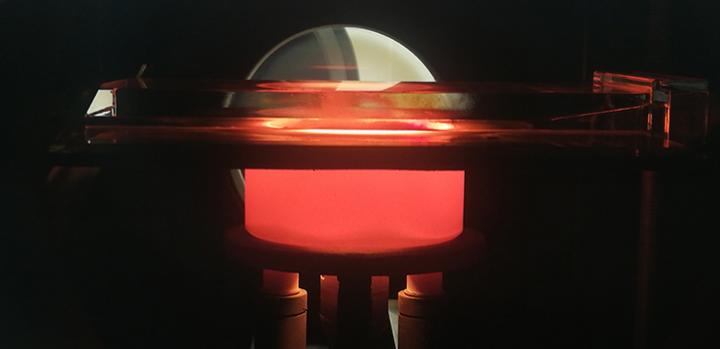
Making pure red LEDs from nitride crystals is a goal that has so far frustrated engineers. However, these LEDs are vital for building the next generation of energy-efficient micro-LED displays to follow OLED displays and for creating lighting with color tuning. Now, for the first time, a team of electrical engineers at KAUST has succeeded in making these LEDs.

“Electrical engineers can already make bright LEDs using varying materials to produce different colors. But to improve display technologies, engineers must integrate the three primary color LEDs, red, green and blue, onto one chip,” explains Daisuke Iida, an electrical engineer at KAUST. This means they need to find one material that is suitable for manufacturing all three colors. The material should be able to produce each color with high intensity, and ideally, it should have a high-power output, but use relatively little battery voltage.

The best candidates for generating all three colors are a family of compounds called nitride semiconductors. These are crystals containing nitrogen that in theory can be used to create LEDs that produce light with wavelengths between ultraviolet and infrared, which includes the entire visible spectrum. Engineers usually use gallium nitride to make blue and green LEDs, but they have struggled to make bright red LEDs with this crystal. “Red vision has been almost impossible–other groups have only really succeeded in making orange, not apple red,” says group leader, Kazuhiro Ohkawa. “Now, we have developed a crystal growth system to realize pure red LEDs.”

Replacing a large portion of the gallium with the element indium gives the desired red, but it is hard to do because indium easily evaporates from the crystal. So Iida, Ohkawa and colleagues created a reactor with extra indium vapor above the crystal’s surface, a process known as metalorganic vapor-phase deposition. This added pressure prevents the indium in the crystal from escaping. “This gives us a higher indium concentration at the surface,” says Ohkawa. “That’s our secret!”

But there was another hurdle to overcome. Indium is made of larger atoms than gallium, so when it is introduced, it creates defects in the crystal, degrading the quality of output light. The team’s trick was to also add aluminum, which has small atoms. “The introduction of the small atoms reduces the strain on the crystal, resulting in fewer crystal defects,” says Iida.

“Another advantage is that the LEDs operate at about half the voltage of its competitors,” says Ohkawa. “This will give you a longer lifetime for batteries.”

###

Media Contact
Carolyn Unck
[email protected]

Original Source

https://discovery.kaust.edu.sa/en/article/965/pure-red-leds-fulfill-a-primary-goal

Related Journal Article

http://dx.doi.org/10.35848/1882-0786/ab7168

Tags: Chemistry/Physics/Materials SciencesElectrical Engineering/ElectronicsMaterialsSuperconductors/Semiconductors
Share12Tweet8Share2ShareShareShare2

Related Posts

Intelligent Microgrid Management Promises Lower Household Energy Bills and Reduced Diesel Emissions — Chemistry

Intelligent Microgrid Management Promises Lower Household Energy Bills and Reduced Diesel Emissions

July 4, 2026
Graz University of Technology Deciphers the Structural Secrets of MOF Thin Films — Chemistry

Graz University of Technology Deciphers the Structural Secrets of MOF Thin Films

July 2, 2026

Breaking Thermodynamic Limits: Wavelength-Driven Catalysis Advances Ammonia Synthesis

July 2, 2026

From Quantum Mechanics to AI-Powered Materials Discovery: MARVEL Marks 12 Years of Transforming Computational Science

July 2, 2026
Please login to join discussion

POPULAR NEWS

  • Detection of EDCs in Breast Milk and Infant Urine Up to Six Months Highlights Early Exposure Risks

    77 shares
    Share 31 Tweet 19
  • Saying Goodbye to PGY-6: Pediatric Fellowship Realities

    103 shares
    Share 41 Tweet 26
  • New Drug Candidate Developed at McMaster Shows Potential for Treating Brain Cancer

    58 shares
    Share 23 Tweet 15
  • KTU Researchers Explore Ultrasound’s Role in Enhancing Blood Flow Beyond Diagnostics

    53 shares
    Share 21 Tweet 13

About

We bring you the latest biotechnology news from best research centers and universities around the world. Check our website.

Follow us

Recent News

Quasi-Bound States Boost Quantum Well Photoresponse

Lysine Pyruvylation Links Glycolysis to Epigenetics

Multiphysics Coupling: Single vs. Multiple DeepONet Branches

Subscribe to Blog via Email

Success! An email was just sent to confirm your subscription. Please find the email now and click 'Confirm' to start subscribing.

Join 83 other subscribers
  • Contact Us

Bioengineer.org © Copyright 2023 All Rights Reserved.

Welcome Back!

Login to your account below

Forgotten Password?

Retrieve your password

Please enter your username or email address to reset your password.

Log In
No Result
View All Result
  • Homepages
    • Home Page 1
    • Home Page 2
  • News
  • National
  • Business
  • Health
  • Lifestyle
  • Science

Bioengineer.org © Copyright 2023 All Rights Reserved.