• HOME
  • NEWS
  • EXPLORE
    • CAREER
      • Companies
      • Jobs
    • EVENTS
    • iGEM
      • News
      • Team
    • PHOTOS
    • VIDEO
    • WIKI
  • BLOG
  • COMMUNITY
    • FACEBOOK
    • INSTAGRAM
    • TWITTER
Sunday, October 4, 2026
BIOENGINEER.ORG
No Result
View All Result
  • Login
  • HOME
  • NEWS
  • EXPLORE
    • CAREER
      • Companies
      • Jobs
        • Lecturer
        • PhD Studentship
        • Postdoc
        • Research Assistant
    • EVENTS
    • iGEM
      • News
      • Team
    • PHOTOS
    • VIDEO
    • WIKI
  • BLOG
  • COMMUNITY
    • FACEBOOK
    • INSTAGRAM
    • TWITTER
  • HOME
  • NEWS
  • EXPLORE
    • CAREER
      • Companies
      • Jobs
        • Lecturer
        • PhD Studentship
        • Postdoc
        • Research Assistant
    • EVENTS
    • iGEM
      • News
      • Team
    • PHOTOS
    • VIDEO
    • WIKI
  • BLOG
  • COMMUNITY
    • FACEBOOK
    • INSTAGRAM
    • TWITTER
No Result
View All Result
Bioengineer.org
No Result
View All Result
Home NEWS Science News Biology

Proteins stand up to nerve cell regression

Bioengineer by Bioengineer
April 24, 2019
in Biology
Reading Time: 2 mins read
0
IMAGE
Share on FacebookShare on TwitterShare on LinkedinShare on RedditShare on Telegram

IMAGE

Credit: Yingjie Zhang and Chwee Tat Koe

SINGAPORE, 24 April 2019 – A study by Duke-NUS Medical School has found that members of the multiprotein ‘Integrator complex’, known for its role in gene regulation, are crucial for healthy brain development in fruit flies. The findings have implications for further understanding and treating neurodevelopmental disorders in humans.

Mutations in human Integrator genes intS1 and intS8 were associated with neurodevelopmental syndrome, which is characterized by profound intellectual disability, epilepsy and subtle structural brain abnormalities. However, the role of the Integrator complex during brain development has not been well understood. Associate Professor Wang Hongyan, Deputy Director of Duke-NUS’ Neuroscience and Behavioural Disorders Programme and lead author of the study, said, “We examined members of the Integrator complex in fruit fly brains to understand their roles in the development of the nervous system.”

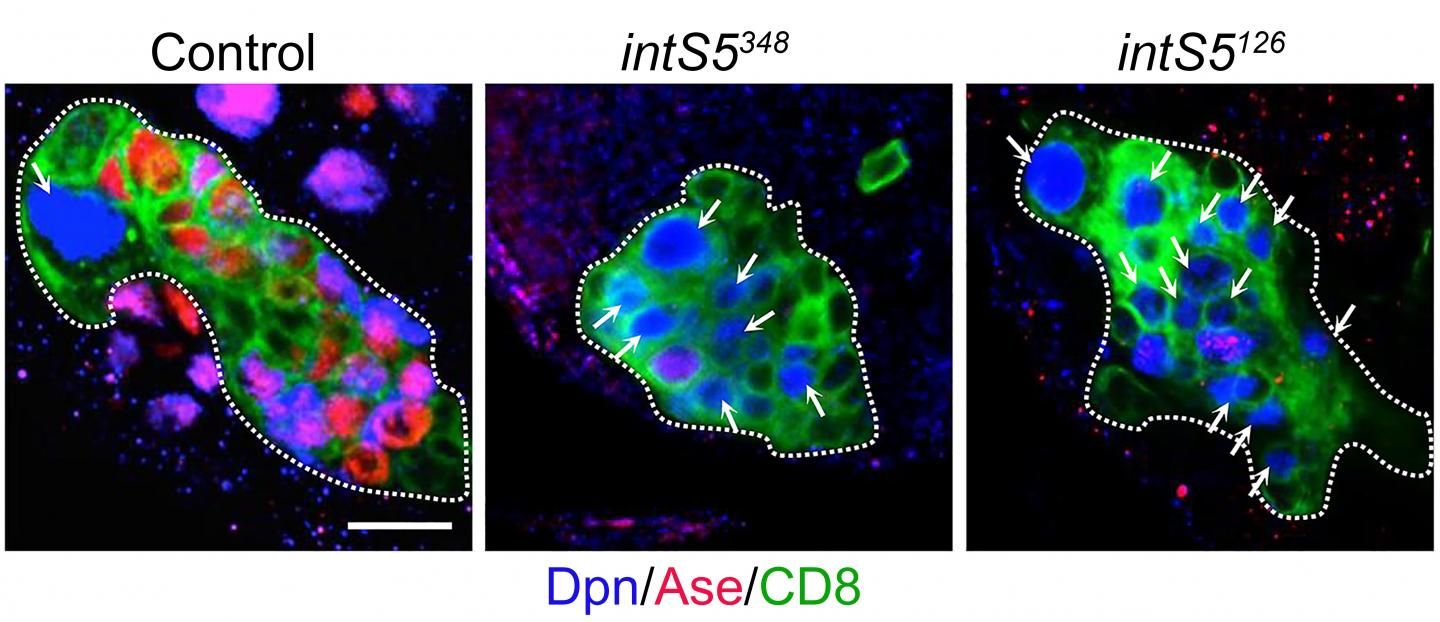
Normally, neural stem cells in larval brains differentiate into intermediate neural progenitors, which ultimately form into nerve cells. Several factors are understood to prevent intermediate neural progenitor cells from turning back into neural stem cells, a process called dedifferentiation. Assoc Prof Wang and her team previously showed that when dedifferentiation occurs, abnormal neural stem cell-derived tumours can form in fruit fly brains. Nerve cell generation also becomes insufficient.

Assoc Prof Wang and her team mutated and turned off members of the Integrator complex in the fruit fly brains. Abnormal neural stem cells were formed when Integrator proteins were absent in brain cells. Turning off several Integrator genes in intermediate neural progenitor cells led to excessive formation of neural stem cells. Their investigations provided evidence that Integrator proteins help prevent intermediate neural progenitors from dedifferentiating into neural stem cells. A transcription factor called Earmuff, which is needed for the prevention of dedifferentiation, was identified as the primary target of Integrator complex proteins in the brain cells.

The findings highlight the critical and novel roles played by Integrator complex proteins in preventing dedifferentiation, and thus in promoting brain development in fruit flies. They also show that Integrator complex proteins regulate Earmuff, which is a known dedifferentiation suppressor. “Given that Integrator and Earmuff are highly conserved in flies and humans, our study will facilitate understanding the function of their mammalian and human counterparts during brain development, in addition to understanding potential disease mechanisms,” says Assoc Prof Wang.

Professor Patrick Casey, Senior Vice Dean of Research, Duke-NUS Medical School, commented, “The study of the Integrator complex in neurodevelopment has been largely unexplored, and these findings provide valuable insights to better understand and treat neurodegenerative diseases in the future.”

###

Media Contact
Federico Graciano
[email protected]

Original Source

https://www.duke-nus.edu.sg/about/media/media-releases/detail/index/proteins-stand-up-to-nerve-cell-regression

Related Journal Article

http://dx.doi.org/10.1016/j.celrep.2019.03.089

Tags: Cell BiologyMedicine/Healthneurobiology
Share13Tweet7Share2ShareShareShare1

Related Posts

Simple Sugar Dextrose Emerges as Best Carbon Source for Zero-Exchange Shrimp Hatcheries

Simple Sugar Dextrose Emerges as Best Carbon Source for Zero-Exchange Shrimp Hatcheries

October 4, 2026
New Algorithm Simulates Gene Frequency Histories Exactly, Even as Populations Change Size

New Algorithm Simulates Gene Frequency Histories Exactly, Even as Populations Change Size

October 4, 2026

Touch-Sensing Piezo Channels Found to Steer the Cells That Build Our Teeth

October 4, 2026

Rumen Fluke Parasite Reveals Its Molecular Playbook Across Life Stages

October 4, 2026
Please login to join discussion

POPULAR NEWS

  • Alloys That Shrink Their Own Grains: New PIX Mechanism Refines Metals With Heat Alone

    Alloys That Shrink Their Own Grains: New PIX Mechanism Refines Metals With Heat Alone

    29 shares
    Share 12 Tweet 7
  • Endurance Exercise Reshapes the Liver in Males and Females Through Distinct Molecular Routes

    29 shares
    Share 12 Tweet 7
  • Single Transcription Factor PU.1 Rapidly Converts Fibroblasts into Macrophage-Lineage Cells

    29 shares
    Share 12 Tweet 7
  • New Scale Measures How Ready Nurse Educators Really Are for the AI Era

    29 shares
    Share 12 Tweet 7

About

We bring you the latest biotechnology news from best research centers and universities around the world. Check our website.

Follow us

Recent News

Alloys That Shrink Their Own Grains: New PIX Mechanism Refines Metals With Heat Alone

Endurance Exercise Reshapes the Liver in Males and Females Through Distinct Molecular Routes

Single Transcription Factor PU.1 Rapidly Converts Fibroblasts into Macrophage-Lineage Cells

Subscribe to Blog via Email

Success! An email was just sent to confirm your subscription. Please find the email now and click 'Confirm' to start subscribing.

Join 85 other subscribers
  • Contact Us

Bioengineer.org © Copyright 2023 All Rights Reserved.

Welcome Back!

Login to your account below

Forgotten Password?

Retrieve your password

Please enter your username or email address to reset your password.

Log In
No Result
View All Result
  • Homepages
    • Home Page 1
    • Home Page 2
  • News
  • National
  • Business
  • Health
  • Lifestyle
  • Science

Bioengineer.org © Copyright 2023 All Rights Reserved.