• HOME
  • NEWS
  • EXPLORE
    • CAREER
      • Companies
      • Jobs
    • EVENTS
    • iGEM
      • News
      • Team
    • PHOTOS
    • VIDEO
    • WIKI
  • BLOG
  • COMMUNITY
    • FACEBOOK
    • INSTAGRAM
    • TWITTER
Saturday, May 23, 2026
BIOENGINEER.ORG
No Result
View All Result
  • Login
  • HOME
  • NEWS
  • EXPLORE
    • CAREER
      • Companies
      • Jobs
        • Lecturer
        • PhD Studentship
        • Postdoc
        • Research Assistant
    • EVENTS
    • iGEM
      • News
      • Team
    • PHOTOS
    • VIDEO
    • WIKI
  • BLOG
  • COMMUNITY
    • FACEBOOK
    • INSTAGRAM
    • TWITTER
  • HOME
  • NEWS
  • EXPLORE
    • CAREER
      • Companies
      • Jobs
        • Lecturer
        • PhD Studentship
        • Postdoc
        • Research Assistant
    • EVENTS
    • iGEM
      • News
      • Team
    • PHOTOS
    • VIDEO
    • WIKI
  • BLOG
  • COMMUNITY
    • FACEBOOK
    • INSTAGRAM
    • TWITTER
No Result
View All Result
Bioengineer.org
No Result
View All Result
Home NEWS Science News Biology

Pros and cons of genetic scissors

Bioengineer by Bioengineer
September 17, 2019
in Biology
Reading Time: 3 mins read
0
IMAGE
Share on FacebookShare on TwitterShare on LinkedinShare on RedditShare on Telegram

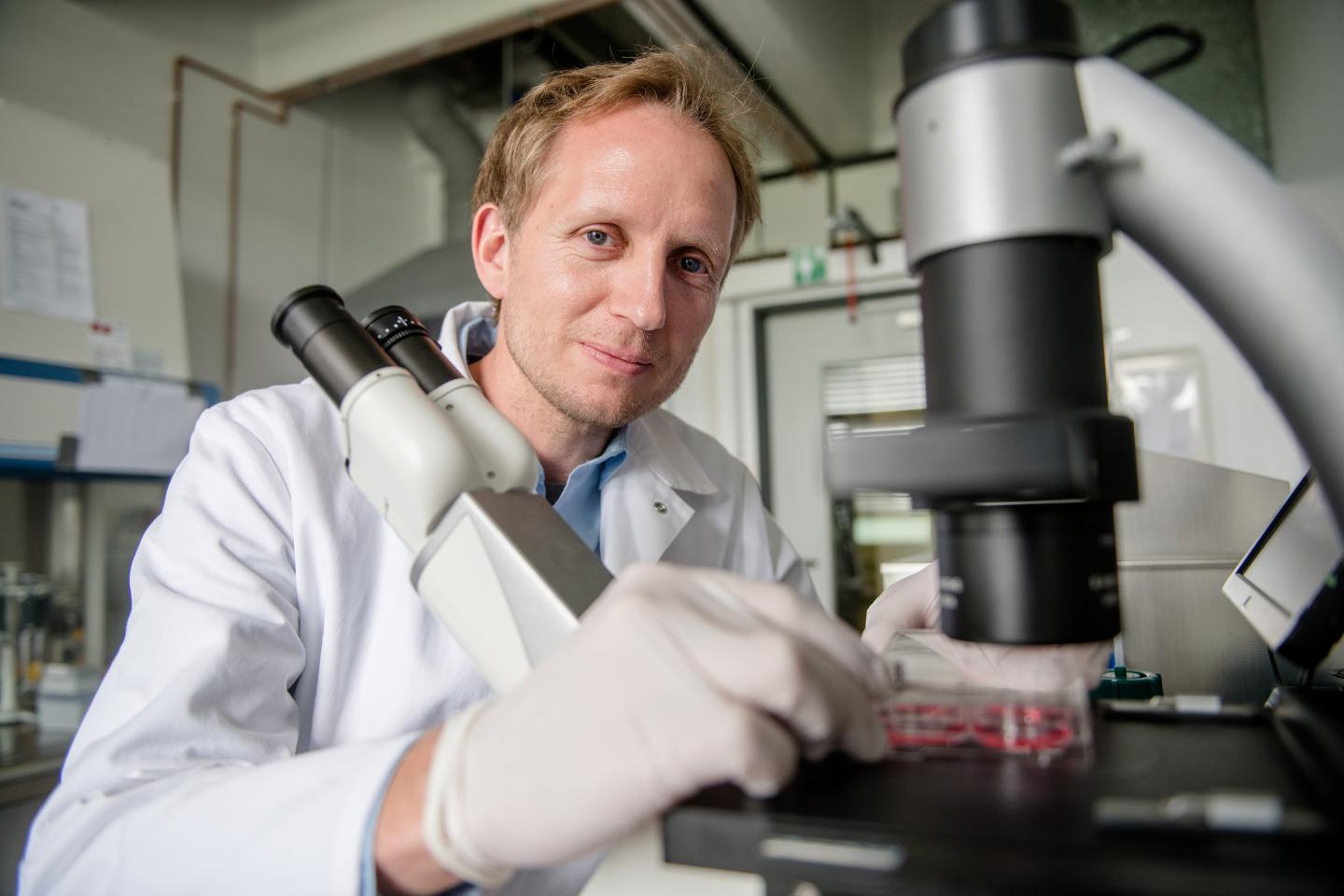
In combination with other methods, Crispr technology might one day render animal testing obsolete.
IMAGE

Credit: RUB, Marquard

Crispr technology has greatly facilitated gene editing. Associate Professor Thorsten Müller from Ruhr-Universität Bochum and Dr. Hassan Bukhari from Harvard Medical School discuss its pros and cons in a review article in the journal Trends in Cell Biology from 12 September 2019. They believe Crispr technology has future potential primarily if it can be rendered usable in the field of stem cell research.

In order to analyse the effects of genes or gene products, they used to be artificially over-activated. “Thus, they would occur up to 1,000 times more frequently than in nature,” says Thorsten Müller. “The cell was flooded with gene products, the proteins, which can falsify function analysis.” The Crispr method eliminates this difficulty. It can be used to implant blueprints of fluorescent proteins in cells and to position them behind a specific gene. “This has enabled us to monitor for the first time a protein’s function live under natural conditions – rather than after 1,000-fold overproduction,” explains the biochemist.

The Crispr method, too, has been optimised. Initially, researchers had to create so-called vectors in a time-consuming process, in order to label genes in the genome. Vectors are DNA segments whose sequence has to be to some extent identical with the DNA of the target cell, to ensure that the implanted gene finds the right spot. Today, they take advantage of the cells’ natural DNA repair function, which considerably simplifies the creation of vectors, and are consequently able to introduce fluorescent proteins quickly and easily.

How drugs work

In addition, fluorescent tagging makes it possible to observe where the labelled gene products are located in the cell live under the microscope. “This could be interesting in order to test the effects of drugs on certain gene products,” explains Müller. To this end, researchers would have to stimulate the cell with the active substance and track if and how the position of the gene product changes.

Different genes could be labelled with fluorescent biosensors in different colours and analysed simultaneously. The stronger the reading of a tagged gene, the more strongly does the cell fluoresce in the respective colour.

Organoids could replace animal testing

The authors believe a combination of this method with so-called organoids offers considerable potential. Organoids are mini organs derived from induced pluripotent stem cells that can be extracted from an adult organism. They can be used to, for example, build mini brains that are the equivalent to the human brain as far as function is concerned.

Should the application of Crispr technology in stem cells become more widespread, researchers would be able to analyse the effects of gene modification in complex tissues, rather than just in isolated cells. “We could study human genes live in tissues resembling those of humans and wouldn’t have to rely on animal models as much as we do now,” concludes Müller.

Following these considerations, Müller and Bukhari have compiled a number of key research questions in the review article, which have to be answered in order to consolidate Crispr technology and organoid technology.

###

Media Contact
Thorsten Müller
[email protected]

Original Source

https://news.rub.de/english/press-releases/2019-09-17-review-article-pros-and-cons-genetic-scissors

Related Journal Article

http://dx.doi.org/10.1016/j.tcb.2019.08.004

Tags: BiochemistryBiologyBiomedical/Environmental/Chemical EngineeringBiotechnologyGeneticsMedicine/Health
Share13Tweet8Share2ShareShareShare2

Related Posts

Rising Sightings of Blue and Fin Whales in the South East Atlantic — Biology

Rising Sightings of Blue and Fin Whales in the South East Atlantic

May 23, 2026
New Maps Reveal How European Landscapes Can Simultaneously Promote Climate Action and Biodiversity Conservation — Biology

New Maps Reveal How European Landscapes Can Simultaneously Promote Climate Action and Biodiversity Conservation

May 22, 2026

University of Cincinnati Structural Biologists Achieve World First in Visualizing Crucial Cell Protein

May 22, 2026

Reducing Fertilizer Use Through Strategic Scientific Partnerships

May 22, 2026
Please login to join discussion

POPULAR NEWS

  • blank

    New Study Reveals Plants Can Detect the Sound of Rain

    734 shares
    Share 293 Tweet 183
  • ESMO 2025: mRNA COVID Vaccines Enhance Efficacy of Cancer Immunotherapy

    312 shares
    Share 125 Tweet 78
  • Research Indicates Potential Connection Between Prenatal Medication Exposure and Elevated Autism Risk

    847 shares
    Share 339 Tweet 212
  • Common Food Preservatives Associated with Elevated Blood Pressure and Increased Heart Disease Risk

    55 shares
    Share 22 Tweet 14

About

We bring you the latest biotechnology news from best research centers and universities around the world. Check our website.

Follow us

Recent News

Music and Motion Shape Emotion in Chinese Performance

N-acetylcysteine Trials for Preterm Birth Prevention

Nomogram Predicts Early Outcomes in Childhood Aplastic Anemia

Subscribe to Blog via Email

Enter your email address to subscribe to this blog and receive notifications of new posts by email.

Join 83 other subscribers
  • Contact Us

Bioengineer.org © Copyright 2023 All Rights Reserved.

Welcome Back!

Login to your account below

Forgotten Password?

Retrieve your password

Please enter your username or email address to reset your password.

Log In
No Result
View All Result
  • Homepages
    • Home Page 1
    • Home Page 2
  • News
  • National
  • Business
  • Health
  • Lifestyle
  • Science

Bioengineer.org © Copyright 2023 All Rights Reserved.