MADISON — University of Wisconsin–Madison engineers have developed low-cost sensors that allow for real-time, continuous monitoring of nitrate in soil types that are common in Wisconsin. These printed electrochemical sensors could enable farmers to make better informed nutrient management decisions and reap economic benefits.
Credit: Photo by Kuan-Yu Chen
MADISON — University of Wisconsin–Madison engineers have developed low-cost sensors that allow for real-time, continuous monitoring of nitrate in soil types that are common in Wisconsin. These printed electrochemical sensors could enable farmers to make better informed nutrient management decisions and reap economic benefits.
“Our sensors could give farmers a greater understanding of the nutrient profile of their soil and how much nitrate is available for the plants, helping them to make more precise decisions on how much fertilizer they really need,” says Joseph Andrews, an assistant professor of mechanical engineering at UW–Madison who led the research. “If they can buy less fertilizer, the cost savings could be quite significant at large-acreage farms.”
While nitrate is an essential nutrient for growing crops, excess nitrate can leach out of soil and into groundwater. This type of pollution is dangerous for people who drink contaminated well water and is harmful for the environment. The researchers’ new sensors could also be used as an agricultural research tool to monitor nitrate leaching and help guide best practices for mitigating its harmful effects.
Current methods for monitoring nitrate in the soil are laborious, expensive and don’t provide real-time data. That’s why Andrews, an expert in printed electronics, and his team set out to create a better and less costly solution.
For this project, the researchers used an inkjet printing process to fabricate potentiometric sensors, a type of thin-film electrochemical sensor. Potentiometric sensors are commonly used to accurately measure nitrate in liquid solutions. However, these sensors aren’t typically suitable for use in soil environments, where coarse soil particles will scratch them and interfere with obtaining accurate measurements.
“The main challenge we were trying to solve is figuring out a way to enable these electrochemical sensors to work well in the harsh environment of soil and accurately sense nitrate ions,” Andrews says.
The team’s solution was to place a layer over the sensor made from polyvinylidene fluoride. Andrews says this material has two key features. First, it has very tiny pores, about 400 nanometers in size, that allow nitrate ions to pass through while blocking soil particles. Second, it’s hydrophilic, meaning it attracts water and acts like a sponge to absorb it.
“So, any nitrate-laden water gets preferentially soaked into our sensor, and this is really important because soil also acts like a sponge, and you’re going to have a losing battle for getting moisture to come to your sensor unless you can match the water absorption potential of soil,” Andrews says. “These features of the polyvinylidene fluoride layer enable us to extract the nitrate-laden water, get it to the surface of our sensor and accurately sense nitrate.”
The researchers detailed their advance in a paper published in March 2024 in the journal Advanced Material Technologies.
The team has tested its sensors in two different soil types that are relevant for Wisconsin — sandy soil, which is common in the north-central part of the state, and silt loam soil, which is common in southwestern Wisconsin — and found that the sensors produced accurate results.
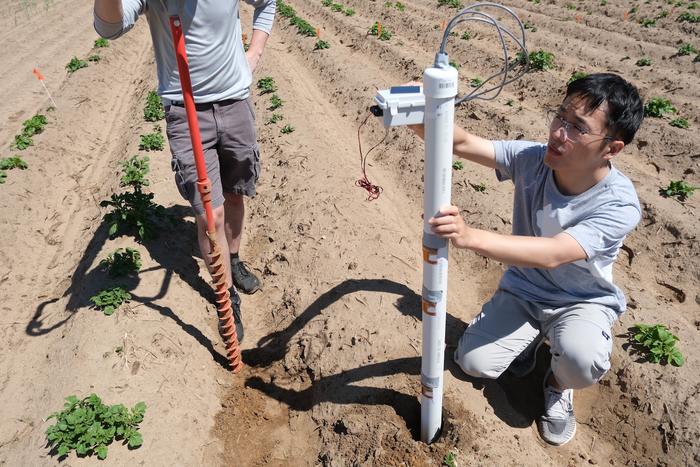
The researchers are now incorporating their nitrate sensors into a multifunctional sensing system they call a “sensing sticker,” in which three different kinds of sensors are mounted on a flexible plastic surface with an adhesive on the back. These stickers also contain moisture and temperature sensors.
The researchers will attach several sensing stickers to a rod, positioning them at different heights, and then bury the rod in the soil. This setup allows them to take measurements at multiple depths in the soil.
“By measuring the nitrate, moisture and temperature at different depths, we can now quantify the process of nitrate leaching and capture how nitrate is moving through the soil, which hasn’t been possible before,” Andrews says.
In summer 2024, the researchers plan to conduct further testing with their sensors by deploying 30 sensing rods in the soil at UW–Madison’s Hancock Agricultural Research Station and Arlington Agricultural Research Station.
The researchers are patenting their technology through the Wisconsin Alumni Research Foundation.
UW–Madison co-authors on the paper include Kuan-Yu Chen, Aatresha Biswas, Shuohao Cai, and Jingyi Huang, a professor of soil science.
This research was supported by the USDA Agriculture and Food Research Initiative Foundational Program (project no. WIS04075), the National Science Foundation Signals in the Soil grant 2226568, and the University of Wisconsin–Madison Dairy Innovation Hub.
###
–Adam Malecek, [email protected]
Journal
Advanced Materials Technologies
Method of Research
Experimental study
Subject of Research
Not applicable