In a newly published clinical report, authors from Longhui People's Hospital and The Second Xiangya Hospital of Central South University describe an aggressive presentation of primary jejunal follicular dendritic cell sarcoma. Follicular dendritic cell sarcoma represents a rare mesenchymal neoplasm. Jejunal involvement is exceptionally uncommon, accounting for less than 5 percent of all extranodal presentations, with fewer than 20 cases documented in published medical literature. The clinical investigation centers on a 62-year-old female patient who initially sought medical attention after experiencing persistent left lower quadrant abdominal pain.
Diagnostic imaging performed during initial clinical evaluation identified substantial localized disease within the small intestine. A computed tomography scan of the abdomen revealed a jejunal mass measuring 8.7 by 9.4 centimeters. Comprehensive staging assessments identified no radiological enlargement of regional lymph nodes, and no suspicious metastatic lesions were detected within the liver or the spleen. However, because no separate lymph node sampling was undertaken during the initial operative intervention, the pathological nodal status of the malignancy could not be formally assessed or staged.
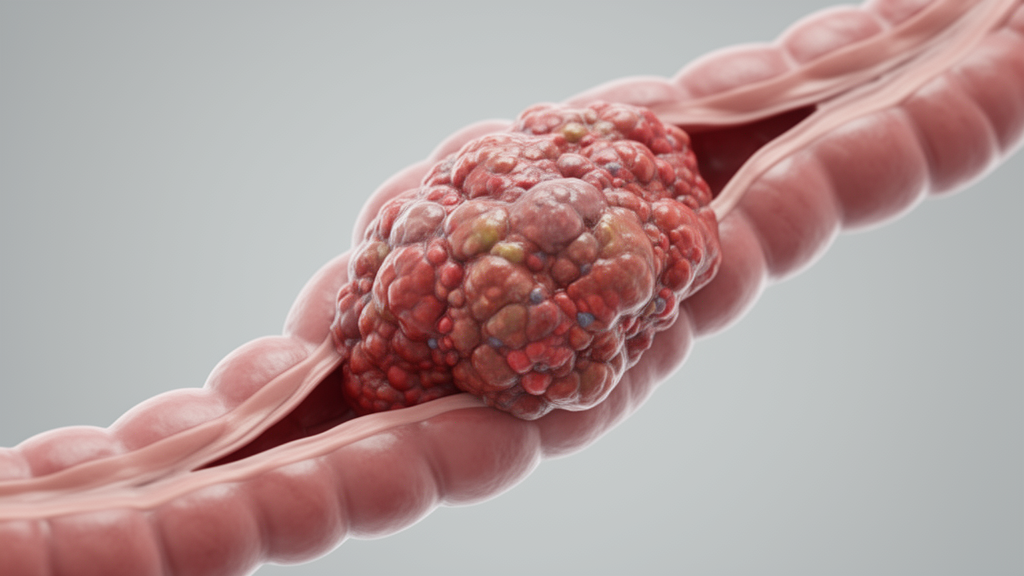
Pathological evaluation of the resected specimen revealed a large, solid jejunal tumor measuring 13.5 by 9.8 by 7.7 centimeters.
Microscopic and phenotypic evaluation established a definitive diagnosis of classic-type follicular dendritic cell sarcoma based on distinctive cellular morphology and follicular dendritic cell marker immunohistochemistry. The neoplastic tissue showed diffuse positivity for CD21, CD35, CXCL13, and somatostatin receptor 2 (SSTR2), while in situ hybridization for Epstein-Barr virus-encoded small RNA (EBER) was negative. Histopathological examination revealed pronounced adverse features, including geographic tumor necrosis and high proliferative activity characterized by more than 5 mitotic figures per 10 high-power fields.
To further characterize the underlying biological drivers of the malignancy, the medical team conducted targeted next-generation sequencing across both DNA and RNA extracted from tumor tissue. Genomic profiling identified a copy-number loss of the CYLD gene, which functions as a negative regulator of nuclear factor kappa B (NF-κB) activation. In addition, sequencing identified copy-number amplification located on chromosome 15q involving the MAP2K1 gene. This MAP2K1 alteration occurred as a structural copy-number gain in the absence of an activating point mutation. The authors noted that CYLD loss aligns directly with the NF-κB pathway dysregulation previously described in follicular dendritic cell sarcomas.
Targeted sequencing also detected several additional genomic alterations whose direct contributions to tumor development remain unconfirmed. The analysis identified two novel gene fusions, SRSF3::MTCH1 and VIRMA::HOXA13, alongside missense variants within the AXIN1 and CYP2A6 genes, all of which the investigators classified as variants of uncertain clinical significance. Genomic testing also revealed a heterozygous germline pathogenic mutation in the EXT2 gene, which the investigators identified as an incidental finding unrelated to the pathogenesis of the sarcoma. Although these genomic findings provided supportive evidence regarding the biological characteristics of the neoplasm, the authors emphasized that they were supportive rather than independently diagnostic.
Following surgical resection, the patient received adjuvant chemotherapy consisting of the CHOP regimen, combining cyclophosphamide, doxorubicin, vincristine, and prednisone. Despite systemic chemotherapy, the sarcoma exhibited a remarkably rapid recurrence just 3 months after surgical resection, and the patient succumbed to progressive disease 8 months after the initial surgery. The clinical team observed that the exceptionally aggressive clinical course was consistent with the convergence of large initial tumor size, an elevated mitotic index, and adverse genomic copy-number alterations. The authors concluded that cases demonstrating these adverse clinicopathological and molecular features may warrant intensified postoperative disease surveillance and careful consideration of targeted therapies directed against the MEK or NF-κB signaling pathways.
Subject of Research: Clinical, pathological, and genomic characterization of primary jejunal follicular dendritic cell sarcoma.
Article Title: Primary jejunal follicular dendritic cell sarcoma: a case report with clinicopathological, immunophenotypic, and genetic characterization and literature review
Article References: Ning, X., Zhou, M., Xiao, G., Wu, S., Guo, W., Wang, Y., Guo, J., Lei, C., Fan, S., & Ma, X. (2026). Primary jejunal follicular dendritic cell sarcoma: a case report with clinicopathological, immunophenotypic, and genetic characterization and literature review. Frontiers in Oncology, 16, Article 1990004. https://doi.org/10.3389/fonc.2026.1990004
Image Credits: AI Generated
DOI: 10.3389/fonc.2026.1990004
Keywords: follicular dendritic cell sarcoma, jejunal sarcoma, CYLD loss, MAP2K1 amplification, NF-κB pathway, targeted next-generation sequencing, mesenchymal neoplasm, extranodal sarcoma, adjuvant CHOP chemotherapy, CD21 immunohistochemistry, CD35 marker, CXCL13 expression, SSTR2 positivity, geographic necrosis, mitotic rate, SRSF3-MTCH1 fusion, VIRMA-HOXA13 fusion
News Source: Nathaniel Bowman. (November 17, 2026). Primary Jejunal Sarcoma Case Demonstrates Rapid Recurrence and Adverse Genetic Alterations. Scienmag.