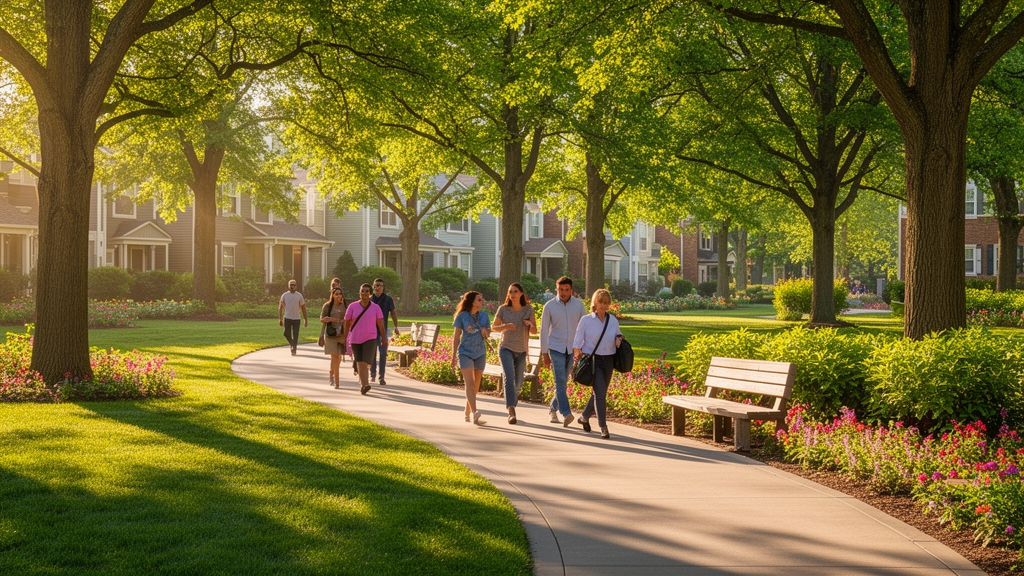
A 12-month longitudinal study of 426 Calgary adults indicates that favorable changes in how residents perceive their local parks and neighborhood walkability are linked to increases in transportation-related walking. The research, published in 2026, sought to clarify how shifts in these environmental perceptions correlate with concurrent changes in neighborhood transportation walking, which involves walking to reach specific destinations, and recreational walking.
The study participants resided in municipal redevelopment areas specifically targeted for bus rapid transit and pedestrian infrastructure improvements. Researchers collected data between August and September 2018 and again one year later. Neighborhood transportation and recreational walking behaviors were measured using the Neighborhood Physical Activity Questionnaire, while perceptions of the neighborhood were captured through the Physical Activity Neighborhood Environment Scale and supplemental questions regarding park experiences.
At the study’s start, the cohort had a mean age of 47.0 years, with 69.0% female and 78.2% having completed university education. Baseline activity levels were recorded at a mean of 61.2 minutes per week for transportation walking and 103.8 minutes per week for recreational walking. Throughout the 12-month period, researchers noted that mean perceived walkability, park perceptions, and total weekly walking frequency did not change significantly for the entire sample.
When analyzing individual associations, favorable changes in perceived walkability were linked to higher odds of reporting any increase in weekly transportation walking, yielding an odds ratio of 1.71.
Participants who reported favorable changes in their park perceptions showed significantly higher odds of increasing their weekly transportation walking across three distinct measures: any increase, an increase of at least 30 minutes, and an increase of at least 60 minutes. The odds ratios for these thresholds were 1.74, 2.00, and 2.12, respectively.
In contrast to the findings for transportation walking, the researchers found that neither changes in perceived walkability nor changes in park perceptions were associated with any measurable change in recreational walking behaviors.
The authors conclude that neighborhood perceptions may play a meaningful role in strategies designed to promote local transportation walking. While the mechanisms underlying these associations and the specific direction of influence remain uncertain, the findings suggest that the quality of local parks or how residents experience these spaces may be relevant to walking undertaken for daily travel. The research emphasizes that public health promotion efforts should carefully consider both the built environment and the subjective ways in which residents perceive their local surroundings.
To evaluate these relationships, the research team utilized multivariable binary logistic regression models. These analyses estimated the independent associations between 12-month shifts in perceptions and physical activity while controlling for baseline walking levels, objective walkability, study site, and sociodemographic characteristics. Perceptions were categorized specifically as improved versus unchanged or less favorable. In tracking outcomes, the researchers monitored any increase in weekly walking frequency alongside distinct duration thresholds.
The statistical models also detailed the uncertainty surrounding each measured association. For favorable walkability changes, the odds ratio of 1.71 for any increase in transportation walking had a 95 percent confidence interval spanning 1.07 to 2.72. For favorable park perceptions, the corresponding 95 percent confidence intervals were 1.08 to 2.80 for any increase, 1.15 to 3.46 for increases of at least 30 minutes, and 1.07 to 4.19 for increases of 60 minutes or more. In addition, the baseline sample demonstrated substantial variation, with standard deviations of 13.6 years for participant age, 81.8 minutes for transportation walking, and 121.9 minutes for recreational walking.
Subject of Research: Longitudinal study of perceived neighborhood walkability and park usage in Calgary adults.
Article Title: Changes in perceived neighborhood walkability and park perceptions in relation to transportation and recreational walking: a 12-month pre-post longitudinal study
Article References: McCormack, G. R., & Nair, G. (2026). Changes in perceived neighborhood walkability and park perceptions in relation to transportation and recreational walking: a 12-month pre-post longitudinal study. BMC Public Health. https://doi.org/10.1186/s12889-026-30299-8
Image Credits: AI Generated
DOI: 10.1186/s12889-026-30299-8
Keywords: Neighborhood walkability, Park perceptions, Transportation walking, Recreational walking, Longitudinal study, Built environment, Public health, Calgary, Physical activity, Urban planning, PANES, NPAQ, Pedestrian infrastructure, Bus rapid transit, Urban design, Exercise behavior, Health promotion, Behavioral science, Activity patterns
News Source: Ophelia Keating. (November 18, 2026). Improved Neighborhood Park Perceptions Linked to Increased Weekly Transportation Walking. Scienmag.