Credit: Songhao Guo
Two-dimensional (2D) organic-inorganic halide perovskites are emerging materials for photovoltaic and optoelectronic applications due to their unique physical properties and a high degree of tunability. Despite impressive advances, challenges remain, including unsatisfactory performance and a vague understanding of their structure-property relationships. Addressing these challenges requires more suitable material systems and advanced in situ characterization methods.
An international team led by Dr. Xujie Lü and Dr. Wenge Yang from the Center for High Pressure Science and Technology Advanced Research (HPSTAR) and Prof. Song Jin from the University of Wisconsin-Madison discovered that lattice compression under a mild pressure considerably suppresses the carrier trapping of a 2D perovskite (HA)2(GA)Pb2I7, leading to significantly enhanced emission. Intriguingly, a new phase obtained after pressure-treatment possesses a higher crystallographic symmetry, fewer trap states, and enhanced PL intensity. The findings were recently published in Angew. Chem. Int. Ed.
Lattice compression through hydrostatic pressure is an effective way to tune the structural and optical properties of two-dimensional (2D) halide perovskites – a new class of emerging materials for photovoltaic and light-emitting applications. However, few examples exhibit improved photoluminescence (PL) performance of 2D perovskites upon compression, and the structure-property relationship remains unclear.
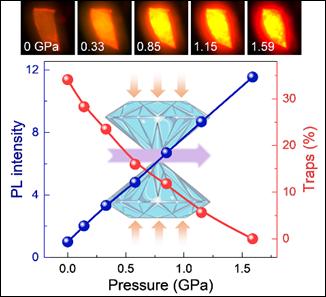
In this work, the team used pressure to modulate a recently developed 2D perovskite (HA)2(GA)Pb2I7, whose structure features an enormous cage previously unattainable. This affords a rare opportunity to understand the structure-property relationship and explore emergent phenomena. Impressively, a remarkable 12-fold PL enhancement was achieved under a mild pressure within 1.6 GPa. The underlying mechanism was systematically investigated by in situ structural, spectroscopic, and theoretical analyses. The lattice contraction leads to phonon hardening that considerably reduces the exciton-phonon interaction and, thus, enlarges the potential barrier for carrier trapping. Therefore, the photogenerated carriers can barely form the trapped states, and the nonradiative recombination pathway is primarily blocked, resulting in an enhanced emission from the free excitons.
Interestingly, for the first time, they revealed an irreversible and anomalous process during decompression, obtaining a yellow, non-luminescent, amorphous phase of (HA)2(GA)Pb2I7 with a higher bandgap. The emission can be triggered and dramatically increased under laser irradiation when the pressure was released to 1.5 GPa, accompanied by a color change from yellow to orange. Based on this observation, they used the laser beam to draw an “HP” pattern on the yellow sample surface in the DAC chamber. When the pressure was released entirely, the amorphous yellow phase could spontaneously transform into a new orange phase with enhanced PL by over 100% compared with the pristine sample. Further structural characterization and spectra analysis reveals that the new phase possesses a higher crystallographic symmetry and less carrier trapping.
By using pressure to engineer the highly-distorted 2D halide perovskite, this work provides fresh insights into the structure-property relationships of perovskites and also enables the discovery of new high-performance materials through pressure-induced phase transitions.
###
Media Contact
Haini Dong
[email protected]
Original Source
http://hpstar.
Related Journal Article
http://dx.