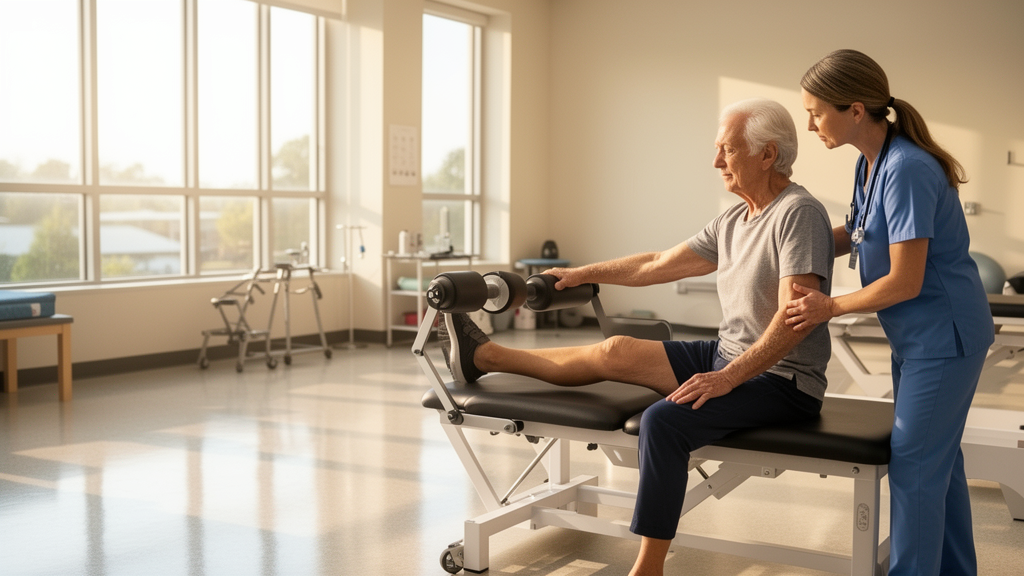
A prospective longitudinal study conducted across primary care rehabilitation facilities in Sweden has revealed that an older adult patient’s baseline normalized quadriceps strength and preoperative interlimb symmetry are the primary factors associated with knee extension strength one year following elective total knee arthroplasty. The investigation, which monitored sixty-five years or older individuals undergoing fast-track surgical procedures for end-stage knee osteoarthritis, determined that patients possessing greater pre-surgical muscle force relative to their overall body mass demonstrated substantially higher normalized strength in their operated limbs twelve months later. Conversely, general demographic factors such as patient age and biological sex, as well as broader functional measures like endurance walking capacity, showed no independent predictive association with long-term postoperative strength outcomes in multivariate regression modeling.
Although clinical guidelines advocate targeted preoperative resistance exercise to preserve functional autonomy, surgical intervention universally induces an acute, profound drop in quadriceps capacity during initial postoperative phases. Functional recovery typically follows an extended trajectory, where muscle performance gradually improves from three to six months and continues progressing through two full years post-surgery. Normalizing quadriceps force against total body mass provides a standardized, clinically meaningful index of physical competence, yet the specific preoperative factors determining whether a patient achieves satisfactory normalized strength over twelve months have remained poorly characterized.
To clarify these long-term predictive associations, researchers designed a prospective observational investigation based within the healthcare infrastructure of Region Västra Götaland, Sweden, recruiting surgical candidates consecutively between November 2021 and November 2022. Formal institutional approval was granted by the Swedish Ethical Review Authority, and the study was retrospectively registered in the Clinical Trials Registry under identifier NCT05248815 following initial patient enrollment. All study participants were recruited by clinical nursing personnel during standardized preoperative educational briefings at Alingsås Hospital, a specialized regional facility operating an established fast-track surgical care protocol. Baseline clinical evaluations and physical performance assessments were conducted within a tightly controlled window between one and fourteen days prior to scheduled joint arthroplasty. All postoperative follow-up evaluations were executed exactly one year following surgery, averaging 51.9 weeks across the cohort, with testing administered at three primary care physiotherapy centers by a single designated project leader who was not masked to initial baseline results.
The initial participant screening encompassed 194 consecutive surgical candidates, from which eighty-two individuals declined participation, fifty-one failed to meet specified eligibility criteria, and five could not complete pre-surgical scheduling logistics. The resulting baseline cohort comprised fifty-six consenting older adults scheduled for primary unilateral knee arthroplasty due to idiopathic osteoarthritis who were expected to participate in standard outpatient primary care physiotherapy. Throughout the twelve-month observation period, seventeen participants were excluded from final statistical evaluations due to contralateral knee arthroplasty, localized surgical complications requiring manipulation under anesthesia, unrelated systemic medical crises such as sepsis or malignant disease, withdrawal without stated reasons, or inability to perform maximal strength assessments. Ultimately, thirty-nine patients completed comprehensive one-year quadriceps evaluations in their operated limbs, while thirty-five completed bilateral testing enabling calculation of interlimb symmetry indices, establishing a clearly defined cohort characterized by an uncomplicated recovery trajectory.
Physical testing protocols incorporated rigorous, standardized functional and biomechanical instrumentation to quantify patient status before and after arthroplasty. Quadriceps strength was captured as maximum voluntary isometric contraction using a fixated MicroFET2 digital handheld dynamometer rigidly mounted to the distal lower-leg lever of an Ergo Fit Leg Extension apparatus. Seated participants, stabilized with back support and knees flexed at ninety degrees, exerted maximal isometric extension force against the padded lever arm for five seconds across repeated trials with sixty-second recovery intervals, utilizing the highest recorded force normalized against body weight in newtons. In addition to strength testing, participants completed the standardized six-minute walk test along a twenty-meter corridor in accordance with Osteoarthritis Research Society International guidelines to capture integrated cardiopulmonary fitness and lower-limb ambulatory endurance. Functional status was further characterized using the thirty-second chair stand test, while joint symptoms, physical limitations, and daily functioning were evaluated through the forty-two-item Knee Injury and Osteoarthritis Outcome Score instrument.
The investigative team established three distinct multivariable linear regression models to isolate preoperative indicators associated with twelve-month recovery while carefully controlling for potential confounding factors. The primary model evaluated absolute normalized quadriceps strength in the operated limb at one year as a function of age, sex, baseline normalized strength, walking distance, and limb symmetry index. The second model examined longitudinal changes in normalized quadriceps strength from baseline to one year, deliberately excluding baseline strength to prevent mathematical coupling while evaluating remaining functional and demographic predictors. The third regression model assessed the twelve-month limb symmetry index, representing the ratio of operated limb strength to contralateral limb strength expressed as a percentage. Because sample size constraints created potential vulnerabilities to model overfitting, the researchers purposefully restricted independent variables to five prespecified predictors supported by theoretical biomechanical rationale and conducted post hoc sensitivity analyses utilizing parsimonious two-variable models.
Within the primary multivariable regression model evaluating operated limb strength at one year, preoperative normalized quadriceps strength and preoperative limb symmetry index emerged as the only statistically significant predictors. The complete five-factor model demonstrated exceptional explanatory capacity, accounting for sixty-nine percent of the variance in twelve-month quadriceps strength with an overall adjusted R-squared of 0.690. Preoperative normalized strength exhibited the strongest relative contribution, where a five percentage-point higher baseline strength corresponded to an estimated 3.6 percentage-point increase in normalized strength one year post-surgery. Conversely, preoperative limb symmetry index demonstrated an inverse conditional relationship, wherein a ten percentage-point lower baseline symmetry was associated with an estimated 1.7 percentage-point higher postoperative strength. Sensitivity analyses confirming these findings in reduced models showed that preoperative strength and symmetry remained statistically robust predictors, while univariable associations between sex, walking distance, and one-year strength diminished entirely upon multivariable adjustment.
In the secondary regression analysis investigating longitudinal changes in quadriceps strength, preoperative limb symmetry index was the sole independent variable demonstrating a statistically significant association with functional improvements. Lower baseline symmetry between limbs predicted greater net gains in normalized strength over the twelve-month recovery window, reflecting a negative regression coefficient of minus 0.19. Similarly, baseline limb symmetry was the only significant predictor of one-year postoperative symmetry, exhibiting a positive coefficient of 0.41. However, both secondary regression models exhibited comparatively modest overall explanatory power, each accounting for less than twenty percent of total outcome variance. The investigators noted that while lower initial symmetry may indicate greater physiological headroom for muscle rehabilitation and neuromuscular restoration, the observed association could also reflect regression to the mean, altered compensatory weight-bearing patterns, or intrinsic mathematical dependencies arising from shared denominator and numerator calculations between symmetry ratios and strength measurements.
The investigation yielded notable negative findings regarding widely assumed demographic determinants of postoperative recovery, as neither chronological age nor biological sex demonstrated statistically significant independent associations with long-term strength. Although univariable screening suggested potential sex-related differences, the full multivariable model indicated that female sex did not significantly diminish one-year normalized strength once baseline muscular capacity was accounted for, albeit with broad confidence intervals warranting cautious interpretation. Similarly, preoperative walking endurance measured by the six-minute walk test failed to predict one-year strength outcomes, demonstrating that general functional mobility does not substitute for direct dynamometric assessment of muscle capacity. Post hoc attrition analyses comparing the thirty-nine fully evaluated participants against the seventeen excluded individuals revealed that dropouts suffered significantly worse baseline joint pain, lower activities of daily living scores, and impaired chair-stand performance, underscoring that the analyzed cohort represented an unusually healthy, high-functioning subgroup.
The authors emphasized critical methodological limitations that restrict the broader extrapolation of these findings beyond carefully selected patient populations experiencing smooth surgical outcomes. The investigation lacked an a priori statistical power calculation, creating a potential risk of type II errors where subtler physiological associations might remain undetected due to the modest sample of thirty-nine participants. Because patients who developed medical complications, revisions, or severe persistent functional impairments were systematically excluded, the reported predictive trajectories apply specifically to older adults managed within fast-track arthroplasty pathways who complete standard primary rehabilitation without adverse events. Consequently, these exploratory multivariable findings highlight the value of objective pre-surgical strength screening while demanding rigorous prospective validation in larger, more heterogeneous patient cohorts across varied healthcare systems.
Subject of Research: Preoperative physical factors associated with long-term quadriceps strength recovery after total knee arthroplasty
Article Title: Preoperative factors associated with quadriceps strength 1 year after total knee arthroplasty: a prospective longitudinal study
Article References: Sjöström, P., Nordeman, L., Rolfson, O., & Larsson, A. (2026). Preoperative factors associated with quadriceps strength 1 year after total knee arthroplasty: a prospective longitudinal study. BMC Musculoskeletal Disorders, 27(1), Article 914. https://doi.org/10.1186/s12891-026-10657-8
Image Credits: AI Generated
DOI: 10.1186/s12891-026-10657-8
Keywords: total knee arthroplasty, quadriceps strength, normalized quadriceps strength, limb symmetry index, knee osteoarthritis, fast-track arthroplasty, postoperative recovery, isometric dynamometry, six-minute walk test, physical function, orthopedic rehabilitation, primary care rehabilitation, prospective longitudinal study, muscle strength recovery, joint replacement, geriatric orthopedics, multiple linear regression
News Source: Ophelia Keating. (November 12, 2026). Preoperative Quadriceps Strength Predicts Knee Extension Force After Joint Replacement. Scienmag.